

332
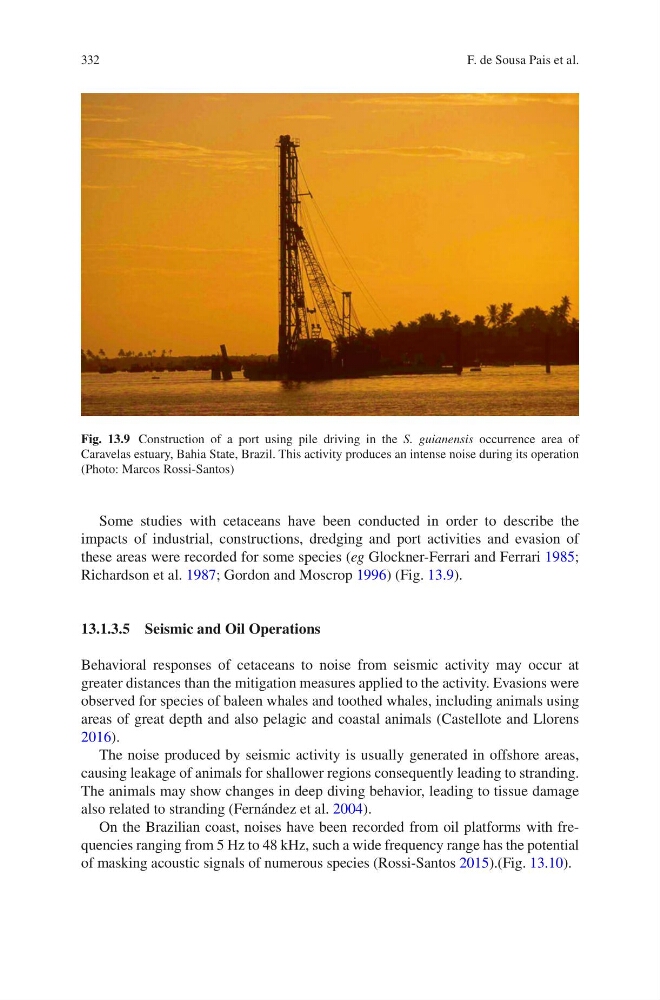
Some studies with cetaceans have been conducted in order to describe the
impacts of industrial, constructions, dredging and port activities and evasion of
these areas were recorded for some species (eg Glockner-Ferrari and Ferrari 1985;
Richardson et al. 1987; Gordon and Moscrop 1996) (Fig. 13.9).
13.1.3.5 Seismic and Oil Operations
Behavioral responses of cetaceans to noise from seismic activity may occur at
greater distances than the mitigation measures applied to the activity. Evasions were
observed for species of baleen whales and toothed whales, including animals using
areas of great depth and also pelagic and coastal animals (Castellote and Llorens
2016).
The noise produced by seismic activity is usually generated in offshore areas,
causing leakage of animals for shallower regions consequently leading to stranding.
The animals may show changes in deep diving behavior, leading to tissue damage
also related to stranding (Fernández et al. 2004).
On the Brazilian coast, noises have been recorded from oil platforms with frequencies ranging from 5 Hz to 48 kHz, such a wide frequency range has the potential
of masking acoustic signals of numerous species (Rossi-Santos 2015).(Fig. 13.10).
Fig. 13.9 Construction of a port using pile driving in the S. guianensis occurrence area of
Caravelas estuary, Bahia State, Brazil. This activity produces an intense noise during its operation
(Photo: Marcos Rossi-Santos)
F. de Sousa Pais et al.
Some studies with cetaceans have been conducted in order to describe the
impacts of industrial, constructions, dredging and port activities and evasion of
these areas were recorded for some species (eg Glockner-Ferrari and Ferrari 1985;
Richardson et al. 1987; Gordon and Moscrop 1996) (Fig. 13.9).
13.1.3.5 Seismic and Oil Operations
Behavioral responses of cetaceans to noise from seismic activity may occur at
greater distances than the mitigation measures applied to the activity. Evasions were
observed for species of baleen whales and toothed whales, including animals using
areas of great depth and also pelagic and coastal animals (Castellote and Llorens
2016).
The noise produced by seismic activity is usually generated in offshore areas,
causing leakage of animals for shallower regions consequently leading to stranding.
The animals may show changes in deep diving behavior, leading to tissue damage
also related to stranding (Fernández et al. 2004).
On the Brazilian coast, noises have been recorded from oil platforms with frequencies ranging from 5 Hz to 48 kHz, such a wide frequency range has the potential
of masking acoustic signals of numerous species (Rossi-Santos 2015).(Fig. 13.10).
Fig. 13.9 Construction of a port using pile driving in the S. guianensis occurrence area of
Caravelas estuary, Bahia State, Brazil. This activity produces an intense noise during its operation
(Photo: Marcos Rossi-Santos)
F. de Sousa Pais et al.