

330
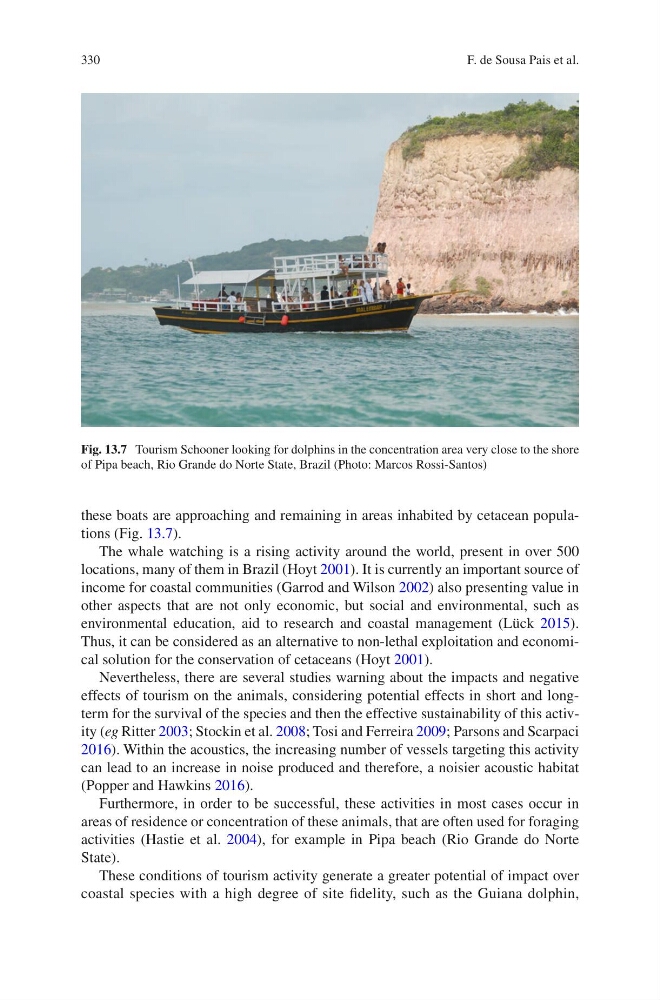
these boats are approaching and remaining in areas inhabited by cetacean populations (Fig. 13.7).
The whale watching is a rising activity around the world, present in over 500
locations, many of them in Brazil (Hoyt 2001). It is currently an important source of
income for coastal communities (Garrod and Wilson 2002) also presenting value in
other aspects that are not only economic, but social and environmental, such as
environmental education, aid to research and coastal management (Lück 2015).
Thus, it can be considered as an alternative to non-lethal exploitation and economical solution for the conservation of cetaceans (Hoyt 2001).
Nevertheless, there are several studies warning about the impacts and negative
effects of tourism on the animals, considering potential effects in short and longterm for the survival of the species and then the effective sustainability of this activity (eg Ritter 2003; Stockin et al. 2008; Tosi and Ferreira 2009; Parsons and Scarpaci
2016). Within the acoustics, the increasing number of vessels targeting this activity
can lead to an increase in noise produced and therefore, a noisier acoustic habitat
(Popper and Hawkins 2016).
Furthermore, in order to be successful, these activities in most cases occur in
areas of residence or concentration of these animals, that are often used for foraging
activities (Hastie et al. 2004), for example in Pipa beach (Rio Grande do Norte
State).
These conditions of tourism activity generate a greater potential of impact over
coastal species with a high degree of site fidelity, such as the Guiana dolphin,
Fig. 13.7 Tourism Schooner looking for dolphins in the concentration area very close to the shore
of Pipa beach, Rio Grande do Norte State, Brazil (Photo: Marcos Rossi-Santos)
F. de Sousa Pais et al.
these boats are approaching and remaining in areas inhabited by cetacean populations (Fig. 13.7).
The whale watching is a rising activity around the world, present in over 500
locations, many of them in Brazil (Hoyt 2001). It is currently an important source of
income for coastal communities (Garrod and Wilson 2002) also presenting value in
other aspects that are not only economic, but social and environmental, such as
environmental education, aid to research and coastal management (Lück 2015).
Thus, it can be considered as an alternative to non-lethal exploitation and economical solution for the conservation of cetaceans (Hoyt 2001).
Nevertheless, there are several studies warning about the impacts and negative
effects of tourism on the animals, considering potential effects in short and longterm for the survival of the species and then the effective sustainability of this activity (eg Ritter 2003; Stockin et al. 2008; Tosi and Ferreira 2009; Parsons and Scarpaci
2016). Within the acoustics, the increasing number of vessels targeting this activity
can lead to an increase in noise produced and therefore, a noisier acoustic habitat
(Popper and Hawkins 2016).
Furthermore, in order to be successful, these activities in most cases occur in
areas of residence or concentration of these animals, that are often used for foraging
activities (Hastie et al. 2004), for example in Pipa beach (Rio Grande do Norte
State).
These conditions of tourism activity generate a greater potential of impact over
coastal species with a high degree of site fidelity, such as the Guiana dolphin,
Fig. 13.7 Tourism Schooner looking for dolphins in the concentration area very close to the shore
of Pipa beach, Rio Grande do Norte State, Brazil (Photo: Marcos Rossi-Santos)
F. de Sousa Pais et al.