

324
Previously, the genus Sotalia was monospecific, Sotalia fluviatilis, represented
by animals that inhabit fluvial areas, in the Amazon region, and those that occur
along the coast of South and Central America. The taxonomy of the species was
revised and through tridimensional morphometric analysis (Monteiro-Filho et al.
2002) and genetic analysis from mitochondrial DNA (Cunha et al. 2005), recently
there was split into two species. Currently the fluvial dolphin is categorized as
Sotalia fluviatilis and the marine dolphin as Sotalia guianensis.
Guiana dolphins present longevity about 30 years (Rosas et al. 2003), are shorter
than 220 cm (Flores and da Silva 2009) and show no apparent sexual dimorphism
(Flores 2002). Its dorsal portion is described with grayish and the ventral can vary
between pink and white (da Silva and Best 1996), and its dorsal fin has a triangular
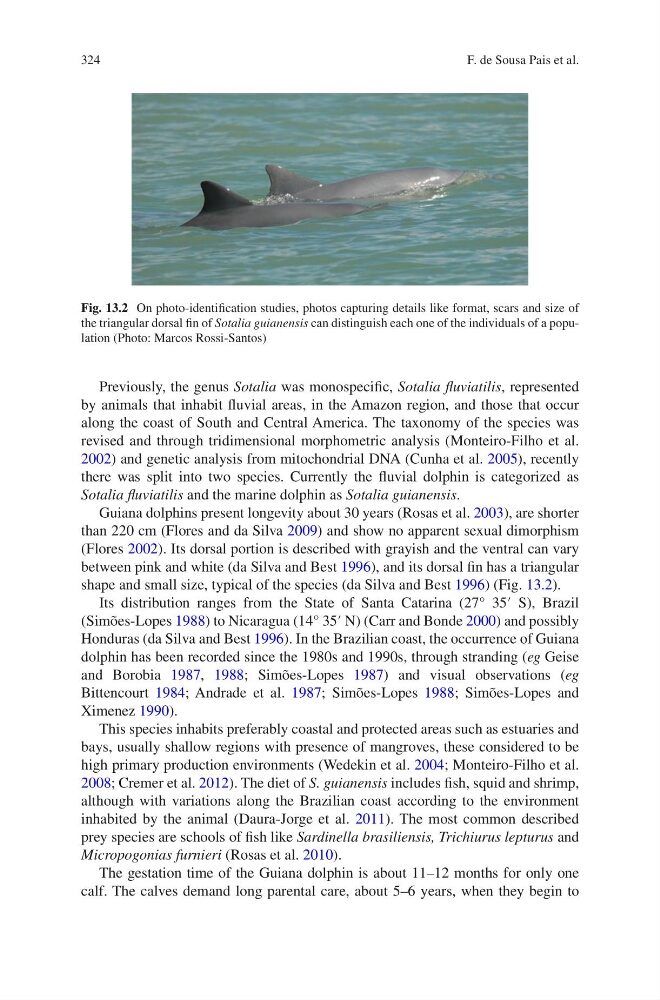
shape and small size, typical of the species (da Silva and Best 1996) (Fig. 13.2).
Its distribution ranges from the State of Santa Catarina (27° 35′ S), Brazil
(Simões-Lopes 1988) to Nicaragua (14° 35′ N) (Carr and Bonde 2000) and possibly
Honduras (da Silva and Best 1996). In the Brazilian coast, the occurrence of Guiana
dolphin has been recorded since the 1980s and 1990s, through stranding (eg Geise
and Borobia 1987, 1988; Simões-Lopes 1987) and visual observations (eg
Bittencourt 1984; Andrade et al. 1987; Simões-Lopes 1988; Simões-Lopes and
Ximenez 1990).
This species inhabits preferably coastal and protected areas such as estuaries and
bays, usually shallow regions with presence of mangroves, these considered to be
high primary production environments (Wedekin et al. 2004; Monteiro-Filho et al.
2008; Cremer et al. 2012). The diet of S. guianensis includes fish, squid and shrimp,
although with variations along the Brazilian coast according to the environment
inhabited by the animal (Daura-Jorge et al. 2011). The most common described
prey species are schools of fish like Sardinella brasiliensis, Trichiurus lepturus and
Micropogonias furnieri (Rosas et al. 2010).
The gestation time of the Guiana dolphin is about 11–12 months for only one
calf. The calves demand long parental care, about 5–6 years, when they begin to
Fig. 13.2 On photo-identification studies, photos capturing details like format, scars and size of
the triangular dorsal fin of Sotalia guianensis can distinguish each one of the individuals of a population (Photo: Marcos Rossi-Santos)
F. de Sousa Pais et al.
Previously, the genus Sotalia was monospecific, Sotalia fluviatilis, represented
by animals that inhabit fluvial areas, in the Amazon region, and those that occur
along the coast of South and Central America. The taxonomy of the species was
revised and through tridimensional morphometric analysis (Monteiro-Filho et al.
2002) and genetic analysis from mitochondrial DNA (Cunha et al. 2005), recently
there was split into two species. Currently the fluvial dolphin is categorized as
Sotalia fluviatilis and the marine dolphin as Sotalia guianensis.
Guiana dolphins present longevity about 30 years (Rosas et al. 2003), are shorter
than 220 cm (Flores and da Silva 2009) and show no apparent sexual dimorphism
(Flores 2002). Its dorsal portion is described with grayish and the ventral can vary
between pink and white (da Silva and Best 1996), and its dorsal fin has a triangular
shape and small size, typical of the species (da Silva and Best 1996) (Fig. 13.2).
Its distribution ranges from the State of Santa Catarina (27° 35′ S), Brazil
(Simões-Lopes 1988) to Nicaragua (14° 35′ N) (Carr and Bonde 2000) and possibly
Honduras (da Silva and Best 1996). In the Brazilian coast, the occurrence of Guiana
dolphin has been recorded since the 1980s and 1990s, through stranding (eg Geise
and Borobia 1987, 1988; Simões-Lopes 1987) and visual observations (eg
Bittencourt 1984; Andrade et al. 1987; Simões-Lopes 1988; Simões-Lopes and
Ximenez 1990).
This species inhabits preferably coastal and protected areas such as estuaries and
bays, usually shallow regions with presence of mangroves, these considered to be
high primary production environments (Wedekin et al. 2004; Monteiro-Filho et al.
2008; Cremer et al. 2012). The diet of S. guianensis includes fish, squid and shrimp,
although with variations along the Brazilian coast according to the environment
inhabited by the animal (Daura-Jorge et al. 2011). The most common described
prey species are schools of fish like Sardinella brasiliensis, Trichiurus lepturus and
Micropogonias furnieri (Rosas et al. 2010).
The gestation time of the Guiana dolphin is about 11–12 months for only one
calf. The calves demand long parental care, about 5–6 years, when they begin to
Fig. 13.2 On photo-identification studies, photos capturing details like format, scars and size of
the triangular dorsal fin of Sotalia guianensis can distinguish each one of the individuals of a population (Photo: Marcos Rossi-Santos)
F. de Sousa Pais et al.