

323
Cetaceans are aquatic mammals with complex social structures that have large
cognitive abilities. Exploitation of marine resources by anthropogenic activities
have the potential to affect aquatic organisms in many ways, interfering with the
maintenance of social relations and the balance of ecosystems, leading to population declines and, in extreme cases, extinction of species (Whitehead et al. 2000).
A methodology that has been growing in a scientific outlook is the study of
sounds in aquatic environments, bringing new ways to research about animals’ life
cycle, social behavior and interactions with the whole ecosystem.
The growing interest and funding of research about the sound in the marine environment are of great importance for achieving sustainable management of ocean
especially in coastal regions (Erbe et al. 2016). Bioacoustics is a field of study dedicated to understand the mechanisms of sound production and perception of animals
and how these animals communicate in their acoustic habitats.
The application of bioacoustics techniques in behavioral ecology and Cetacean
conservation studies are recent in Brazil, having started in the 1990’s, but only after
the year 2000 studies began to be published (eg Monteiro-Filho and Monteiro 2001).
Most studies in Brazil have focused on the Guiana dolphin (Sotalia guianensis), the
principal species aimed in this study.
13.1.1 Guiana Dolphin
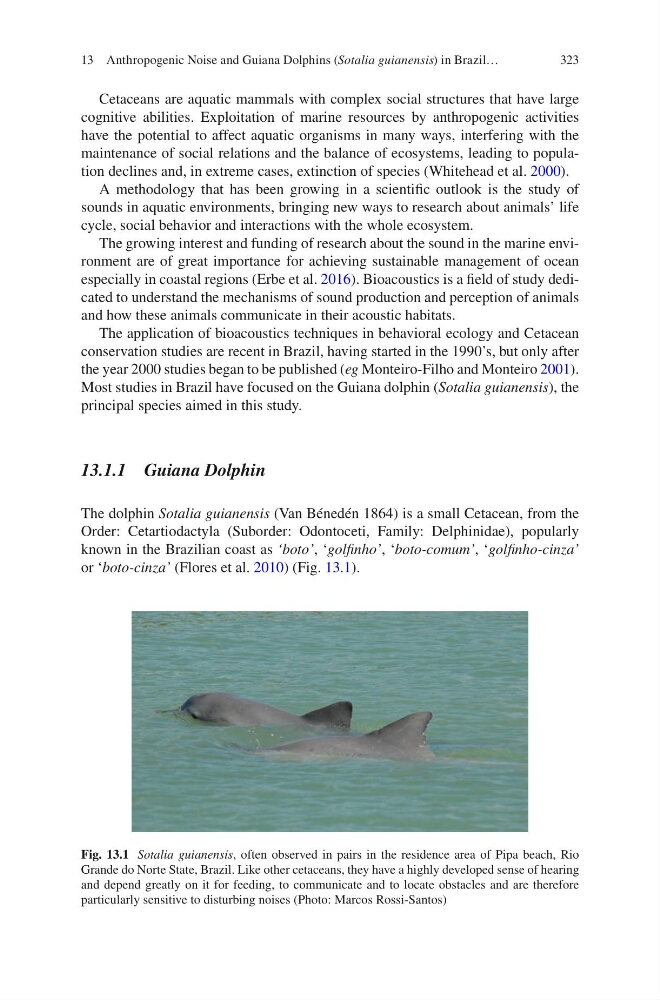
The dolphin Sotalia guianensis (Van Bénedén 1864) is a small Cetacean, from the
Order: Cetartiodactyla (Suborder: Odontoceti, Family: Delphinidae), popularly
known in the Brazilian coast as ‘boto’, ‘golfinho’, ‘boto-comum’, ‘golfinho-cinza’
or ‘boto-cinza’ (Flores et al. 2010) (Fig. 13.1).
Fig. 13.1 Sotalia guianensis, often observed in pairs in the residence area of Pipa beach, Rio
Grande do Norte State, Brazil. Like other cetaceans, they have a highly developed sense of hearing
and depend greatly on it for feeding, to communicate and to locate obstacles and are therefore
particularly sensitive to disturbing noises (Photo: Marcos Rossi-Santos)
13 Anthropogenic Noise and Guiana Dolphins (Sotalia guianensis) in Brazil…
Cetaceans are aquatic mammals with complex social structures that have large
cognitive abilities. Exploitation of marine resources by anthropogenic activities
have the potential to affect aquatic organisms in many ways, interfering with the
maintenance of social relations and the balance of ecosystems, leading to population declines and, in extreme cases, extinction of species (Whitehead et al. 2000).
A methodology that has been growing in a scientific outlook is the study of
sounds in aquatic environments, bringing new ways to research about animals’ life
cycle, social behavior and interactions with the whole ecosystem.
The growing interest and funding of research about the sound in the marine environment are of great importance for achieving sustainable management of ocean
especially in coastal regions (Erbe et al. 2016). Bioacoustics is a field of study dedicated to understand the mechanisms of sound production and perception of animals
and how these animals communicate in their acoustic habitats.
The application of bioacoustics techniques in behavioral ecology and Cetacean
conservation studies are recent in Brazil, having started in the 1990’s, but only after
the year 2000 studies began to be published (eg Monteiro-Filho and Monteiro 2001).
Most studies in Brazil have focused on the Guiana dolphin (Sotalia guianensis), the
principal species aimed in this study.
13.1.1 Guiana Dolphin
The dolphin Sotalia guianensis (Van Bénedén 1864) is a small Cetacean, from the
Order: Cetartiodactyla (Suborder: Odontoceti, Family: Delphinidae), popularly
known in the Brazilian coast as ‘boto’, ‘golfinho’, ‘boto-comum’, ‘golfinho-cinza’
or ‘boto-cinza’ (Flores et al. 2010) (Fig. 13.1).
Fig. 13.1 Sotalia guianensis, often observed in pairs in the residence area of Pipa beach, Rio
Grande do Norte State, Brazil. Like other cetaceans, they have a highly developed sense of hearing
and depend greatly on it for feeding, to communicate and to locate obstacles and are therefore
particularly sensitive to disturbing noises (Photo: Marcos Rossi-Santos)
13 Anthropogenic Noise and Guiana Dolphins (Sotalia guianensis) in Brazil…