

281
Little information has been published on non-infectious diseases, infectious and
parasitic diseases, serological surveys and contaminants that affect the health of
native West Indian manatees in South America. In general, publications on T. manatus mortality in the continent categorize the origin of these events as anthropogenic
(bycatch, hunting, collision with vessels, injury by projectile, solid waste ingestion,
etc.), natural (disease, senility, etc.), perinatal and undetermined events, but final
pathological diagnoses are unsufficiently detailed. In the Orinoco River, Colombia,
Castelblanco et al. (2009) reported that more than 85% of manatee deaths were
related to human activities, especially calves and juveniles. In Northeastern Brazil,
the perinatal causes are predominant (75–80%), followed by those of anthropogenic
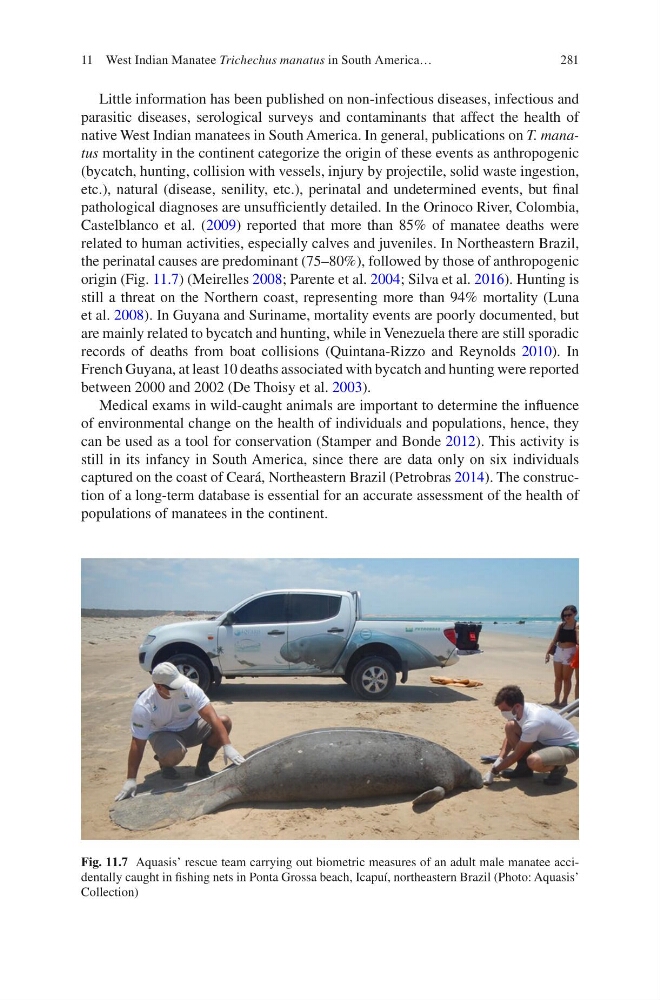
origin (Fig. 11.7) (Meirelles 2008; Parente et al. 2004; Silva et al. 2016). Hunting is
still a threat on the Northern coast, representing more than 94% mortality (Luna
et al. 2008). In Guyana and Suriname, mortality events are poorly documented, but
are mainly related to bycatch and hunting, while in Venezuela there are still sporadic
records of deaths from boat collisions (Quintana-Rizzo and Reynolds 2010). In
French Guyana, at least 10 deaths associated with bycatch and hunting were reported
between 2000 and 2002 (De Thoisy et al. 2003).
Medical exams in wild-caught animals are important to determine the influence
of environmental change on the health of individuals and populations, hence, they
can be used as a tool for conservation (Stamper and Bonde 2012). This activity is
still in its infancy in South America, since there are data only on six individuals
captured on the coast of Ceará, Northeastern Brazil (Petrobras 2014). The construction of a long-term database is essential for an accurate assessment of the health of
populations of manatees in the continent.
Fig. 11.7 Aquasis’ rescue team carrying out biometric measures of an adult male manatee accidentally caught in fishing nets in Ponta Grossa beach, Icapuí, northeastern Brazil (Photo: Aquasis’
Collection)
11 West Indian Manatee Trichechus manatus in South America…
Little information has been published on non-infectious diseases, infectious and
parasitic diseases, serological surveys and contaminants that affect the health of
native West Indian manatees in South America. In general, publications on T. manatus mortality in the continent categorize the origin of these events as anthropogenic
(bycatch, hunting, collision with vessels, injury by projectile, solid waste ingestion,
etc.), natural (disease, senility, etc.), perinatal and undetermined events, but final
pathological diagnoses are unsufficiently detailed. In the Orinoco River, Colombia,
Castelblanco et al. (2009) reported that more than 85% of manatee deaths were
related to human activities, especially calves and juveniles. In Northeastern Brazil,
the perinatal causes are predominant (75–80%), followed by those of anthropogenic
origin (Fig. 11.7) (Meirelles 2008; Parente et al. 2004; Silva et al. 2016). Hunting is
still a threat on the Northern coast, representing more than 94% mortality (Luna
et al. 2008). In Guyana and Suriname, mortality events are poorly documented, but
are mainly related to bycatch and hunting, while in Venezuela there are still sporadic
records of deaths from boat collisions (Quintana-Rizzo and Reynolds 2010). In
French Guyana, at least 10 deaths associated with bycatch and hunting were reported
between 2000 and 2002 (De Thoisy et al. 2003).
Medical exams in wild-caught animals are important to determine the influence
of environmental change on the health of individuals and populations, hence, they
can be used as a tool for conservation (Stamper and Bonde 2012). This activity is
still in its infancy in South America, since there are data only on six individuals
captured on the coast of Ceará, Northeastern Brazil (Petrobras 2014). The construction of a long-term database is essential for an accurate assessment of the health of
populations of manatees in the continent.
Fig. 11.7 Aquasis’ rescue team carrying out biometric measures of an adult male manatee accidentally caught in fishing nets in Ponta Grossa beach, Icapuí, northeastern Brazil (Photo: Aquasis’
Collection)
11 West Indian Manatee Trichechus manatus in South America…