

189
7.5 Future Research and Perspectives for Sea Turtle
Conservation
At the very beginning in the late 1970s, TAMAR faced a big challenge: obtain information on sea turtles occurrence along the 8.000 km of the Brazilian coastline, a
mission with continental dimension. What was apparently a very basic gave us a
starting point to explore a whole new universe. Collection of data, village by village,
and observations in the field during the initial assessment, from 1980 to 1982,
resulted in the first map of the sea turtle spatial and temporal distribution in our
country and the main threats for these species (Marcovaldi and Marcovaldi 1999).
As so many other sea turtle projects from other countries at that time, the key questions to be responded were related to the land part of the sea turtle life cycle.
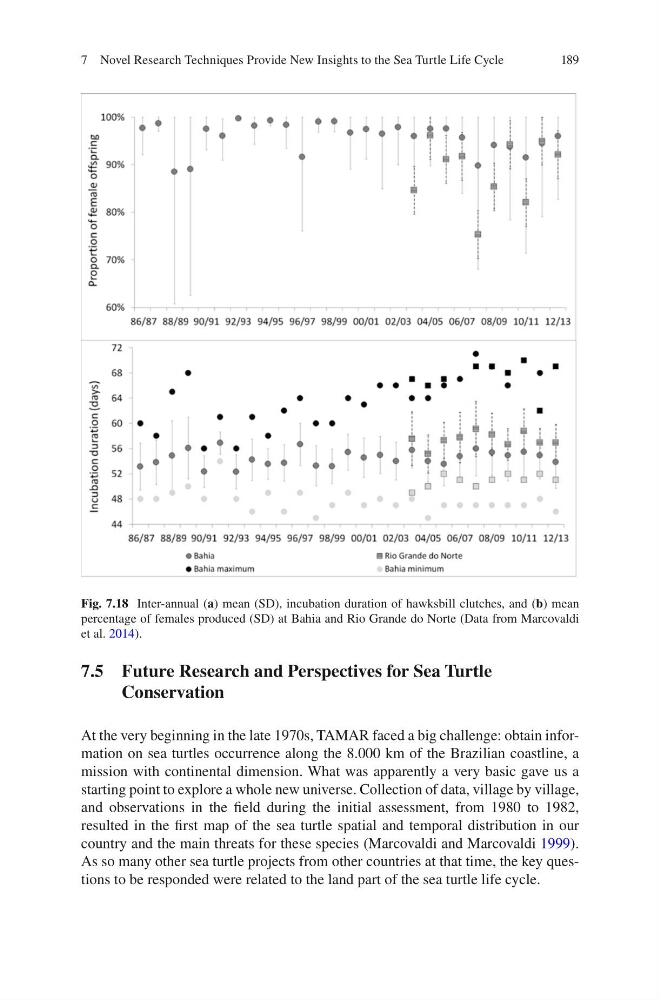
Fig. 7.18 Inter-annual (a) mean (SD), incubation duration of hawksbill clutches, and (b) mean
percentage of females produced (SD) at Bahia and Rio Grande do Norte (Data from Marcovaldi
et al. 2014).
7 Novel Research Techniques Provide New Insights to the Sea Turtle Life Cycle
7.5 Future Research and Perspectives for Sea Turtle
Conservation
At the very beginning in the late 1970s, TAMAR faced a big challenge: obtain information on sea turtles occurrence along the 8.000 km of the Brazilian coastline, a
mission with continental dimension. What was apparently a very basic gave us a
starting point to explore a whole new universe. Collection of data, village by village,
and observations in the field during the initial assessment, from 1980 to 1982,
resulted in the first map of the sea turtle spatial and temporal distribution in our
country and the main threats for these species (Marcovaldi and Marcovaldi 1999).
As so many other sea turtle projects from other countries at that time, the key questions to be responded were related to the land part of the sea turtle life cycle.
Fig. 7.18 Inter-annual (a) mean (SD), incubation duration of hawksbill clutches, and (b) mean
percentage of females produced (SD) at Bahia and Rio Grande do Norte (Data from Marcovaldi
et al. 2014).
7 Novel Research Techniques Provide New Insights to the Sea Turtle Life Cycle