

116
(e. g. Barlow and Taylor 2005; Lewis et al. 2007; Hastie et al. 2003; Leaper et al.
2003; Moretti et al. 2006; Swift et al. 2009).
Different types of equipment have been used over the years for different purposes. Their characteristics depend on the target species (Evans and Hammond
2004) and specific questions and analysis planned. At least two hydrophones in a
linear array are necessary to apply the target motion analysis in order to define a
spatial localization (Barlow and Taylor 2005; Lewis et al. 2007, Swift et al. 2009).
Usually the recording system is composed by a fanless computer, a data acquisition
board for frequencies higher than 192 kHz and an audio interface for frequencies
below 192 kHz (Fig. 5.3). The use of a data acquisition board requires a high quality
bandpass filter, given that the audio interface provides an anti-aliasing filter. The
power supply of the system has to be considered with attention in order to reduce
the electrical noise associated with the moving platform, but in some cases may be
necessary an independent clean battery power (Rankin and Barlow 2010).
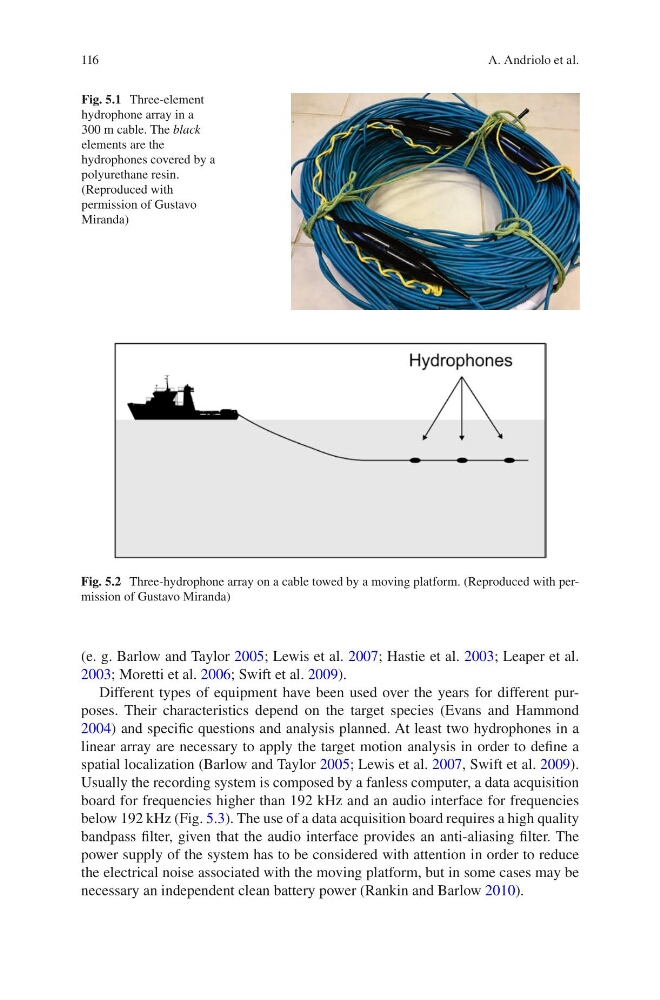
Fig. 5.2 Three-hydrophone array on a cable towed by a moving platform. (Reproduced with permission of Gustavo Miranda)
Fig. 5.1 Three-element
hydrophone array in a
300 m cable. The black
elements are the
hydrophones covered by a
polyurethane resin.
(Reproduced with
permission of Gustavo
Miranda)
A. Andriolo et al.
(e. g. Barlow and Taylor 2005; Lewis et al. 2007; Hastie et al. 2003; Leaper et al.
2003; Moretti et al. 2006; Swift et al. 2009).
Different types of equipment have been used over the years for different purposes. Their characteristics depend on the target species (Evans and Hammond
2004) and specific questions and analysis planned. At least two hydrophones in a
linear array are necessary to apply the target motion analysis in order to define a
spatial localization (Barlow and Taylor 2005; Lewis et al. 2007, Swift et al. 2009).
Usually the recording system is composed by a fanless computer, a data acquisition
board for frequencies higher than 192 kHz and an audio interface for frequencies
below 192 kHz (Fig. 5.3). The use of a data acquisition board requires a high quality
bandpass filter, given that the audio interface provides an anti-aliasing filter. The
power supply of the system has to be considered with attention in order to reduce
the electrical noise associated with the moving platform, but in some cases may be
necessary an independent clean battery power (Rankin and Barlow 2010).
Fig. 5.2 Three-hydrophone array on a cable towed by a moving platform. (Reproduced with permission of Gustavo Miranda)
Fig. 5.1 Three-element
hydrophone array in a
300 m cable. The black
elements are the
hydrophones covered by a
polyurethane resin.
(Reproduced with
permission of Gustavo
Miranda)
A. Andriolo et al.