

damage can result in granule cell degranulation and the
release of mediators of inflammation, whereas an increase
in the number of these cells is reported in chronically
inflamed tissues. There is diversity in their staining
properties, with both basophilic and acidophilic components
in their granules.
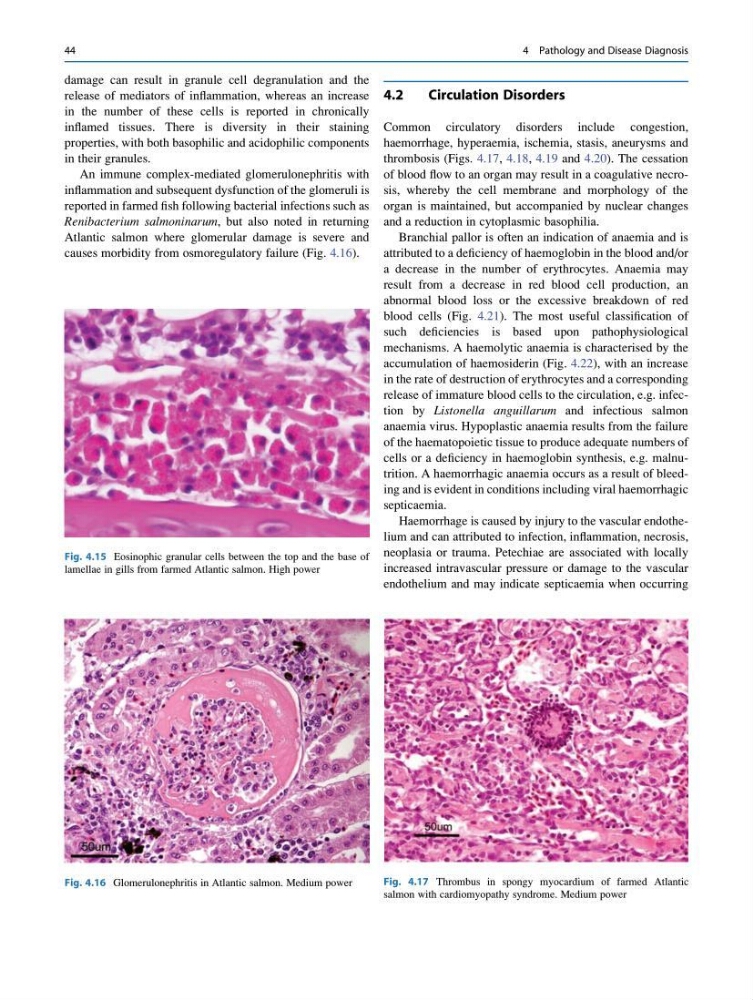
An immune complex-mediated glomerulonephritis with
inflammation and subsequent dysfunction of the glomeruli is
reported in farmed fish following bacterial infections such as
Renibacterium salmoninarum, but also noted in returning
Atlantic salmon where glomerular damage is severe and
causes morbidity from osmoregulatory failure (Fig. 4.16).
4.2
Circulation Disorders
Common circulatory disorders include congestion,
haemorrhage, hyperaemia, ischemia, stasis, aneurysms and
thrombosis (Figs. 4.17, 4.18, 4.19 and 4.20). The cessation
of blood flow to an organ may result in a coagulative necrosis, whereby the cell membrane and morphology of the
organ is maintained, but accompanied by nuclear changes
and a reduction in cytoplasmic basophilia.
Branchial pallor is often an indication of anaemia and is
attributed to a deficiency of haemoglobin in the blood and/or
a decrease in the number of erythrocytes. Anaemia may
result from a decrease in red blood cell production, an
abnormal blood loss or the excessive breakdown of red
blood cells (Fig. 4.21). The most useful classification of
such deficiencies is based upon pathophysiological
mechanisms. A haemolytic anaemia is characterised by the
accumulation of haemosiderin (Fig. 4.22), with an increase
in the rate of destruction of erythrocytes and a corresponding
release of immature blood cells to the circulation, e.g. infection by Listonella anguillarum and infectious salmon
anaemia virus. Hypoplastic anaemia results from the failure
of the haematopoietic tissue to produce adequate numbers of
cells or a deficiency in haemoglobin synthesis, e.g. malnutrition. A haemorrhagic anaemia occurs as a result of bleeding and is evident in conditions including viral haemorrhagic
septicaemia.
Haemorrhage is caused by injury to the vascular endothelium and can attributed to infection, inflammation, necrosis,
neoplasia or trauma. Petechiae are associated with locally
increased intravascular pressure or damage to the vascular
endothelium and may indicate septicaemia when occurring
Fig. 4.15 Eosinophic granular cells between the top and the base of
lamellae in gills from farmed Atlantic salmon. High power
Fig. 4.16 Glomerulonephritis in Atlantic salmon. Medium power
Fig. 4.17 Thrombus in spongy myocardium of farmed Atlantic
salmon with cardiomyopathy syndrome. Medium power
44
4 Pathology and Disease Diagnosis
release of mediators of inflammation, whereas an increase
in the number of these cells is reported in chronically
inflamed tissues. There is diversity in their staining
properties, with both basophilic and acidophilic components
in their granules.
An immune complex-mediated glomerulonephritis with
inflammation and subsequent dysfunction of the glomeruli is
reported in farmed fish following bacterial infections such as
Renibacterium salmoninarum, but also noted in returning
Atlantic salmon where glomerular damage is severe and
causes morbidity from osmoregulatory failure (Fig. 4.16).
4.2
Circulation Disorders
Common circulatory disorders include congestion,
haemorrhage, hyperaemia, ischemia, stasis, aneurysms and
thrombosis (Figs. 4.17, 4.18, 4.19 and 4.20). The cessation
of blood flow to an organ may result in a coagulative necrosis, whereby the cell membrane and morphology of the
organ is maintained, but accompanied by nuclear changes
and a reduction in cytoplasmic basophilia.
Branchial pallor is often an indication of anaemia and is
attributed to a deficiency of haemoglobin in the blood and/or
a decrease in the number of erythrocytes. Anaemia may
result from a decrease in red blood cell production, an
abnormal blood loss or the excessive breakdown of red
blood cells (Fig. 4.21). The most useful classification of
such deficiencies is based upon pathophysiological
mechanisms. A haemolytic anaemia is characterised by the
accumulation of haemosiderin (Fig. 4.22), with an increase
in the rate of destruction of erythrocytes and a corresponding
release of immature blood cells to the circulation, e.g. infection by Listonella anguillarum and infectious salmon
anaemia virus. Hypoplastic anaemia results from the failure
of the haematopoietic tissue to produce adequate numbers of
cells or a deficiency in haemoglobin synthesis, e.g. malnutrition. A haemorrhagic anaemia occurs as a result of bleeding and is evident in conditions including viral haemorrhagic
septicaemia.
Haemorrhage is caused by injury to the vascular endothelium and can attributed to infection, inflammation, necrosis,
neoplasia or trauma. Petechiae are associated with locally
increased intravascular pressure or damage to the vascular
endothelium and may indicate septicaemia when occurring
Fig. 4.15 Eosinophic granular cells between the top and the base of
lamellae in gills from farmed Atlantic salmon. High power
Fig. 4.16 Glomerulonephritis in Atlantic salmon. Medium power
Fig. 4.17 Thrombus in spongy myocardium of farmed Atlantic
salmon with cardiomyopathy syndrome. Medium power
44
4 Pathology and Disease Diagnosis