

2.10.2 Testes
The testes are a pair of sac-shaped organs surrounded by
a capsule of connective tissue suspended from the abdominal roof by a mesenterium called the mesorchium.
In juveniles, they are thin strands while they may be large
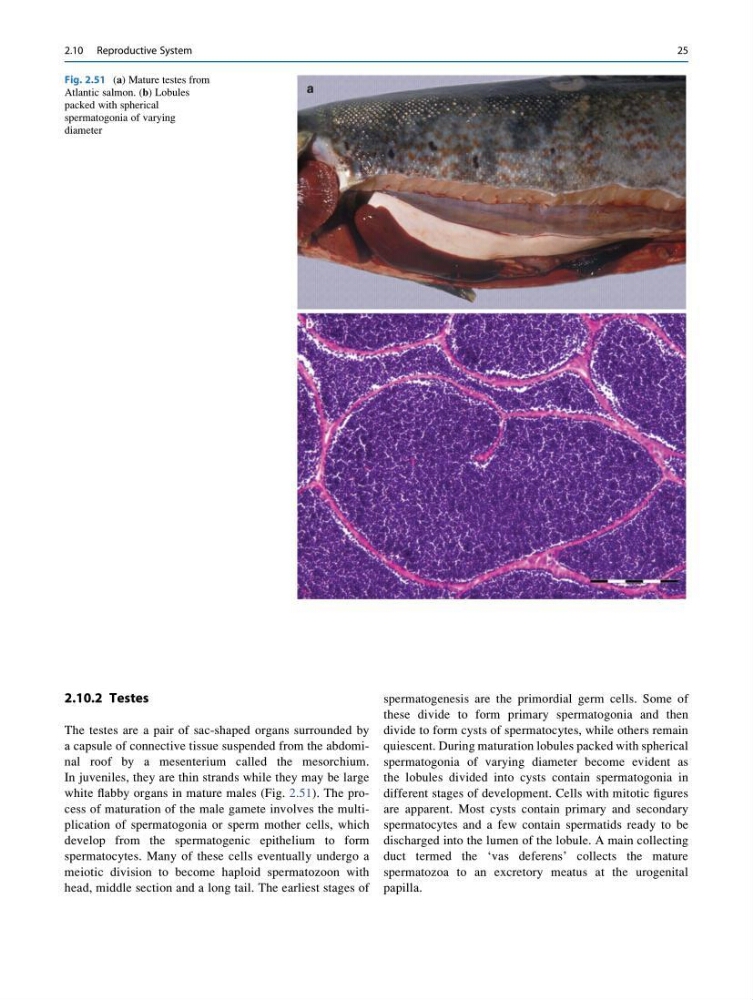
white flabby organs in mature males (Fig. 2.51). The process of maturation of the male gamete involves the multiplication of spermatogonia or sperm mother cells, which
develop from the spermatogenic epithelium to form
spermatocytes. Many of these cells eventually undergo a
meiotic division to become haploid spermatozoon with
head, middle section and a long tail. The earliest stages of
spermatogenesis are the primordial germ cells. Some of
these divide to form primary spermatogonia and then
divide to form cysts of spermatocytes, while others remain
quiescent. During maturation lobules packed with spherical
spermatogonia of varying diameter become evident as
the lobules divided into cysts contain spermatogonia in
different stages of development. Cells with mitotic figures
are apparent. Most cysts contain primary and secondary
spermatocytes and a few contain spermatids ready to be
discharged into the lumen of the lobule. A main collecting
duct termed the ‘vas deferens’ collects the mature
spermatozoa to an excretory meatus at the urogenital
papilla.
Fig. 2.51 (a) Mature testes from
Atlantic salmon. (b) Lobules
packed with spherical
spermatogonia of varying
diameter
2.10 Reproductive System
25
The testes are a pair of sac-shaped organs surrounded by
a capsule of connective tissue suspended from the abdominal roof by a mesenterium called the mesorchium.
In juveniles, they are thin strands while they may be large
white flabby organs in mature males (Fig. 2.51). The process of maturation of the male gamete involves the multiplication of spermatogonia or sperm mother cells, which
develop from the spermatogenic epithelium to form
spermatocytes. Many of these cells eventually undergo a
meiotic division to become haploid spermatozoon with
head, middle section and a long tail. The earliest stages of
spermatogenesis are the primordial germ cells. Some of
these divide to form primary spermatogonia and then
divide to form cysts of spermatocytes, while others remain
quiescent. During maturation lobules packed with spherical
spermatogonia of varying diameter become evident as
the lobules divided into cysts contain spermatogonia in
different stages of development. Cells with mitotic figures
are apparent. Most cysts contain primary and secondary
spermatocytes and a few contain spermatids ready to be
discharged into the lumen of the lobule. A main collecting
duct termed the ‘vas deferens’ collects the mature
spermatozoa to an excretory meatus at the urogenital
papilla.
Fig. 2.51 (a) Mature testes from
Atlantic salmon. (b) Lobules
packed with spherical
spermatogonia of varying
diameter
2.10 Reproductive System
25