

epithelium of the first segment. A variable intermediate
segment may be distinguished, with a lower and more cuboidal epithelium. The brush border becomes intermittent and
as it reaches the distal segment, they are absent. Each
collecting duct system terminates in a mesonephric duct
(Fig. 2.24). Histologically the proximal tubules have a
wider lumen compared to that of the neck region and the
distal tubules. Within the glomerulus, erythrocytes can be
distinguished within the capillary lumen as well as the nuclei
of mesangial cells, capillary endothelial cells and the
podocytes of the visceral epithelium of the Bowman’s capsule. Salmonids from the marine environment have fewer
and smaller glomeruli and the distal part of the tubule is
lacking. Collecting ducts pass urine into two ureters which
fuse to form the urinary bladder (Fig. 2.25).
Functionally, the principle role of the posterior kidney is
maintenance of a stable internal environment with respect to
water and salts, therefore it needs to adapt to the external
water conditions. Accordingly, in the freshwater the fish is
hypertonic and the nephron must conserve salts and eliminate excess water which enters the body through the gills.
Conversely, in the marine environment, the fish is hypotonic,
the urine produced is scant and contains various di- and
trivalent electrolytes as well as nitrogenous end-products.
The nephron must conserve water through a reduction in
urinary volume in order to prevent dehydration. This function is accomplished by a high glomerular filtration rate,
reabsorption of salts in the proximal tubules and further
concentration of the urine in the distal segment. Ammonia,
urea and monovalent electrolytes are mainly excreted
through the gills.
2.6
Digestive System
The digestive system is composed of the alimentary canal
and digestive glands (gastric glands, pyloric caeca, liver,
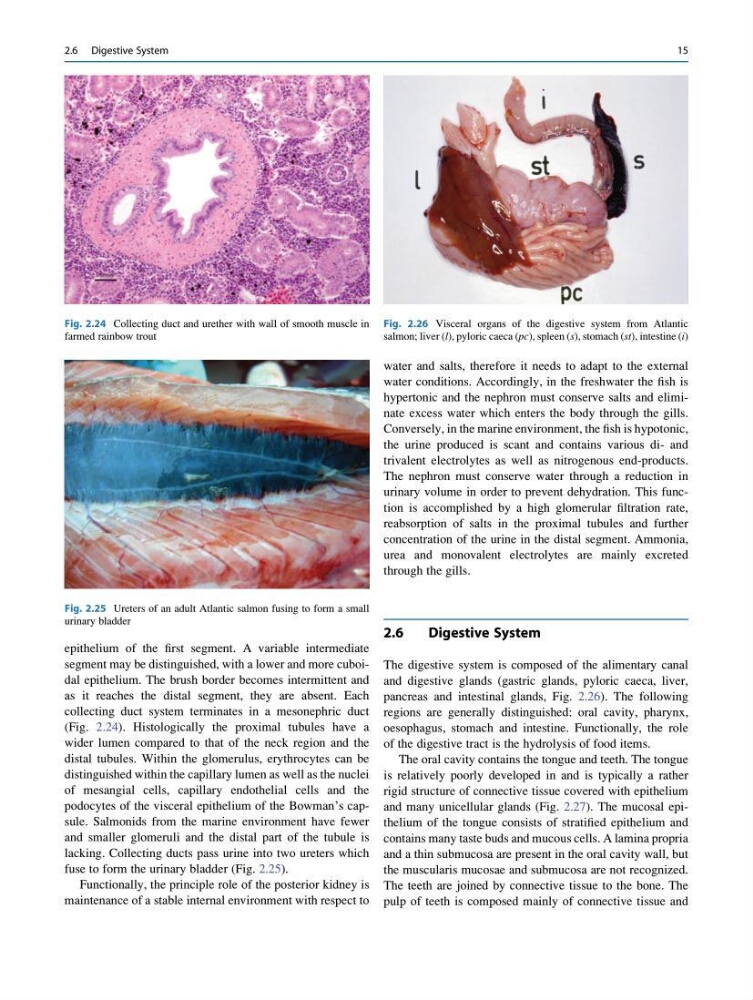
pancreas and intestinal glands, Fig. 2.26). The following
regions are generally distinguished: oral cavity, pharynx,
oesophagus, stomach and intestine. Functionally, the role
of the digestive tract is the hydrolysis of food items.
The oral cavity contains the tongue and teeth. The tongue
is relatively poorly developed in and is typically a rather
rigid structure of connective tissue covered with epithelium
and many unicellular glands (Fig. 2.27). The mucosal epithelium of the tongue consists of stratified epithelium and
contains many taste buds and mucous cells. A lamina propria
and a thin submucosa are present in the oral cavity wall, but
the muscularis mucosae and submucosa are not recognized.
The teeth are joined by connective tissue to the bone. The
pulp of teeth is composed mainly of connective tissue and
Fig. 2.24 Collecting duct and urether with wall of smooth muscle in
farmed rainbow trout
Fig. 2.25 Ureters of an adult Atlantic salmon fusing to form a small
urinary bladder
Fig. 2.26 Visceral organs of the digestive system from Atlantic
salmon; liver (l), pyloric caeca (pc), spleen (s), stomach (st), intestine (i)
2.6 Digestive System
15
segment may be distinguished, with a lower and more cuboidal epithelium. The brush border becomes intermittent and
as it reaches the distal segment, they are absent. Each
collecting duct system terminates in a mesonephric duct
(Fig. 2.24). Histologically the proximal tubules have a
wider lumen compared to that of the neck region and the
distal tubules. Within the glomerulus, erythrocytes can be
distinguished within the capillary lumen as well as the nuclei
of mesangial cells, capillary endothelial cells and the
podocytes of the visceral epithelium of the Bowman’s capsule. Salmonids from the marine environment have fewer
and smaller glomeruli and the distal part of the tubule is
lacking. Collecting ducts pass urine into two ureters which
fuse to form the urinary bladder (Fig. 2.25).
Functionally, the principle role of the posterior kidney is
maintenance of a stable internal environment with respect to
water and salts, therefore it needs to adapt to the external
water conditions. Accordingly, in the freshwater the fish is
hypertonic and the nephron must conserve salts and eliminate excess water which enters the body through the gills.
Conversely, in the marine environment, the fish is hypotonic,
the urine produced is scant and contains various di- and
trivalent electrolytes as well as nitrogenous end-products.
The nephron must conserve water through a reduction in
urinary volume in order to prevent dehydration. This function is accomplished by a high glomerular filtration rate,
reabsorption of salts in the proximal tubules and further
concentration of the urine in the distal segment. Ammonia,
urea and monovalent electrolytes are mainly excreted
through the gills.
2.6
Digestive System
The digestive system is composed of the alimentary canal
and digestive glands (gastric glands, pyloric caeca, liver,
pancreas and intestinal glands, Fig. 2.26). The following
regions are generally distinguished: oral cavity, pharynx,
oesophagus, stomach and intestine. Functionally, the role
of the digestive tract is the hydrolysis of food items.
The oral cavity contains the tongue and teeth. The tongue
is relatively poorly developed in and is typically a rather
rigid structure of connective tissue covered with epithelium
and many unicellular glands (Fig. 2.27). The mucosal epithelium of the tongue consists of stratified epithelium and
contains many taste buds and mucous cells. A lamina propria
and a thin submucosa are present in the oral cavity wall, but
the muscularis mucosae and submucosa are not recognized.
The teeth are joined by connective tissue to the bone. The
pulp of teeth is composed mainly of connective tissue and
Fig. 2.24 Collecting duct and urether with wall of smooth muscle in
farmed rainbow trout
Fig. 2.25 Ureters of an adult Atlantic salmon fusing to form a small
urinary bladder
Fig. 2.26 Visceral organs of the digestive system from Atlantic
salmon; liver (l), pyloric caeca (pc), spleen (s), stomach (st), intestine (i)
2.6 Digestive System
15