

a lack of dietary histidine. Histologically, cataracts typically
manifest as vacuolation, lysis of fibres and proliferation of
capsular cells. Depending on severity, it may cause impaired
vision or total blindness.
Osmotic cataract is the result of fluctuating osmolality
where the fish is unable to adjust to the environmental
salinity and may be reversible. Temperature fluctuations,
gas supersaturation and exposure to UV light are other
examples.
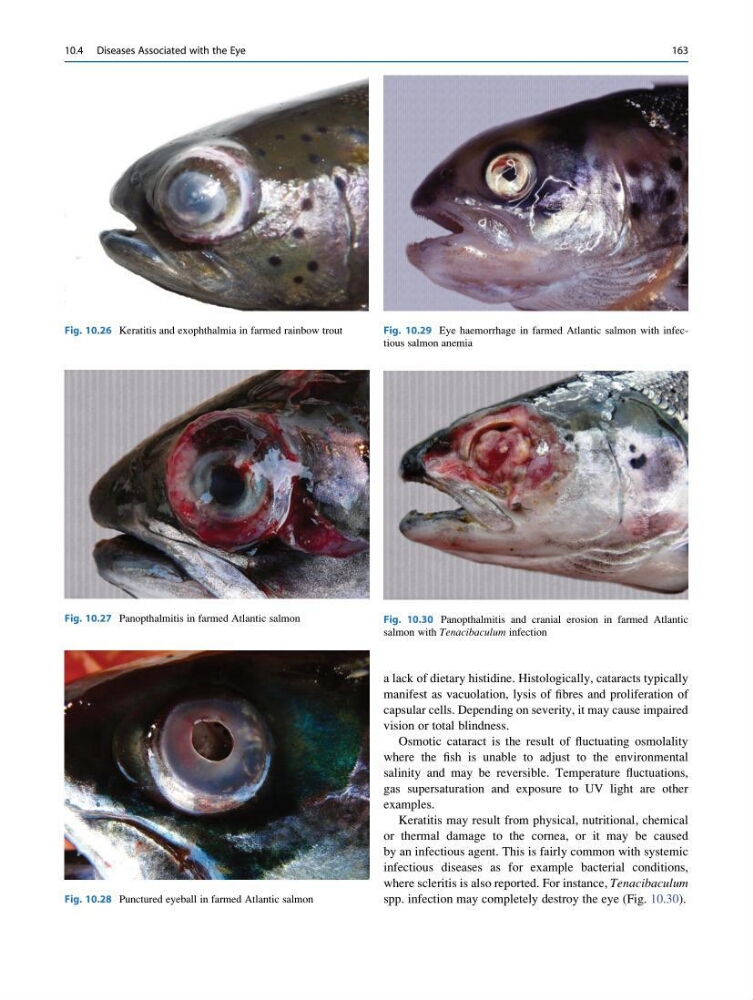
Keratitis may result from physical, nutritional, chemical
or thermal damage to the cornea, or it may be caused
by an infectious agent. This is fairly common with systemic
infectious diseases as for example bacterial conditions,
where scleritis is also reported. For instance, Tenacibaculum
spp. infection may completely destroy the eye (Fig. 10.30).
Fig. 10.26 Keratitis and exophthalmia in farmed rainbow trout
Fig. 10.27 Panopthalmitis in farmed Atlantic salmon
Fig. 10.28 Punctured eyeball in farmed Atlantic salmon
Fig. 10.30 Panopthalmitis and cranial erosion in farmed Atlantic
salmon with Tenacibaculum infection
Fig. 10.29 Eye haemorrhage in farmed Atlantic salmon with infectious salmon anemia
10.4 Diseases Associated with the Eye
163
manifest as vacuolation, lysis of fibres and proliferation of
capsular cells. Depending on severity, it may cause impaired
vision or total blindness.
Osmotic cataract is the result of fluctuating osmolality
where the fish is unable to adjust to the environmental
salinity and may be reversible. Temperature fluctuations,
gas supersaturation and exposure to UV light are other
examples.
Keratitis may result from physical, nutritional, chemical
or thermal damage to the cornea, or it may be caused
by an infectious agent. This is fairly common with systemic
infectious diseases as for example bacterial conditions,
where scleritis is also reported. For instance, Tenacibaculum
spp. infection may completely destroy the eye (Fig. 10.30).
Fig. 10.26 Keratitis and exophthalmia in farmed rainbow trout
Fig. 10.27 Panopthalmitis in farmed Atlantic salmon
Fig. 10.28 Punctured eyeball in farmed Atlantic salmon
Fig. 10.30 Panopthalmitis and cranial erosion in farmed Atlantic
salmon with Tenacibaculum infection
Fig. 10.29 Eye haemorrhage in farmed Atlantic salmon with infectious salmon anemia
10.4 Diseases Associated with the Eye
163