

usually present. In some cases, lesions become extensive and
can involve most of the abdominal cavity with fusion of
most organs to the body wall (Fig. 10.7). Extensive
melanisation is sometimes evident. Granulomatous
responses and location of oil droplets have also been
recorded in organs such as gill, liver and muscle.
Vaccination may also induce autoimmunity with marked
glomerulonephritis (see Fig. 4.16) characterized by deposition of immune complexes in the mesangial cells of the
glomerulus. Inflammatory responses may also be found in
the uveal tract and in the heart (epicarditis and multifocal
myocarditis). Occurrence of characteristic SplendoreHoeppli reactions (asteroid bodies) in lesions is typical in
hypersensitivity reactions.
10.3 Dietary Imbalance
Salmonids are, in principle, carnivores with a relatively short
digestive tract and essentially identical, although slight
modifications exist between species. Growth, food intake,
stomach evacuation rate and feed efficiency ratio of Atlantic
salmon are influenced by temperature and fish size. However,
farmed and wild fish face very different challenges in relation
to their nutrition. The former have a fairly continuous access
to a dry pelleted feed throughout their life cycle and
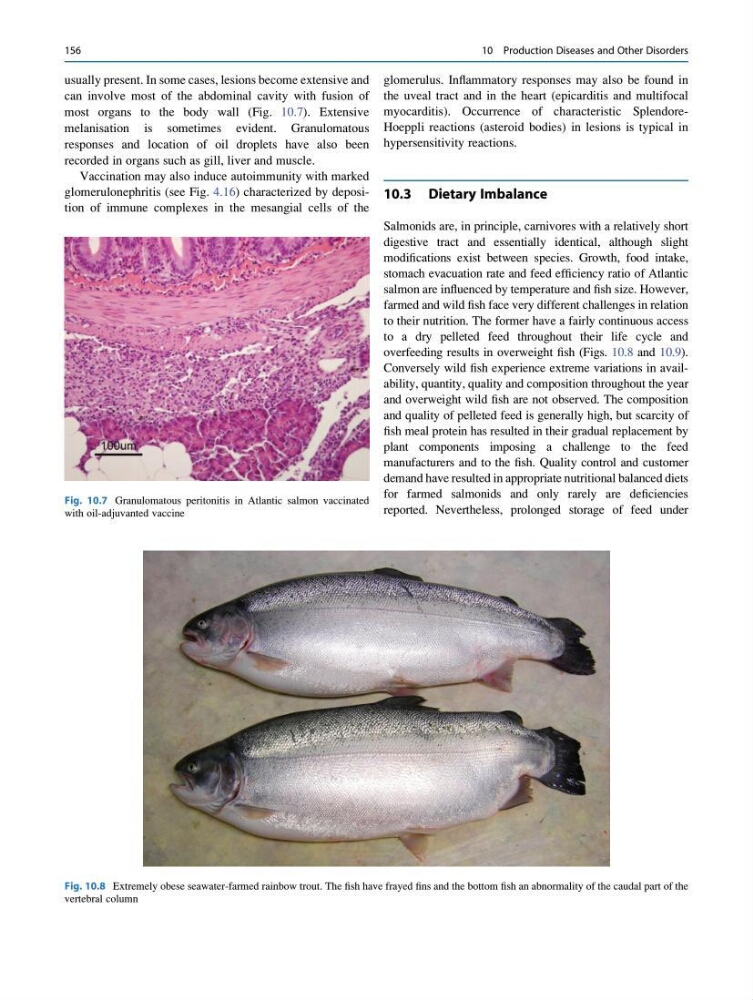
overfeeding results in overweight fish (Figs. 10.8 and 10.9).
Conversely wild fish experience extreme variations in availability, quantity, quality and composition throughout the year
and overweight wild fish are not observed. The composition
and quality of pelleted feed is generally high, but scarcity of
fish meal protein has resulted in their gradual replacement by
plant components imposing a challenge to the feed
manufacturers and to the fish. Quality control and customer
demand have resulted in appropriate nutritional balanced diets
for farmed salmonids and only rarely are deficiencies
reported. Nevertheless, prolonged storage of feed under
Fig. 10.7 Granulomatous peritonitis in Atlantic salmon vaccinated
with oil-adjuvanted vaccine
Fig. 10.8 Extremely obese seawater-farmed rainbow trout. The fish have frayed fins and the bottom fish an abnormality of the caudal part of the
vertebral column
156
10 Production Diseases and Other Disorders
can involve most of the abdominal cavity with fusion of
most organs to the body wall (Fig. 10.7). Extensive
melanisation is sometimes evident. Granulomatous
responses and location of oil droplets have also been
recorded in organs such as gill, liver and muscle.
Vaccination may also induce autoimmunity with marked
glomerulonephritis (see Fig. 4.16) characterized by deposition of immune complexes in the mesangial cells of the
glomerulus. Inflammatory responses may also be found in
the uveal tract and in the heart (epicarditis and multifocal
myocarditis). Occurrence of characteristic SplendoreHoeppli reactions (asteroid bodies) in lesions is typical in
hypersensitivity reactions.
10.3 Dietary Imbalance
Salmonids are, in principle, carnivores with a relatively short
digestive tract and essentially identical, although slight
modifications exist between species. Growth, food intake,
stomach evacuation rate and feed efficiency ratio of Atlantic
salmon are influenced by temperature and fish size. However,
farmed and wild fish face very different challenges in relation
to their nutrition. The former have a fairly continuous access
to a dry pelleted feed throughout their life cycle and
overfeeding results in overweight fish (Figs. 10.8 and 10.9).
Conversely wild fish experience extreme variations in availability, quantity, quality and composition throughout the year
and overweight wild fish are not observed. The composition
and quality of pelleted feed is generally high, but scarcity of
fish meal protein has resulted in their gradual replacement by
plant components imposing a challenge to the feed
manufacturers and to the fish. Quality control and customer
demand have resulted in appropriate nutritional balanced diets
for farmed salmonids and only rarely are deficiencies
reported. Nevertheless, prolonged storage of feed under
Fig. 10.7 Granulomatous peritonitis in Atlantic salmon vaccinated
with oil-adjuvanted vaccine
Fig. 10.8 Extremely obese seawater-farmed rainbow trout. The fish have frayed fins and the bottom fish an abnormality of the caudal part of the
vertebral column
156
10 Production Diseases and Other Disorders