

linked with reduced or absent functional respiration. Fish
swimming upstream help to maintain the distribution of the
mussel. Attached glochidia excyst as juvenile mussels and
their release from their branchial cysts results in open lesions
which are subject to secondary infections. Preliminary diagnosis can be achieved by microscopic examination of fresh
smears and confirmed by tissue sections.
Net cages provide attachment sites for planktonic larvae
and other organisms and this is referred to as ‘fouling’.
Mussels are among the most important fouling molluscs
and their colonisation of salmon nets can lead to a reduction
in water flow. However, despite the close proximity to the
farmed fish, there are only a few reports of larval settlement
to the gill filaments by post-veliger larvae. Gross and
subsequent examination can confirm the presence of larvae
with associated hyperplasia and fusion.
9.9
Annelida
9.9.1 Leeches
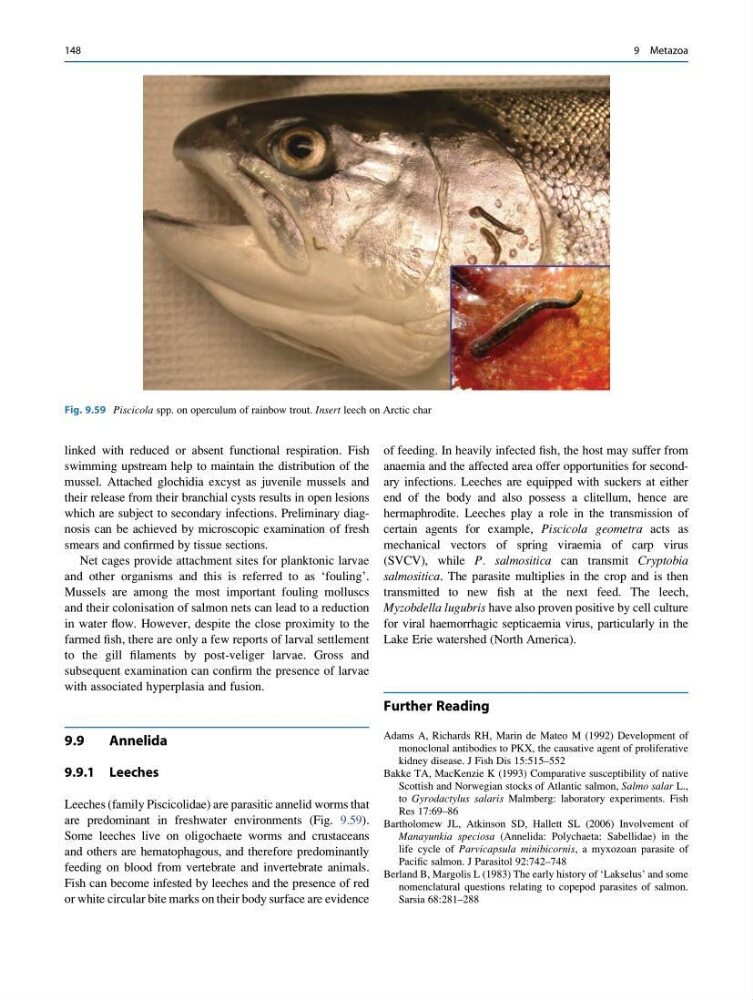
Leeches (family Piscicolidae) are parasitic annelid worms that
are predominant in freshwater environments (Fig. 9.59).
Some leeches live on oligochaete worms and crustaceans
and others are hematophagous, and therefore predominantly
feeding on blood from vertebrate and invertebrate animals.
Fish can become infested by leeches and the presence of red
or white circular bite marks on their body surface are evidence
of feeding. In heavily infected fish, the host may suffer from
anaemia and the affected area offer opportunities for secondary infections. Leeches are equipped with suckers at either
end of the body and also possess a clitellum, hence are
hermaphrodite. Leeches play a role in the transmission of
certain agents for example, Piscicola geometra acts as
mechanical vectors of spring viraemia of carp virus
(SVCV), while P. salmositica can transmit Cryptobia
salmositica. The parasite multiplies in the crop and is then
transmitted to new fish at the next feed. The leech,
Myzobdella lugubris have also proven positive by cell culture
for viral haemorrhagic septicaemia virus, particularly in the
Lake Erie watershed (North America).
Further Reading
Adams A, Richards RH, Marin de Mateo M (1992) Development of
monoclonal antibodies to PKX, the causative agent of proliferative
kidney disease. J Fish Dis 15:515–552
Bakke TA, MacKenzie K (1993) Comparative susceptibility of native
Scottish and Norwegian stocks of Atlantic salmon, Salmo salar L.,
to Gyrodactylus salaris Malmberg: laboratory experiments. Fish
Res 17:69–86
Bartholomew JL, Atkinson SD, Hallett SL (2006) Involvement of
Manayunkia speciosa (Annelida: Polychaeta: Sabellidae) in the
life cycle of Parvicapsula minibicornis, a myxozoan parasite of
Pacific salmon. J Parasitol 92:742–748
Berland B, Margolis L (1983) The early history of ‘Lakselus’ and some
nomenclatural questions relating to copepod parasites of salmon.
Sarsia 68:281–288
Fig. 9.59 Piscicola spp. on operculum of rainbow trout. Insert leech on Arctic char
148
9 Metazoa
swimming upstream help to maintain the distribution of the
mussel. Attached glochidia excyst as juvenile mussels and
their release from their branchial cysts results in open lesions
which are subject to secondary infections. Preliminary diagnosis can be achieved by microscopic examination of fresh
smears and confirmed by tissue sections.
Net cages provide attachment sites for planktonic larvae
and other organisms and this is referred to as ‘fouling’.
Mussels are among the most important fouling molluscs
and their colonisation of salmon nets can lead to a reduction
in water flow. However, despite the close proximity to the
farmed fish, there are only a few reports of larval settlement
to the gill filaments by post-veliger larvae. Gross and
subsequent examination can confirm the presence of larvae
with associated hyperplasia and fusion.
9.9
Annelida
9.9.1 Leeches
Leeches (family Piscicolidae) are parasitic annelid worms that
are predominant in freshwater environments (Fig. 9.59).
Some leeches live on oligochaete worms and crustaceans
and others are hematophagous, and therefore predominantly
feeding on blood from vertebrate and invertebrate animals.
Fish can become infested by leeches and the presence of red
or white circular bite marks on their body surface are evidence
of feeding. In heavily infected fish, the host may suffer from
anaemia and the affected area offer opportunities for secondary infections. Leeches are equipped with suckers at either
end of the body and also possess a clitellum, hence are
hermaphrodite. Leeches play a role in the transmission of
certain agents for example, Piscicola geometra acts as
mechanical vectors of spring viraemia of carp virus
(SVCV), while P. salmositica can transmit Cryptobia
salmositica. The parasite multiplies in the crop and is then
transmitted to new fish at the next feed. The leech,
Myzobdella lugubris have also proven positive by cell culture
for viral haemorrhagic septicaemia virus, particularly in the
Lake Erie watershed (North America).
Further Reading
Adams A, Richards RH, Marin de Mateo M (1992) Development of
monoclonal antibodies to PKX, the causative agent of proliferative
kidney disease. J Fish Dis 15:515–552
Bakke TA, MacKenzie K (1993) Comparative susceptibility of native
Scottish and Norwegian stocks of Atlantic salmon, Salmo salar L.,
to Gyrodactylus salaris Malmberg: laboratory experiments. Fish
Res 17:69–86
Bartholomew JL, Atkinson SD, Hallett SL (2006) Involvement of
Manayunkia speciosa (Annelida: Polychaeta: Sabellidae) in the
life cycle of Parvicapsula minibicornis, a myxozoan parasite of
Pacific salmon. J Parasitol 92:742–748
Berland B, Margolis L (1983) The early history of ‘Lakselus’ and some
nomenclatural questions relating to copepod parasites of salmon.
Sarsia 68:281–288
Fig. 9.59 Piscicola spp. on operculum of rainbow trout. Insert leech on Arctic char
148
9 Metazoa