

9.7.4 Argulus coregoni, A. foliaceus
and A. japonicus
Members of the Argulidae represent the freshwater
counterparts of sea lice and infest the skin and fins of
numerous fish worldwide, including Atlantic salmon, trout,
whitefish and grayling. These parasites have a preoral stylet
that causes local mechanical injury and particularly the
release of digestive enzymes. They are common on wild
fish and can cause severe losses in pond culture and inland
sport fisheries.
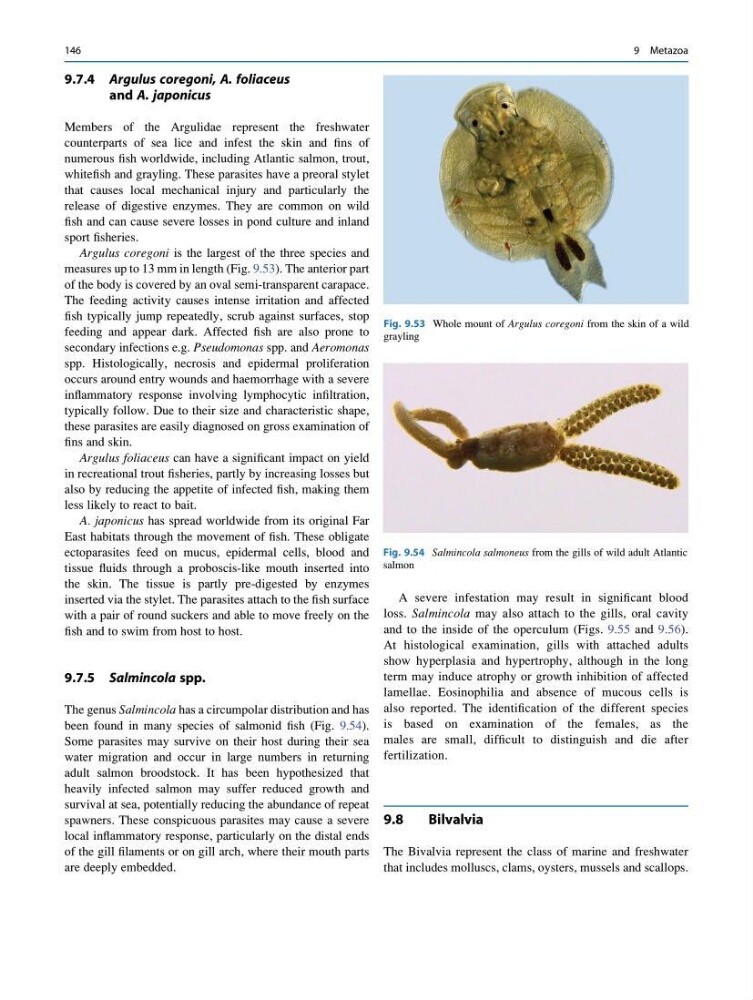
Argulus coregoni is the largest of the three species and
measures up to 13 mm in length (Fig. 9.53). The anterior part
of the body is covered by an oval semi-transparent carapace.
The feeding activity causes intense irritation and affected
fish typically jump repeatedly, scrub against surfaces, stop
feeding and appear dark. Affected fish are also prone to
secondary infections e.g. Pseudomonas spp. and Aeromonas
spp. Histologically, necrosis and epidermal proliferation
occurs around entry wounds and haemorrhage with a severe
inflammatory response involving lymphocytic infiltration,
typically follow. Due to their size and characteristic shape,
these parasites are easily diagnosed on gross examination of
fins and skin.
Argulus foliaceus can have a significant impact on yield
in recreational trout fisheries, partly by increasing losses but
also by reducing the appetite of infected fish, making them
less likely to react to bait.
A. japonicus has spread worldwide from its original Far
East habitats through the movement of fish. These obligate
ectoparasites feed on mucus, epidermal cells, blood and
tissue fluids through a proboscis-like mouth inserted into
the skin. The tissue is partly pre-digested by enzymes
inserted via the stylet. The parasites attach to the fish surface
with a pair of round suckers and able to move freely on the
fish and to swim from host to host.
9.7.5 Salmincola spp.
The genus Salmincola has a circumpolar distribution and has
been found in many species of salmonid fish (Fig. 9.54).
Some parasites may survive on their host during their sea
water migration and occur in large numbers in returning
adult salmon broodstock. It has been hypothesized that
heavily infected salmon may suffer reduced growth and
survival at sea, potentially reducing the abundance of repeat
spawners. These conspicuous parasites may cause a severe
local inflammatory response, particularly on the distal ends
of the gill filaments or on gill arch, where their mouth parts
are deeply embedded.
A severe infestation may result in significant blood
loss. Salmincola may also attach to the gills, oral cavity
and to the inside of the operculum (Figs. 9.55 and 9.56).
At histological examination, gills with attached adults
show hyperplasia and hypertrophy, although in the long
term may induce atrophy or growth inhibition of affected
lamellae. Eosinophilia and absence of mucous cells is
also reported. The identification of the different species
is based on examination of the females, as the
males are small, difficult to distinguish and die after
fertilization.
9.8
Bilvalvia
The Bivalvia represent the class of marine and freshwater
that includes molluscs, clams, oysters, mussels and scallops.
Fig. 9.53 Whole mount of Argulus coregoni from the skin of a wild
grayling
Fig. 9.54 Salmincola salmoneus from the gills of wild adult Atlantic
salmon
146
9 Metazoa
and A. japonicus
Members of the Argulidae represent the freshwater
counterparts of sea lice and infest the skin and fins of
numerous fish worldwide, including Atlantic salmon, trout,
whitefish and grayling. These parasites have a preoral stylet
that causes local mechanical injury and particularly the
release of digestive enzymes. They are common on wild
fish and can cause severe losses in pond culture and inland
sport fisheries.
Argulus coregoni is the largest of the three species and
measures up to 13 mm in length (Fig. 9.53). The anterior part
of the body is covered by an oval semi-transparent carapace.
The feeding activity causes intense irritation and affected
fish typically jump repeatedly, scrub against surfaces, stop
feeding and appear dark. Affected fish are also prone to
secondary infections e.g. Pseudomonas spp. and Aeromonas
spp. Histologically, necrosis and epidermal proliferation
occurs around entry wounds and haemorrhage with a severe
inflammatory response involving lymphocytic infiltration,
typically follow. Due to their size and characteristic shape,
these parasites are easily diagnosed on gross examination of
fins and skin.
Argulus foliaceus can have a significant impact on yield
in recreational trout fisheries, partly by increasing losses but
also by reducing the appetite of infected fish, making them
less likely to react to bait.
A. japonicus has spread worldwide from its original Far
East habitats through the movement of fish. These obligate
ectoparasites feed on mucus, epidermal cells, blood and
tissue fluids through a proboscis-like mouth inserted into
the skin. The tissue is partly pre-digested by enzymes
inserted via the stylet. The parasites attach to the fish surface
with a pair of round suckers and able to move freely on the
fish and to swim from host to host.
9.7.5 Salmincola spp.
The genus Salmincola has a circumpolar distribution and has
been found in many species of salmonid fish (Fig. 9.54).
Some parasites may survive on their host during their sea
water migration and occur in large numbers in returning
adult salmon broodstock. It has been hypothesized that
heavily infected salmon may suffer reduced growth and
survival at sea, potentially reducing the abundance of repeat
spawners. These conspicuous parasites may cause a severe
local inflammatory response, particularly on the distal ends
of the gill filaments or on gill arch, where their mouth parts
are deeply embedded.
A severe infestation may result in significant blood
loss. Salmincola may also attach to the gills, oral cavity
and to the inside of the operculum (Figs. 9.55 and 9.56).
At histological examination, gills with attached adults
show hyperplasia and hypertrophy, although in the long
term may induce atrophy or growth inhibition of affected
lamellae. Eosinophilia and absence of mucous cells is
also reported. The identification of the different species
is based on examination of the females, as the
males are small, difficult to distinguish and die after
fertilization.
9.8
Bilvalvia
The Bivalvia represent the class of marine and freshwater
that includes molluscs, clams, oysters, mussels and scallops.
Fig. 9.53 Whole mount of Argulus coregoni from the skin of a wild
grayling
Fig. 9.54 Salmincola salmoneus from the gills of wild adult Atlantic
salmon
146
9 Metazoa