

disruption with scale loss, followed by epidermal hyperplasia, mucus cell hypertrophy, macrophage infiltration with
some fibrosis, sometimes extending into the cranium. The
resultant ulcers will break the osmotic barrier and are consequently sites for secondary infection.
9.7.2 Caligus elongatus
Caligus elongatus is a non-host specific parasitic copepod
that may infest salmonids in aquaculture in Europe and
eastern Canada. It is distinctly smaller and lighter than
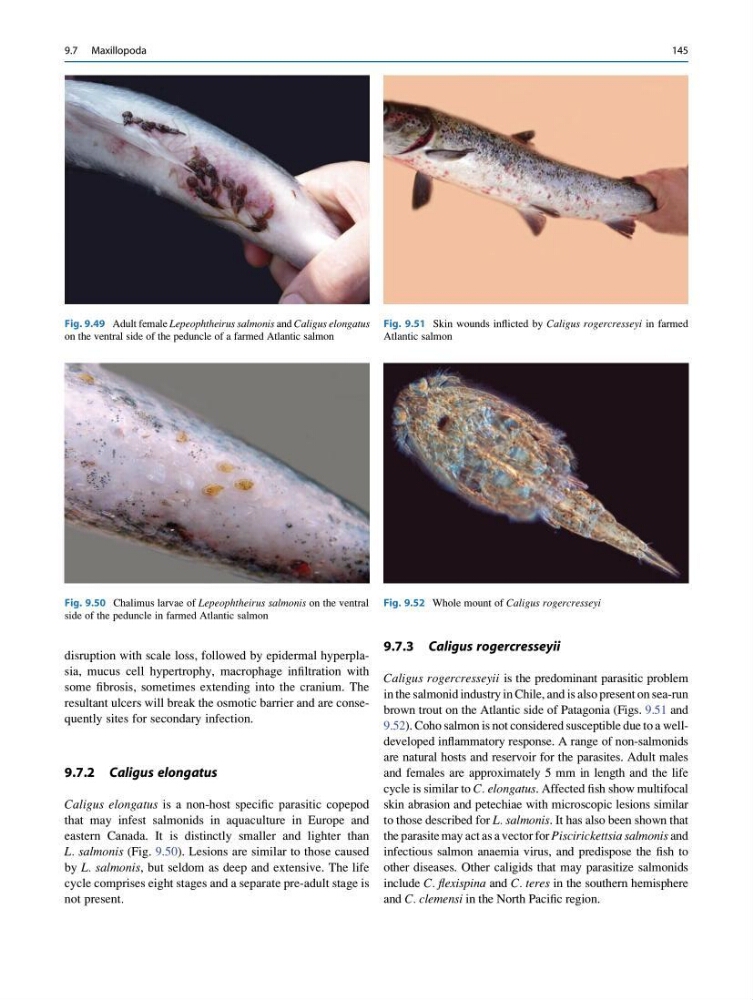
L. salmonis (Fig. 9.50). Lesions are similar to those caused
by L. salmonis, but seldom as deep and extensive. The life
cycle comprises eight stages and a separate pre-adult stage is
not present.
9.7.3 Caligus rogercresseyii
Caligus rogercresseyii is the predominant parasitic problem
in the salmonid industry in Chile, and is also present on sea-run
brown trout on the Atlantic side of Patagonia (Figs. 9.51 and
9.52). Coho salmon is not considered susceptible due to a welldeveloped inflammatory response. A range of non-salmonids
are natural hosts and reservoir for the parasites. Adult males
and females are approximately 5 mm in length and the life
cycle is similar to C. elongatus. Affected fish show multifocal
skin abrasion and petechiae with microscopic lesions similar
to those described for L. salmonis. It has also been shown that
the parasite may act as a vector for Piscirickettsia salmonis and
infectious salmon anaemia virus, and predispose the fish to
other diseases. Other caligids that may parasitize salmonids
include C. flexispina and C. teres in the southern hemisphere
and C. clemensi in the North Pacific region.
Fig. 9.50 Chalimus larvae of Lepeophtheirus salmonis on the ventral
side of the peduncle in farmed Atlantic salmon
Fig. 9.51 Skin wounds inflicted by Caligus rogercresseyi in farmed
Atlantic salmon
Fig. 9.52 Whole mount of Caligus rogercresseyi
Fig. 9.49 Adult female Lepeophtheirus salmonis and Caligus elongatus
on the ventral side of the peduncle of a farmed Atlantic salmon
9.7 Maxillopoda
145
some fibrosis, sometimes extending into the cranium. The
resultant ulcers will break the osmotic barrier and are consequently sites for secondary infection.
9.7.2 Caligus elongatus
Caligus elongatus is a non-host specific parasitic copepod
that may infest salmonids in aquaculture in Europe and
eastern Canada. It is distinctly smaller and lighter than
L. salmonis (Fig. 9.50). Lesions are similar to those caused
by L. salmonis, but seldom as deep and extensive. The life
cycle comprises eight stages and a separate pre-adult stage is
not present.
9.7.3 Caligus rogercresseyii
Caligus rogercresseyii is the predominant parasitic problem
in the salmonid industry in Chile, and is also present on sea-run
brown trout on the Atlantic side of Patagonia (Figs. 9.51 and
9.52). Coho salmon is not considered susceptible due to a welldeveloped inflammatory response. A range of non-salmonids
are natural hosts and reservoir for the parasites. Adult males
and females are approximately 5 mm in length and the life
cycle is similar to C. elongatus. Affected fish show multifocal
skin abrasion and petechiae with microscopic lesions similar
to those described for L. salmonis. It has also been shown that
the parasite may act as a vector for Piscirickettsia salmonis and
infectious salmon anaemia virus, and predispose the fish to
other diseases. Other caligids that may parasitize salmonids
include C. flexispina and C. teres in the southern hemisphere
and C. clemensi in the North Pacific region.
Fig. 9.50 Chalimus larvae of Lepeophtheirus salmonis on the ventral
side of the peduncle in farmed Atlantic salmon
Fig. 9.51 Skin wounds inflicted by Caligus rogercresseyi in farmed
Atlantic salmon
Fig. 9.52 Whole mount of Caligus rogercresseyi
Fig. 9.49 Adult female Lepeophtheirus salmonis and Caligus elongatus
on the ventral side of the peduncle of a farmed Atlantic salmon
9.7 Maxillopoda
145