

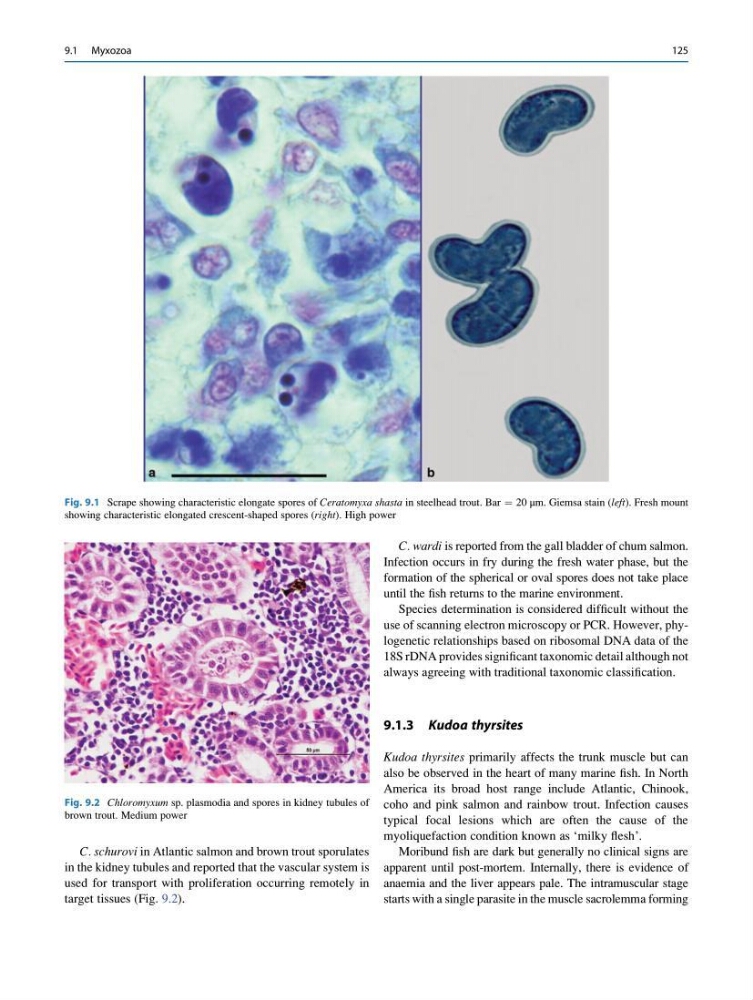
C. schurovi in Atlantic salmon and brown trout sporulates
in the kidney tubules and reported that the vascular system is
used for transport with proliferation occurring remotely in
target tissues (Fig. 9.2).
C. wardi is reported from the gall bladder of chum salmon.
Infection occurs in fry during the fresh water phase, but the
formation of the spherical or oval spores does not take place
until the fish returns to the marine environment.
Species determination is considered difficult without the
use of scanning electron microscopy or PCR. However, phylogenetic relationships based on ribosomal DNA data of the
18S rDNA provides significant taxonomic detail although not
always agreeing with traditional taxonomic classification.
9.1.3 Kudoa thyrsites
Kudoa thyrsites primarily affects the trunk muscle but can
also be observed in the heart of many marine fish. In North
America its broad host range include Atlantic, Chinook,
coho and pink salmon and rainbow trout. Infection causes
typical focal lesions which are often the cause of the
myoliquefaction condition known as ‘milky flesh’.
Moribund fish are dark but generally no clinical signs are
apparent until post-mortem. Internally, there is evidence of
anaemia and the liver appears pale. The intramuscular stage
starts with a single parasite in the muscle sacrolemma forming
Fig. 9.1 Scrape showing characteristic elongate spores of Ceratomyxa shasta in steelhead trout. Bar ¼ 20 μm. Giemsa stain (left). Fresh mount
showing characteristic elongated crescent-shaped spores (right). High power
Fig. 9.2 Chloromyxum sp. plasmodia and spores in kidney tubules of
brown trout. Medium power
9.1 Myxozoa
125
in the kidney tubules and reported that the vascular system is
used for transport with proliferation occurring remotely in
target tissues (Fig. 9.2).
C. wardi is reported from the gall bladder of chum salmon.
Infection occurs in fry during the fresh water phase, but the
formation of the spherical or oval spores does not take place
until the fish returns to the marine environment.
Species determination is considered difficult without the
use of scanning electron microscopy or PCR. However, phylogenetic relationships based on ribosomal DNA data of the
18S rDNA provides significant taxonomic detail although not
always agreeing with traditional taxonomic classification.
9.1.3 Kudoa thyrsites
Kudoa thyrsites primarily affects the trunk muscle but can
also be observed in the heart of many marine fish. In North
America its broad host range include Atlantic, Chinook,
coho and pink salmon and rainbow trout. Infection causes
typical focal lesions which are often the cause of the
myoliquefaction condition known as ‘milky flesh’.
Moribund fish are dark but generally no clinical signs are
apparent until post-mortem. Internally, there is evidence of
anaemia and the liver appears pale. The intramuscular stage
starts with a single parasite in the muscle sacrolemma forming
Fig. 9.1 Scrape showing characteristic elongate spores of Ceratomyxa shasta in steelhead trout. Bar ¼ 20 μm. Giemsa stain (left). Fresh mount
showing characteristic elongated crescent-shaped spores (right). High power
Fig. 9.2 Chloromyxum sp. plasmodia and spores in kidney tubules of
brown trout. Medium power
9.1 Myxozoa
125