

multiplication is temperature mediated, giving raise to
thousands of new individuals, the ‘tomites’. These break
the cyst and become free swimming pear-shaped infecting
forms, ‘theronts’, that have to reach a new host within a
limited time period of ~2–4 days. Theronts penetrate the
host skin becoming ‘throphozoites’, which will grow again
into throphonts. This can be seen constantly turning and
moving under the skin, feeding on the dead cells and fluids
produced by their own action.
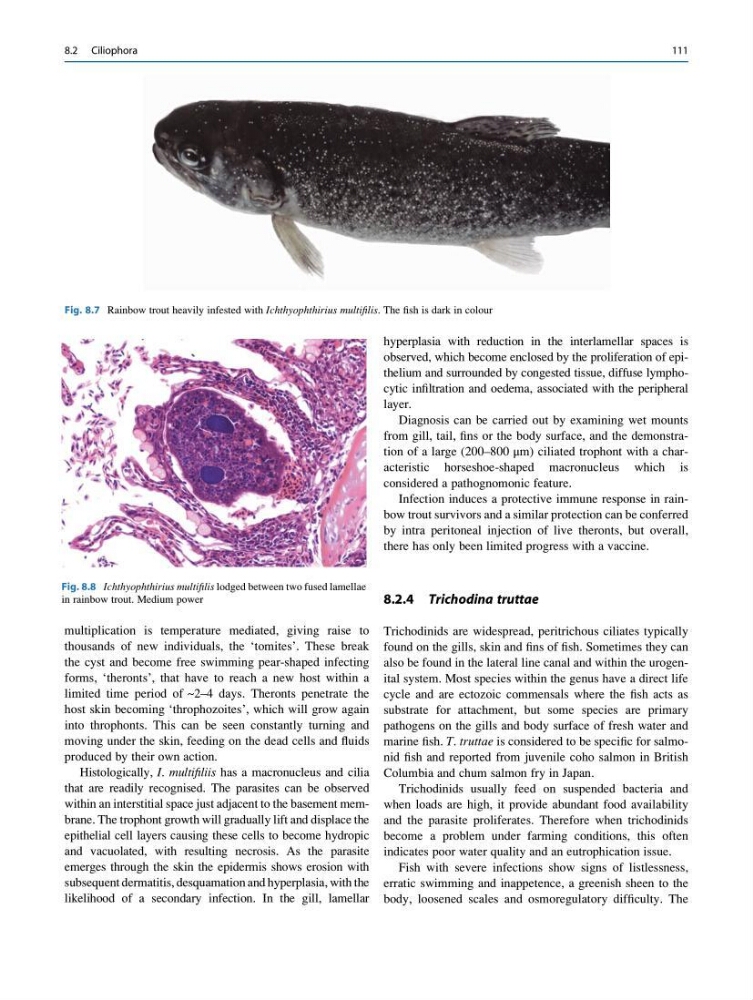
Histologically, I. multifiliis has a macronucleus and cilia
that are readily recognised. The parasites can be observed
within an interstitial space just adjacent to the basement membrane. The trophont growth will gradually lift and displace the
epithelial cell layers causing these cells to become hydropic
and vacuolated, with resulting necrosis. As the parasite
emerges through the skin the epidermis shows erosion with
subsequent dermatitis, desquamation and hyperplasia, with the
likelihood of a secondary infection. In the gill, lamellar
hyperplasia with reduction in the interlamellar spaces is
observed, which become enclosed by the proliferation of epithelium and surrounded by congested tissue, diffuse lymphocytic infiltration and oedema, associated with the peripheral
layer.
Diagnosis can be carried out by examining wet mounts
from gill, tail, fins or the body surface, and the demonstration of a large (200–800 μm) ciliated trophont with a characteristic horseshoe-shaped macronucleus which is
considered a pathognomonic feature.
Infection induces a protective immune response in rainbow trout survivors and a similar protection can be conferred
by intra peritoneal injection of live theronts, but overall,
there has only been limited progress with a vaccine.
8.2.4 Trichodina truttae
Trichodinids are widespread, peritrichous ciliates typically
found on the gills, skin and fins of fish. Sometimes they can
also be found in the lateral line canal and within the urogenital system. Most species within the genus have a direct life
cycle and are ectozoic commensals where the fish acts as
substrate for attachment, but some species are primary
pathogens on the gills and body surface of fresh water and
marine fish. T. truttae is considered to be specific for salmonid fish and reported from juvenile coho salmon in British
Columbia and chum salmon fry in Japan.
Trichodinids usually feed on suspended bacteria and
when loads are high, it provide abundant food availability
and the parasite proliferates. Therefore when trichodinids
become a problem under farming conditions, this often
indicates poor water quality and an eutrophication issue.
Fish with severe infections show signs of listlessness,
erratic swimming and inappetence, a greenish sheen to the
body, loosened scales and osmoregulatory difficulty. The
Fig. 8.8 Ichthyophthirius multifilis lodged between two fused lamellae
in rainbow trout. Medium power
Fig. 8.7 Rainbow trout heavily infested with Ichthyophthirius multifilis. The fish is dark in colour
8.2 Ciliophora
111
thousands of new individuals, the ‘tomites’. These break
the cyst and become free swimming pear-shaped infecting
forms, ‘theronts’, that have to reach a new host within a
limited time period of ~2–4 days. Theronts penetrate the
host skin becoming ‘throphozoites’, which will grow again
into throphonts. This can be seen constantly turning and
moving under the skin, feeding on the dead cells and fluids
produced by their own action.
Histologically, I. multifiliis has a macronucleus and cilia
that are readily recognised. The parasites can be observed
within an interstitial space just adjacent to the basement membrane. The trophont growth will gradually lift and displace the
epithelial cell layers causing these cells to become hydropic
and vacuolated, with resulting necrosis. As the parasite
emerges through the skin the epidermis shows erosion with
subsequent dermatitis, desquamation and hyperplasia, with the
likelihood of a secondary infection. In the gill, lamellar
hyperplasia with reduction in the interlamellar spaces is
observed, which become enclosed by the proliferation of epithelium and surrounded by congested tissue, diffuse lymphocytic infiltration and oedema, associated with the peripheral
layer.
Diagnosis can be carried out by examining wet mounts
from gill, tail, fins or the body surface, and the demonstration of a large (200–800 μm) ciliated trophont with a characteristic horseshoe-shaped macronucleus which is
considered a pathognomonic feature.
Infection induces a protective immune response in rainbow trout survivors and a similar protection can be conferred
by intra peritoneal injection of live theronts, but overall,
there has only been limited progress with a vaccine.
8.2.4 Trichodina truttae
Trichodinids are widespread, peritrichous ciliates typically
found on the gills, skin and fins of fish. Sometimes they can
also be found in the lateral line canal and within the urogenital system. Most species within the genus have a direct life
cycle and are ectozoic commensals where the fish acts as
substrate for attachment, but some species are primary
pathogens on the gills and body surface of fresh water and
marine fish. T. truttae is considered to be specific for salmonid fish and reported from juvenile coho salmon in British
Columbia and chum salmon fry in Japan.
Trichodinids usually feed on suspended bacteria and
when loads are high, it provide abundant food availability
and the parasite proliferates. Therefore when trichodinids
become a problem under farming conditions, this often
indicates poor water quality and an eutrophication issue.
Fish with severe infections show signs of listlessness,
erratic swimming and inappetence, a greenish sheen to the
body, loosened scales and osmoregulatory difficulty. The
Fig. 8.8 Ichthyophthirius multifilis lodged between two fused lamellae
in rainbow trout. Medium power
Fig. 8.7 Rainbow trout heavily infested with Ichthyophthirius multifilis. The fish is dark in colour
8.2 Ciliophora
111