

270: MOLIOAE (OCEAN SUNFISHES)
KEY TO SPECIES
la Clavus supported by about 16 rays, 12 of which
(in adults) bear ossicles; ossicles broader than
spaces between them and forming margin of
clavus; no band of reduced denticles from 0
to A ............................. .................................... M. ramsayi
1b Clavus supported by 12 or 13 rays, 8 or 9
of which (in adults) bear ossicles; ossicles small,
widely separated by skin which (in large adults)
extends beyond them to form distinct lobes; band
of reduced denticles, smoother to the touch, at
base of clavus from from 0 to A ............................. ..... M. mala
Ocean sunfish
270.2 Mala mala
(Linnaeus, 1758)
PLATE 144
Opesee-sonvis
Tetraadon mala Linnaeus, 1758: 334 (Mediterranean). Aledan capensis
Castelnau, 1861: 76 (Cape of Good Hope). Mala mala: Fraser-Brunner.
1951: 113*, Smith. SFSA No. 1213 (in part. figure appears to be M. ramsayi); Smith & Smith, 1966: 149*.
Feeds on pelagic coelenterates (jellyfish), salps, and
when it is in shallow water, on some benthic animals as well.
Attains at least 3 m and 2 000 kg. Found in all oceans, but
not polar seas. Mola is the Latin word for millstone.
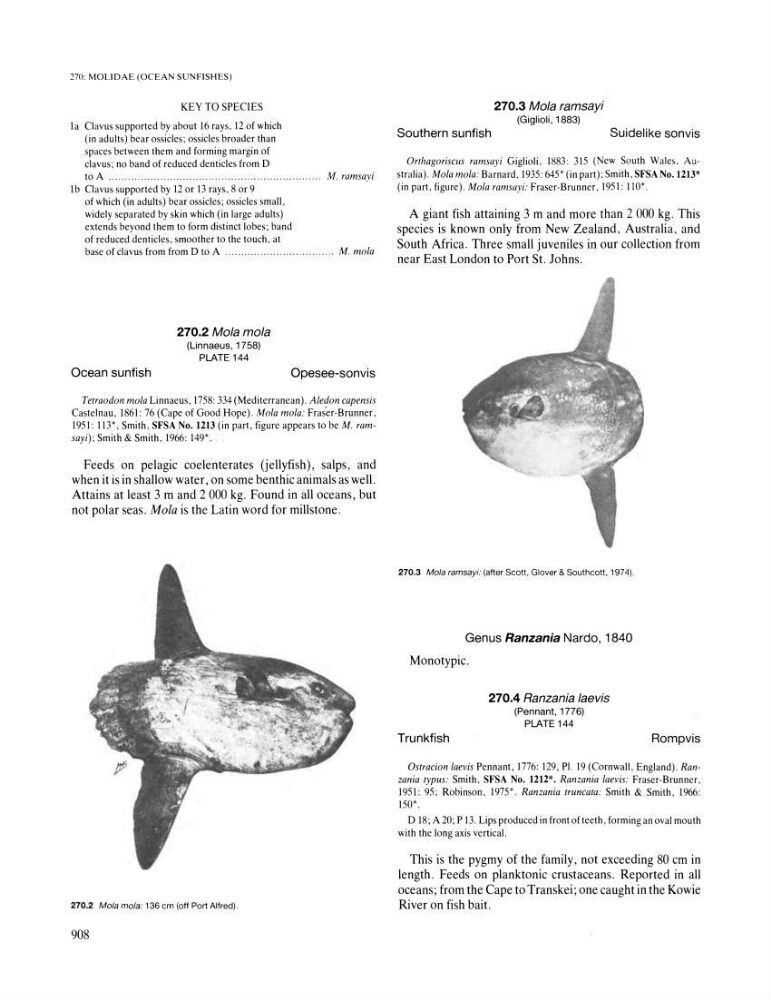
270.2 Mala mala: 136 cm (off Port Alfred).
908
270.3 Mala ramsayi
(Giglioli, 1883)
Southern sunfish
Suidelike sonvis
Orthagoriscus ramsayi Giglioli. 1883: 315 (New South Wales. Australia). Mala mala: Barnard. 1935: 645* (in part); Smith, SFSA No. 1213*
(in part, figure). Mala ramsayi: Fraser-Brunner. 1951: 1]()*.
A giant fish attaining 3 m and more than 2 000 kg. This
species is known only from New Zealand, Australia, and
South Africa. Three small juveniles in our collection from
near East London to Port St. Johns.
270.3 Mala ramsayi: (after Scott, Glover & Southcott, 1974).
Genus Ranzania Nardo, 1840
Monotypic.
Trunkfish
270.4 Ranzania laevis
(Pennant, 1776)
PLATE 144
Rompvis
Ostracian laevis Pennant, 1776: 129, PI. 19 (Cornwall, England). Ranzania typus: Smith, SFSA No. 1212*. Ranzania lan'is: Fraser-Brunner,
1951: 95; Robinson, 1975*. Ranzania truncata: Smith & Smith. 1966:
150*
018; A 20; P 13. Lips produced in front of teeth. forming an oval mouth
with the long axis vertical.
This is the pygmy of the family, not exceeding 80 cm in
length. Feeds on planktonic crustaceans. Reported in all
oceans; from the Cape to Transkei; one caught in the Kowie
River on fish bait.