

calori: Smith, SFSA No. 1184*. Lophodiodon nigropunctatus Smith, 1957:
221, Fig. 4 (Port Alfred); Smith, 1961: 573. No. 1184a.
D 10-12; A 10-11; P 21-23. Spines short; erectile ones with 2 subdermal
roots, fixed ones with 3. No spines on C peduncle, but those at Dbase
extend to near C base; about 16 spines from snout to D base, first 6 or so
erectile; 2-4 forward-pointing spines between and in front of nostrils. A
short tentacle over each eye.
A short pelagic stage, with pupil-size (and smaller) spots
covering body. Benthic individuals with 4 dark bars on
flanks plus a blotch over each P base and at D base; fins
unspotted. Large individuals may have a gular band.
Attains 20 cm. Continental shelf from the Cape to South
China Sea and Australia.
Family No. 270: MOLIDAE
by p.e. Heemstra
Ocean sunfishes
Opesee-sonvisse
Body orbicular or elongate-oval, compressed, truncate
posteriorly, as if the rear end were chopped off. Caudal fin
resorbed during metamorphosis and replaced by a rudderlike structure called a "clavus". Dorsal and anal fins very
high, with short base; in swimming, these fins are flapped
synchronously from side to side and can propel these fishes
at a surprisingly good speed. Mouth very small; teeth fused
in each jaw, forming a parrot-like beak. Gills 4, a slit behind
the last; gill openings reduced to a small hole at base of
pectoral fins. Gasbladder absent in adults. Postlarval stages
(less than 5 mm) with prominent spines on body and a
normal caudal fin; these peculiar postlarval forms were
originally described as distinct species, not related to the
adults.
Sunfishes are found in the open ocean, often drifting at
the surface as if basking in the sun. Three genera are generally recognised, with a total of 4 or 5 species.
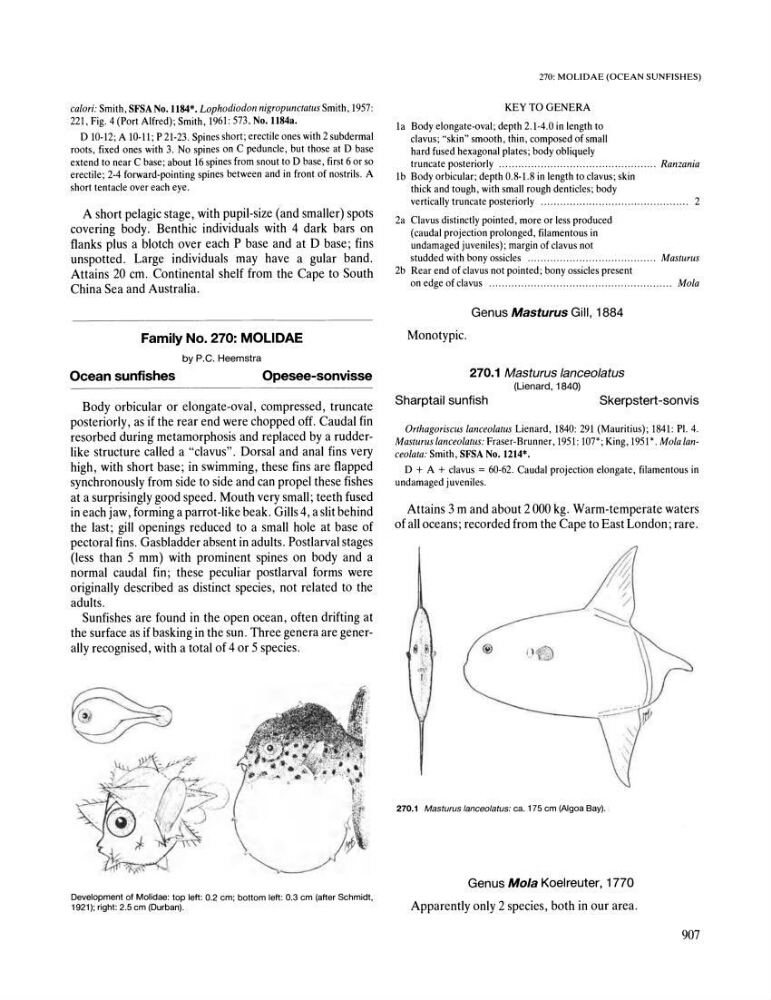
Development of Molidae: top left: 0.2 em; bottom left: 0.3 em (after Schmidt,
1921); right: 2.5 em (Durban).
270: MOLIDAE (OCEAN SUNFISHES)
KEY TO GENERA
1a Body elongate-oval; depth 2.1-4.0 in length to
clavus; "skin" smooth, thin, composed of small
hard fused hexagonal plates; body obliquely
truncate posteriorly ........ .... .. .. .... .. ........................... Ranzania
1 b Body orbicular; depth 0.8-1.8 in length to clavus; skin
thick and tough, with small rough denticles; body
vertically truncate posteriorly .................. .. ... ...... .. ... .... ........ 2
2a Clavus distinctly pointed, more or less produced
(caudal projection prolonged, filamentous in
undamaged juveniles) ; margin of clavus not
studded with bony ossicles ........................................ Masturus
2b Rear end of clavus not pointed; bony ossicles present
on edge of clavus ........ ............... .. .. .. .................. .......... Mola
Monotypic.
Genus Masturus Gill, 1884
270.1 Masturus /anceo/atus
(Lienard, 1840)
Sharptail sunfish
Skerpstert -sonvis
Orthagoriscus lanceolatus Lienard, 1840: 291 (Mauritius); 1841: PI. 4.
Masturus lanceolatus: Fraser-Brunner, 1951: 107*; King, 1951*. Mola lanceolala: Smith , SFSA No. 1214*.
D + A + clavus = 60-62. Caudal projection elongate, filamentous in
undamaged juveniles.
Attains 3 m and about 2 000 kg. Warm-temperate waters
of all oceans; recorded from the Cape to East London; rare.
@
270.1 Masturus lanceolatus: ea. 175 em (Algoa Bay).
Genus Mola Koelreuter, 1770
Apparently only 2 species, both in our area.
907