

(non Richardson): Smith, SFSA No. 1196*. Lagocephalus gloveri Abe &
Tabeta, 1983: 2, PIs. 1-3 (Ito City, Japan); Abe et aI., 1984: 3.
D 12-14; A 12-14; P 16-18; vertebrae 18 (2 fish) or 19 (11). Black
peritoneum of juveniles often shows through white skin of belly;
peritoneum of adults grey. Spinule patch on dorsum V-shaped posteriorly, ending well short of D origin.
Colour of adults from offshore: greenish black dorsally,
flanks greyish silver; belly, A and underside of peduncle
white; 0 and C dusky yellow; tips of C lobes white; P yellowish brown, tip of upper rays dusky. Colour of adults
from inshore sandy areas: pale grey dorsally, with dark
blotch at base of 0, a pair of dark bands across dorsum just
behind eyes and another halfway to 0; dark blotch on top of
peduncle at C base; 0 pale grey, A white; C dusky , darker
distally, the corners white.
Attains at least 41 cm. Known in our area from off Tugela
River to Algoa Bay . If our synonymy is correct, this species
also occurs off Brazil and Japan. Similar to L. spadiceus
(Richardson , 1845), but in spadiceus the rear margin of C is
supposed to be entirely white and the patch of spinules on
dorsum narrows posteriorly to a thin mesial band that
extends almost to 0 origin.
268.20 Lagocephalus inermis
(Schlegel, 1850)
PLATE 143
Smooth blaasop
Gladde blaasop
Tetraodon inermis Schlegel, in Temminck & Schlegel , 1850: 278 , PI.
122, Fig . 2 (Japan) . Lagocephalus inermis: Smith, SFSA No. 1192*; Tyler,
1980: 292* , 326*.
D 12-13; A 10-12 ; P 16-17; minute , embedded spinules on belly from
below eye almost to anus , otherwise body and head smooth; C slightly
concave.
Greenish or dark grey above, silvery white below; gill
opening black internally; peritoneum pale grey. Attains 56
cm . Indo-Pacific, south to Algoa Bay. L. inermis is very
similar to the Atlantic species L. laevigatus Linnaeus, which
reaches southern Angola. L. laevigatus has 012-15, A 1114 and lower P rays blackish . These 2 taxa are considered
subspecies by some authors.
268.21 Lagocephalus lagocephalus
(linnaeus, 1758)
PLATE 143
Oceanic blaasop
Opesee-blaasop
Tetraodon lagocephalus Linnaeus, 1758: 332 (India and Jamaica).
Lagocephalus lagocephalus: Smith , SFSA No. 1193*; Smith & Smith,
1966: 39*; Shipp, 1974: 24*; Tyler, 1980: 292* , 324*.
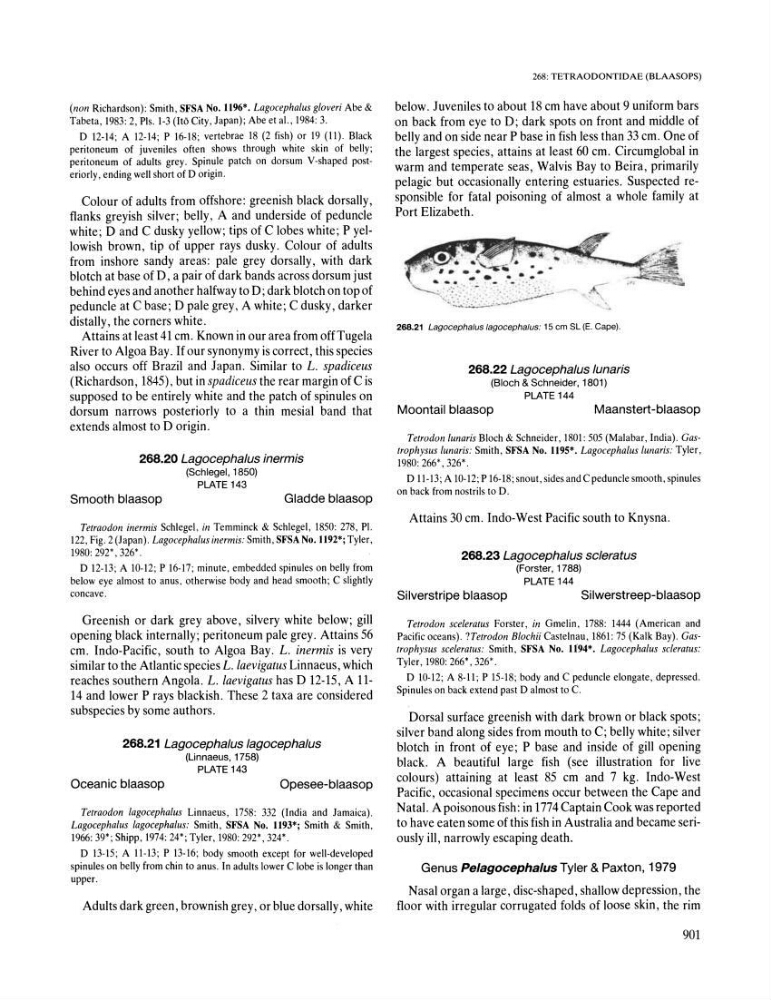
D 13-15; A 11-13; P 13-16; body smooth except for well-developed
spinules on belly from chin to anus. In adults lower C lobe is longer than
upper.
Adults dark green, brownish grey, or blue dorsally, white
268: TETRAODONTIDAE (BLAASOPS)
below. Juveniles to about 18 cm have about 9 uniform bars
on back from eye to 0; dark spots on front and middle of
belly and on side near P base in fish less than 33 cm. One of
the largest species, attains at least 60 cm. Circumglobal in
warm and temperate seas, Walvis Bay to Beira, primarily
pelagic but occasionally entering estuaries. Suspected responsible for fatal poisoning of almost a whole family at
Port Elizabeth.
268.21 Lagocepha/us /agocepha/us: 15 em SL (E. Cape) .
268.22 Lagocephalus lunaris
(Bloch & Schneider, 1801)
PLATE 144
Moontail blaasop
Maanstert-blaasop
Tetrodon lunaris Bloch & Schneider, 1801 : 505 (Malabar, India). Gastrophysus lunaris: Smith , SFSA No. 1195*. Lagoeephalus lunaris: Tyler,
1980: 266*, 326*'
D 11-13 ; A 10-12 ; P 16-18 ; snout, sides and C peduncle smooth . spinules
on back from nostrils to D.
Attains 30 cm. Indo-West Pacific south to Knysna.
268.23 Lagocephalus scleratus
(Forster, 1788)
PLATE 144
Silverstripe blaasop
Si Iwerstreep-blaasop
Tetrodon seeleratus Forster, in Gmelin, 1788: 1444 (American and
Pacific oceans). ?Tetrodon Blochii Castelnau, 1861: 75 (Kalk Bay). Gastrophysus seeleratus: Smith, SFSA No. 1194*. Lagoeephalus scleratus:
Tyler, 1980: 266*,326* .
D 10-12; A 8-11 ; P 15-18; body and C peduncle elongate , depressed.
Spinules on back extend past D almost to C.
Dorsal surface greenish with dark brown or black spots;
silver band along sides from mouth to C; belly white ; silver
blotch in front of eye; P base and inside of gill opening
black. A beautiful large fish (see illustration for live
colours) attaining at least 85 cm and 7 kg. Indo-West
Pacific, occasional specimens occur between the Cape and
Natal. A poisonous fish: in 1774 Captain Cook was reported
to have eaten some of this fish in Australia and became seriously ill, narrowly escaping death.
Genus Pelagocephalus Tyler & Paxton, 1979
Nasal organ a large, disc-shaped, shallow depression, the
floor with irregular corrugated folds of loose skin, the rim
901