

268 : TETRAODONTIDAE (BLAASOPS)
swimming around with C. valentini. It was only the presence
of the spine, very seldom shown, and the longer D and A
that made me realise a filefish was also present. This
mimicry of the toxic toby by the more defenceless Paraluteres prionurus is probably to protect it from predators. -
M.M. Smith.) Indo-West Pacific, south to Durban.
Genus Che/onodon Mulier, 1839
Gill opening not reaching below middle of P base; mouth
below a horizontal line through upper end of gill opening; C
truncate, with rounded corners. Upper LL joins lower
behind A, and lower LL continues forward above A; no lateral cutaneous fold along peduncle. Chelonodon patoca
(Hamilton-Buchanan, 1822), with whole back and belly
spiny, was recorded by Smith (SFSA No. 1201*), but it
apparently does not occur west of India (Smith, 1958: 156)
and is therefore removed from our fauna list. Four species;
2 in our area .
KEY TO SPECIES
la No spines on back; nasal organ cup-like, with
front and rear margins produced into flaps ... ... ..... . C. plellrospilus
I b Spines on front of back; nasal organ a depression
with slightly raised margin expanded before and
behind into a pair of elongate, triangular flaps ... ... .... .. .. C. laticeps
268.17 Chelonodon laticeps
Smith,1948
PLATE 143
Bluespotted blaasop
Blouspikkel-blaasop
Chelollodolliaticeps Smith, 1948: 344 , Figs. 3 (Xora mouth); SFSA No.
1202*; 1958: 156; Hill, 1966: 23. Chelollodon patoca (? non HamiltonBuchanan): Smith. SFSA No. 1201 (not illustration).
D 9- \0; A 8-9; P 15-17; vertebrae 9+ II. Body rather short; D and A
pointed; spinules in regular lines along belly, those on back from interorbital to above P, rest offish smooth. C. patoca is illustrated by Day (1878:
PI. 182, Fig. 4) with spinules extending from the eyes to the D; in none of
our II specimens of C. laticeps do the spinules extend even ~ the distance
from eyes to D.
Large bluish spots (can be whitish in larger specimens) fade
to white on preservation, but 4 vague darker bars, first
across eye and last on C peduncle tend to remain. Attains
about 20 cm . In quiet water among weed from 6 0 S to Xora
River mouth .
268.18 Chelonodon pleurospilus
(Regan, 1919)
PLATE 143
Blaasop beauty
Fraai blaasop
Tetrodon pleurospilus Regan, 1919: 203 (Durban). Sphaeroides
pleurospilus: Smith, SFSA No. 1191*. Chelonodontops pulchellus Smith,
1958: 156, Plate 2, Figs . A & B (Xora River mouth); 1961: 573, No.
1202a*.
D 8-9; A 8; P 15-16; vertebrae 9+ 10. Spinules on belly from below eye
almost to anus, not in regular lines.
900
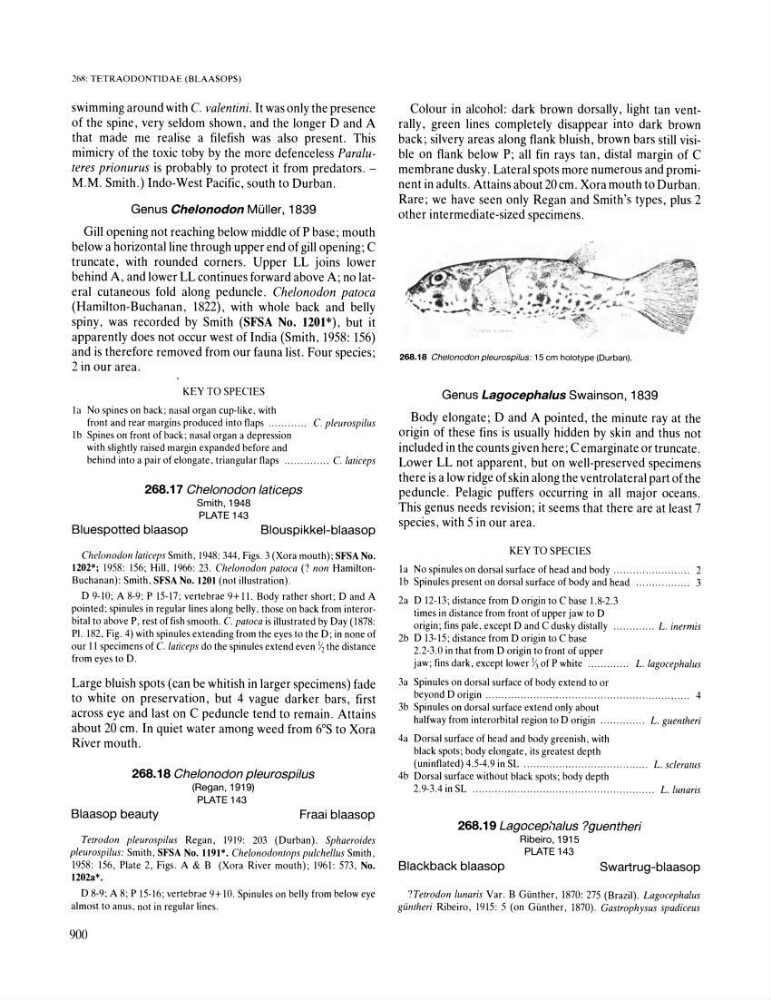
Colour in alcohol: dark brown dorsally, light tan ventrally, green lines completely disappear into dark brown
back; silvery areas along flank bluish , brown bars still visible on flank below P; all fin rays tan, distal margin of C
membrane dusky . Lateral spots more numerous and prominent in adults. Attains about 20 cm. Xora mouth to Durban.
Rare; we have seen only Regan and Smith's types, plus 2
other intermediate-sized specimens.
268.18 Chelonodon pleurospilus: 15 em holotype (Durban).
Genus Lagocepha/us Swainson, 1839
Body elongate; D and A pointed, the minute ray at the
origin of these fins is usually hidden by skin and thus not
included in the counts given here; C emarginate or truncate.
Lower LL not apparent, but on well-preserved specimens
there is a low ridge of skin along the ventrolateral part ofthe
peduncle . Pelagic puffers occurring in all major oceans.
This genus needs revision; it seems that there are at least 7
species, with 5 in our area.
KEY TO SPECIES
I a No spinules on dorsal surface of head and body........ .... ... ... ...... 2
I b Spinules present on dorsal surface of body and head ........ ......... 3
2a D 12-13; distance from D origin to C base 1.8-2.3
times in distance from front of upper jaw to D
origin; fins pale, except D and C dusky distally ...... ....... L. inermis
2b D 13-15 ; distance from D origin to C base
2.2-3.0 in that from D origin to front of upper
jaw; fins dark, except lower Y j of P white .......... ... L. lagocephalus
3a Spinules on dorsal surface of body extend to or
beyond D origin .... .... ... ... .... .... ...... ...... ......... .. ................... 4
3b Spinules on dorsal surface extend only about
halfway from interorbital region to D origin .............. L. guentheri
4a Dorsal surface of head and body greenish, with
black spots; body elongate, its greatest depth
(un inflated) 4.5-4.9 in SL ............................... .. ..... L. sc/eratus
4b Dorsal surface without black spots; body depth
2.9-3.4 in SL ............................................... .. ........ L. lunaris
268.19 Lagocep:1alus ?guentheri
Ribeiro, 1915
PLATE 143
Blackback blaasop
Swartrug-blaasop
?Tetrodoll lunaris Var. B Gunther, 1870: 275 (Brazil). Lagocephaills
giintheri Ribeiro , 1915: 5 (on Gunther, 1870). Gastrophyslls spadicells