

26): TRIAC ANTHODIDAE (SPIKEFISHES)
lower jaw 14-2R. inner teeth 0-2 . Head 2.3-3.0; snout 5.9-7.6; eye 5.0-6.4;
postorbital R.R-12.R; mouth width 11-14; gill opening 7.6-12.5; body depth
1.6-2.5.
Generally reddish, paler below; with 3 yellowish principal lines and 2 reddish-yellow supplemental lines (upper between 0 base and uppermost principal line; lower between
uppermost and middle principal lines at about mid-body
posteriorly onto C peduncle). Attains about 85 mm SL.
Taken in bottom trawls in 50 - 125 m; Japan to South Africa.
265.3 Triacanthodes ethiops: 7 em (Natal).
Genus ''rydemania Weber, 1913
First 3 0 spines well developed, the last 3 rudimentary
and barely, if at all, visible; pelvis flat ventrally, its width 4
in its length; gill opening reaching ventrally to lower ~ of P
base; teeth in 1 row in both jaws. Monotypic.
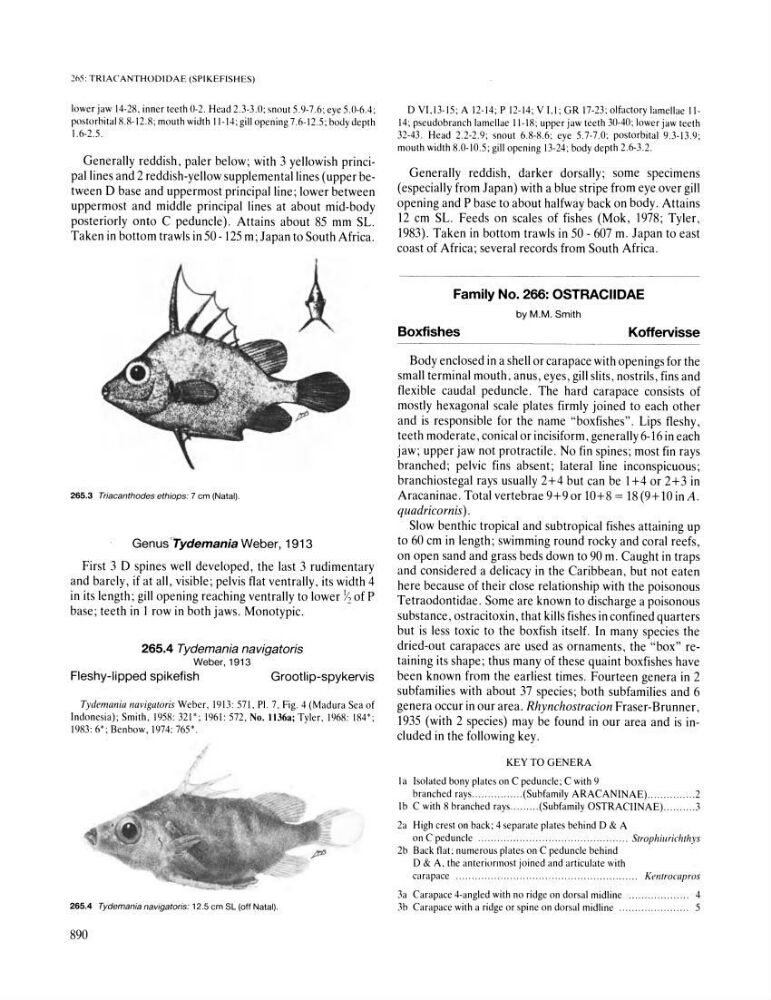
265.4 Tydemania navigatoris
Weber, 1913
Fleshy-lipped spikefish
Grootlip-spykervis
Tydemania navigatoris Weber, 1913: 571, PI. 7, Fig. 4 (Madura Sea of
Indonesia) ; Smith , 195R: 321 *; 1961: 572 , No. 1136a; Tyler, 1968: IR4*;
1983: 6*; Benbow . 1974: 765 *.
!
265.4 Tydemania navigatoris: 12 .5 em SL (off Natal).
890
D VI,I3-15; A 12-14; P 12-14; V [.1; GR 17-23; olfactory lamellae 1114; pseudobranch lamellae 11-18; upper jaw teeth 30-40; lower jaw teeth
32-43. Head 2.2-2 .9; snout 6.8-8.6; eye 5.7-7.0 ; postorbital 9.3-13.9;
mouth width 8.0-10.5 ; gill opening 13-24; body depth 2.6-3.2 .
Generally reddish, darker dorsally ; some specimens
(especially from Japan) with a blue stripe from eye over gill
opening and P base to about halfway back on body. Attains
12 cm SL. Feeds on scales of fishes (Mok , 1978; Tyler,
1983). Taken in bottom trawls in 50 - 607 m. Japan to east
coast of Africa; several records from South Africa.
Family No. 266: OSTRACIIDAE
by M .M . Smith
Boxfishes
Koffervisse
Body enclosed in a shell or carapace with openings for the
small terminal mouth, anus, eyes, gill slits, nostrils, fins and
flexible caudal peduncle . The hard carapace consists of
mostly hexagonal scale plates firmly joined to each other
and is responsible for the name "box fishes" . Lips fleshy,
teeth moderate, conical or incisiform, generally 6-16 in each
jaw; upper jaw not protractile. No fin spines; most fin rays
branched; pelvic fins absent; lateral line inconspicuous;
branchiostegal rays usually 2+4 but can be 1 +4 or 2 + 3 in
Aracaninae . Total vertebrae 9+9 or 10+8 = 18 (9+ 10 in A .
quadricornis) .
Slow benthic tropical and subtropical fishes attaining up
to 60 cm in length; swimming round rocky and coral reefs,
on open sand and grass beds down to 90 m. Caught in traps
and considered a delicacy in the Caribbean, but not eaten
here because of their close relationship with the poisonous
Tetraodontidae. Some are known to discharge a poisonous
substance, ostracitoxin, that kills fishes in confined quarters
but is less toxic to the boxfish itself. In many species the
dried-out carapaces are used as ornaments, the "box" retaining its shape; thus many of these quaint boxfishes have
been known from the earliest times . Fourteen genera in 2
subfamilies with about 37 species; both subfamilies and 6
genera occur in our area. Rhynchostracion Fraser-Brunner,
1935 (with 2 species) may be found in our area and is included in the following key.
KEY TO GENERA
la [solated bony plates on C peduncle; C with 9
branched rays .. .. .. .......... (Subfamily ARACAN[NAE)
.. 2
Ib C with 8 branched rays ......... (Subfamily OSTRACIINAE) .......... 3
2a High crest on back ; 4 separate plates behind D & A
on C peduncle .............................................. Strophiurichthys
2b Back flat; numerous plates on C peduncle behind
D & A. the anteriormost joined and articulate with
carapace ................. ...... .......... ........... ... ..... ... Kentrocapros
3a Carapace 4-angled with no ridge on dorsal midline
.. .. ........ . 4
3b Carapace with a ridge or spine on dorsal midline ...... .. .............. 5