

Genus Syacium Ranzani, 1840
Four or 5 species; 1 in our area.
259.20 Syacium micrurum
Ranzani, 1840
Syacium micrurum Ranzani, 1840: 18, PI. 5 (Brazil); Norman, 1934:
132*; Nielsen, 1961: 105. Syaeium ovale (non Gunther): Pauca, 1930: 37.
Syaeium guineensis: Fraser, 1971: 491.
D 85-91; A 66-74; P 11-12 on eyed side; lower GR 7-8; LL 51-62 (LL
57-68 in fish from western Atlantic). Depth 2.3-2.6, head 3.6-4.2 in SL.
Interorbital width in eye usually greater than 2.5. Upper-jaw teeth
biserial, anterior teeth of outer row enlarged canines; lower-jaw teeth
uniserial. Males with somewhat wider interorbital region and longer
upper P rays on eyed side than females. Larvae probably metamorphose
at ca. 14 mm SL.
Eyed side brownish, usually with diffuse dark spot on LL
under P and another near anterior end of C peduncle; no
dark lines on head. Attains 30 (possibly 40) cm. Western
Atlantic from Florida to Rio de Janeiro; in eastern Atlantic
from Mauritania to Walvis Bay in 18 -100 m (and probably
shallower) on mud, sand and gravel bottoms.
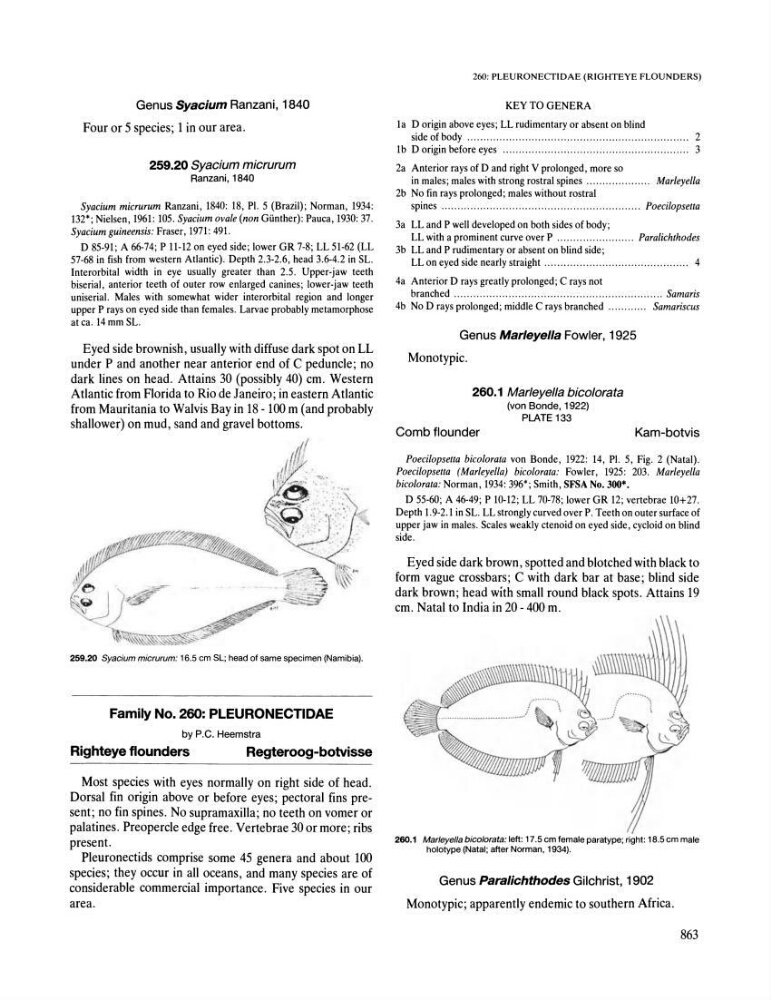
259.20 Syaeium mierurum: 16.5 em SL; head of same specimen (Namibia).
Family No. 260: PLEURONECTIDAE
by P.C. Heemstra
Righteye flounders
Regteroog-botvisse
Most species with eyes normally on right side of head.
Dorsal fin origin above or before eyes; pectoral fins present; no fin spines. No supramaxilla; no teeth on vomer or
palatines. Preopercle edge free. Vertebrae 30 or more; ribs
present.
Pleuronectids comprise some 45 genera and about 100
species; they occur in all oceans, and many species are of
considerable commercial importance. Five species in our
area.
260: PLEURONECTIDAE (RIGHTEYE FLOUNDERS)
KEY TO GENERA
la D origin above eyes; LL rudimentary or absent on blind
side of body ..................................................................... 2
Ib D origin before eyes .......................................................... 3
2a Anterior rays of D and right V prolonged, more so
in males; males with strong rostral spines ......... ........... Marleyella
2b No fin rays prolonged; males without rostral
spines .............................................................. Poeeilopsetta
3a LL and P well developed on both sides of body;
LL with a prominent curve over P ........................ Paraliehthodes
3b LL and P rudimentary or absent on blind side;
LL on eyed side nearly straight............................................. 4
4a Anterior D rays greatly prolonged; C rays not
branched ................................................................. Samaris
4b No D rays prolonged; middle C rays branched ............ Samariseus
Genus Marleyella Fowler, 1925
Monotypic.
260.1 Marleyella bicolorata
(von Bonde, 1922)
PLATE 133
Comb flounder
Kam-botvis
Poeeilopsetta bieolorata von Bonde, 1922: 14, PI. 5, Fig. 2 (Natal).
Poeeilopsetta (Marleyella) bieolorata: Fowler, 1925: 203. Marleyella
bieolorata: Norman, 1934: 396*; Smith, SFSA No. 300*.
D 55-60; A 46-49; P 10-12; LL 70-78; lower GR 12; vertebrae 10+27.
Depth 1.9-2.1 in SL. LL strongly curved over P. Teeth on outer surface of
upper jaw in males. Scales weakly ctenoid on eyed side, cycloid on blind
side.
Eyed side dark brown, spotted and blotched with black to
form vague crossbars; C with dark bar at base; blind side
dark brown; head with small round black spots. Attains 19
cm. Natal to India in 20 - 400 m.
260.1 Mar/eyetla bie%rata: left: 17.5 em female paratype; right: 18.5 em male
holotype (Natal; after Norman, 1934).
Genus Paralichthodes Gilchrist, 1902
Monotypic; apparently endemic to southern Africa.
863