

259: BOTHIDAE (LEFTEYE FLOUNDERS)
spots, frequently arranged in longitudinal row on D and A.
Attains 36 cm. Indo-West Pacific south to Algoa Bay and
possibly to Knysna. From estuaries to 100 m, usually on
mud , sand or gravel bottoms.
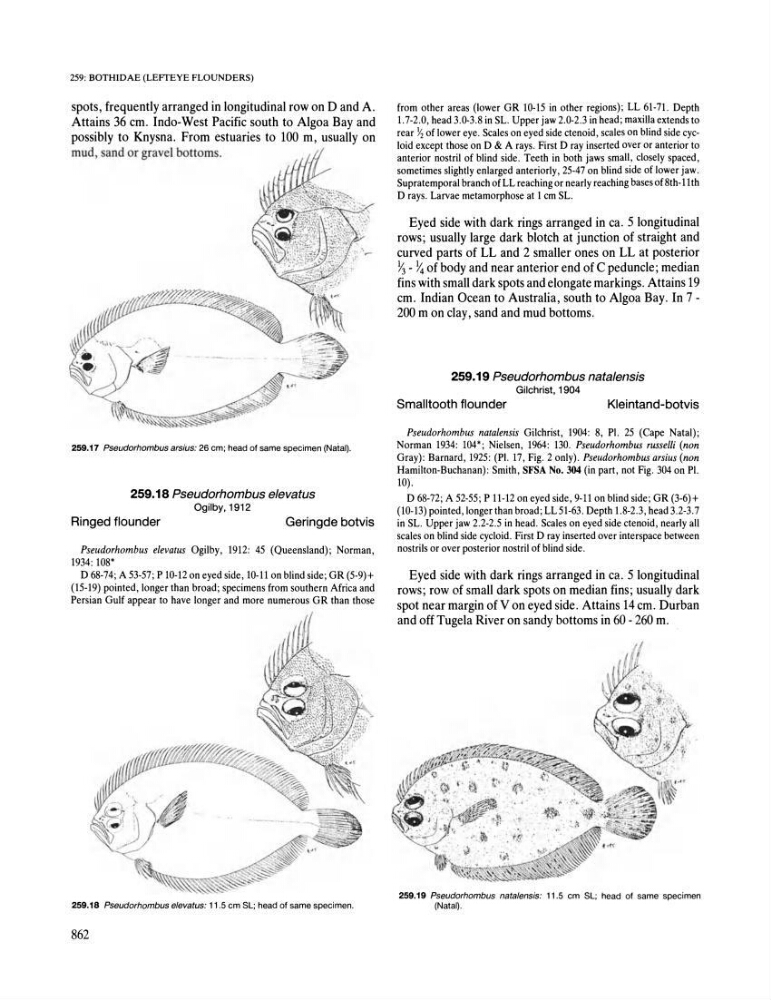
259.17 Pseudorhombus arsius: 26 cm; head of same specimen (Natal).
259.18 Pseudorhombus elevatus
Ogilby, 1912
Ringed flounder
Geringde botvis
Pseudorhombus elevatus Ogilby, 1912: 45 (Queensland); Norman,
1934: 108'
D 68-74; A 53-57; P 10-12 on eyed side, 10-11 on blind side; GR (5-9)+
(15-19) pointed, longer than broad; specimens from southern Africa and
Persian Gulf appear to have longer and more numerous GR than those
259.18 Pseudorhombus elevatus: 11.5 cm SL; head of same specimen.
862
from other areas (lower GR 10-15 in other regions); LL 61-71. Depth
1.7-2.0, head 3.0-3.8 in SL. Upper jaw 2.0-2.3 in head; maxilla extends to
rear Yz of lower eye. Scales on eyed side ctenoid, scales on blind side cycloid except those on D & A rays. First D ray inserted over or anterior to
anterior nostril of blind side. Teeth in both jaws small, closely spaced,
sometimes slightly enlarged anteriorly, 25-47 on blind side of lower jaw.
Supratemporal branch of LL reaching or nearly reaching bases of 8th-11th
D rays. Larvae metamorphose at 1 cm SL.
Eyed side with dark rings arranged in ca. 5 longitudinal
rows; usually large dark blotch at junction of straight and
curved parts of LL and 2 smaller ones on LL at posterior
~ -l'4 of body and near anterior end of C peduncle; median
fins with small dark spots and elongate markings. Attains 19
cm. Indian Ocean to Australia, south to Algoa Bay. In 7 -
200 m on clay, sand and mud bottoms.
259.19 Pseudorhombus natalensis
Gilchrist, 1904
Smalltooth flounder
Kleintand-botvis
Pseudorhombus natalensis Gilchrist, 1904: 8, PI. 25 (Cape Natal);
Norman 1934: 104'; Nielsen, 1964: 130. Pseudorhombus russelli (non
Gray): Barnard, 1925: (PI. 17, Fig. 2 only). Pseudorhombus arsius (non
Hamilton-Buchanan): Smith, SFSA No. 304 (in part, not Fig. 304 on PI.
10).
D 68-72; A 52-55; P 11-12 on eyed side, 9-11 on blind side; GR (3-6)+
(10-13) pointed, longer than broad; LL51-63. Depth 1.8-2.3, head 3.2-3.7
in SL. Upper jaw 2.2-2.5 in head. Scales on eyed side ctenoid, nearly all
scales on blind side cycloid. First D ray inserted over interspace between
nostrils or over posterior nostril of blind side.
Eyed side with dark rings arranged in ca. 5 longitudinal
rows; row of small dark spots on median fins; usually dark
spot near margin of V on eyed side. Attains 14 cm. Durban
and off Tugela River on sandy bottoms in 60 - 260 m.
259.19 Pseudorhombus natalensis: 11.5 cm SL; head of same specimen
(Natal).