

D 11-13 (22-23 in small juveniles); A 14 (18 in small juveniles);
P i,14-19; GR (4-6)+(11-14). Depth 2.9-3.2, head 3.5-3.8.
Body and head bluish dorsally, silvery pink below; C
pink, with a round blackish spot at its base; D and A black;
P yellow or pink; juveniles with large dark spots all over
body . Attains 200 cm and 150 kg. An epipelagic fish of the
high seas, the louvar feeds on jellyfishes and other planktonic animals. A mature female stranded on a beach in the
U.S.A. had ovaries weighing 2 kg and estimated to contain
47 million eggs. Found in all oceans and the Mediterranean
Sea; not reported in polar seas or near equator. A 117 kg
specimen was recently caught 20 miles west of Cape Point
and a small juvenile (RUSI 2617) collected off Richards
Bay.
Family No. 251: XIPHIIDAE
by P.C. Heemstra
Swordfishes
Swaardvisse
Body robust, slightly compressed. Upper jaw and snout
greatly elongated, forming a flat, sharp-edged bony sword.
In fish longer than 1 m, the first dorsal fin height is greater
than length of base, which is well separated from the much
smaller second dorsal fin; pelvic fins absent. Caudal peduncle (of adults) with a single keel on each side. Teeth and
scales absent in adults. One genus with only one species,
found in open water of all oceans.
Swordfish
251.1 Xiphias g/adius
Linnaeus, 1758
PLATE 133
Swaardvis
Xiphias gladius Linnaeus, 1758: 248 (European Seas); Arata, 1954*;
Smith, SFSA No. 873*; Kondritskaya, 1970*; Beckett, 1974*; Penrith &
Cram, 1974; Bozhkov, 1975*.
Length of sword (from front of eye) about l' 3 distance from tip of lower
jaw to fork of tail. D about 40+4; A about 18+4. (Counts from a 352 mm
TL specimen are D 47, A 17 & P 16.) In small juveniles, both jaws are
equally prolonged and with minute teeth, and the skin is covered with
spiny scales.
Dark grey or bronzy to purplish or bluish black dorsally,
whitish ventrally. Attains 5 m and well over 500 kg.
Swordfish over deep water feed on surface or near-surface
fishes (e.g. flying fish, sardines, mackerel, etc.) and squid;
in shallow water (less than 800 m) large swordfish also make
excursions to the bottom where they catch benthic species,
returning to the warmer surface waters to digest them.
Swordfish and mako sharks are well-matched enemies:
pieces of swordfish are occasionally found in the shark's
stomach, and some makos are also observed with wounds
and pieces of the sword embedded in their bodies. A
252: ISTIOPHORIDAE (SAILFISH, SPEARFISHES & MARLINS)
formidable antagonist for big game anglers, this powerful
fish sometimes charges a boat with such speed that the
sword is driven right through the hull of the vessel. A rare
catch in our area, occurs from Namibia to Natal.
B
c
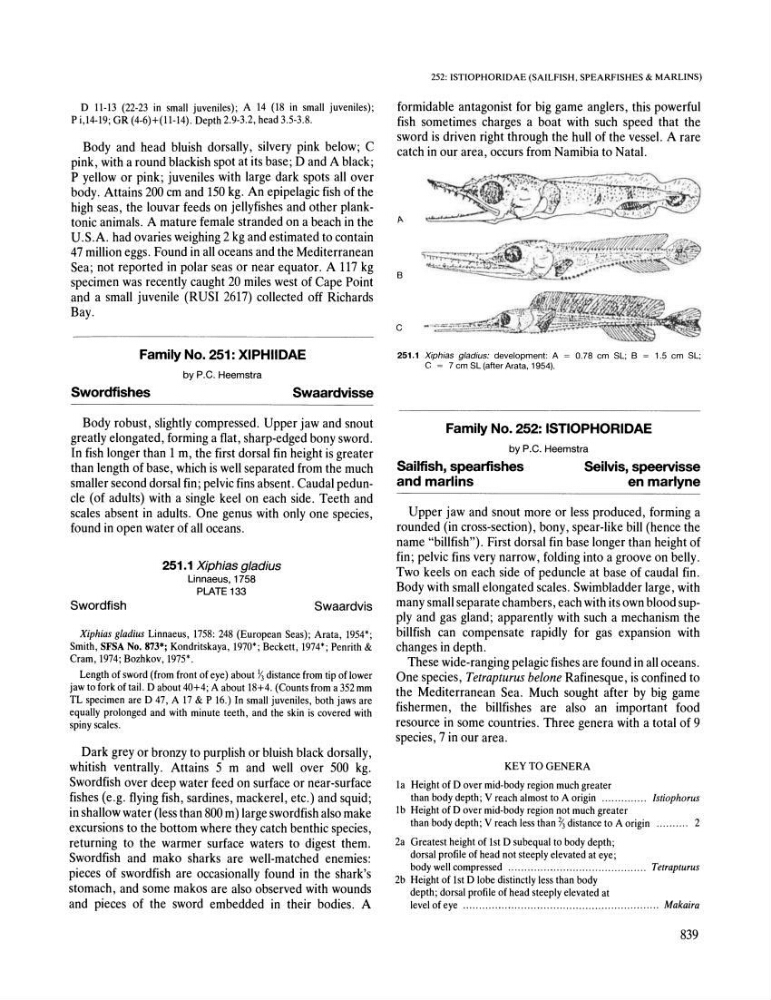
251.1 Xiphias gladius: development: A = 0.78 em SL; B = 1.5 em SL;
C = 7 em SL (after Arata, 1954).
Family No. 252: ISTIOPHORIDAE
by P.C. Heemstra
Sailfish, spearfishes
Seilvis, speervisse
and marlins
en marlyne
Upper jaw and snout more or less produced, forming a
rounded (in cross-section), bony, spear-like bill (hence the
name "billfish"). First dorsal fin base longer than height of
fin; pelvic fins very narrow, folding into a groove on belly.
Two keels on each side of peduncle at base of caudal fin.
Body with small elongated scales. Swimbladder large, with
many small separate chambers, each with its own blood supply and gas gland; apparently with such a mechanism the
billfish can compensate rapidly for gas expansion with
changes in depth.
These wide-ranging pelagic fishes are found in all oceans.
One species, Tetrapturus be/one Rafinesque, is confined to
the Mediterranean Sea. Much sought after by big game
fishermen, the billfishes are also an important food
resource in some countries. Three genera with a total of 9
species, 7 in our area.
KEY TO GENERA
la Height of D over mid-body region much greater
than body depth; V reach almost to A origin .............. /stiophorus
1b Height of D over mid-body region not much greater
than body depth; V reach less than 7] distance to A origin .. .... .. .. 2
2a Greatest height of 1st D subequal to body depth;
dorsal profile of head not steeply elevated at eye;
body well compressed .. ................... ..... ................. Tetrapturus
2b Height of 1st D lobe distinctly less than body
depth; dorsal profile of head steeply elevated at
level of eye ............................... .. .... ..... ............ .. ..... Makaira
839