

249: SCOMBRIDAE (TUNAS, MACKERELS & BONITOS)
oceanic in cold temperature waters. A valuable food-fish
taken mostly by long-line. In our waters known only from
long-line catches off the Gape region during winter. Probably found throughout the southern oceans south of 30 0 S.
Bigeye tuna
249.17 Thunnus obesus
(Lowe, 1839)
Grootoog-tuna
Thynnus obesus Lowe, 1839: 78 (Madeira). Thunnlls obeslls: Talbot &
Penrith, 1961: 240; 1962: 55R; Talbot, 1963: 624; 1964: 203* ; Gibbs &
Collette, 1967: 109; Talbot & Penrith, 1968: 12; Collette & Nauen, 1983:
88*. Thunnus at/anticus (non Lesson): Smith, 1961: 569, No. 83Ia*.
D XIII-XIV+14-16+8-10 finlets'; A 11-15+7-10 fin1ets; P 31-35; GR
(7-9)+(18-20) = 26-29; vertebrae 18+21 = 39. Depth 3.2-3.8; head
3.1-3.4.
Frequently confused with yellowfin tuna, but differs in
having a heavier, thicker-set body and shorter 2nd 0 and A.
Attains 200+ cm FL. The all-tackle angling record is a 197.3
kg fish from Cabo Blanco, Peru, taken in 1957. Epipelagic
and mesopelagic from the surface to 250 m, oceanic. An
important food-fish in many parts of its range. Worldwide
in tropical and subtropical waters. In our waters, known
primarily from long-line catches off the Cape region .
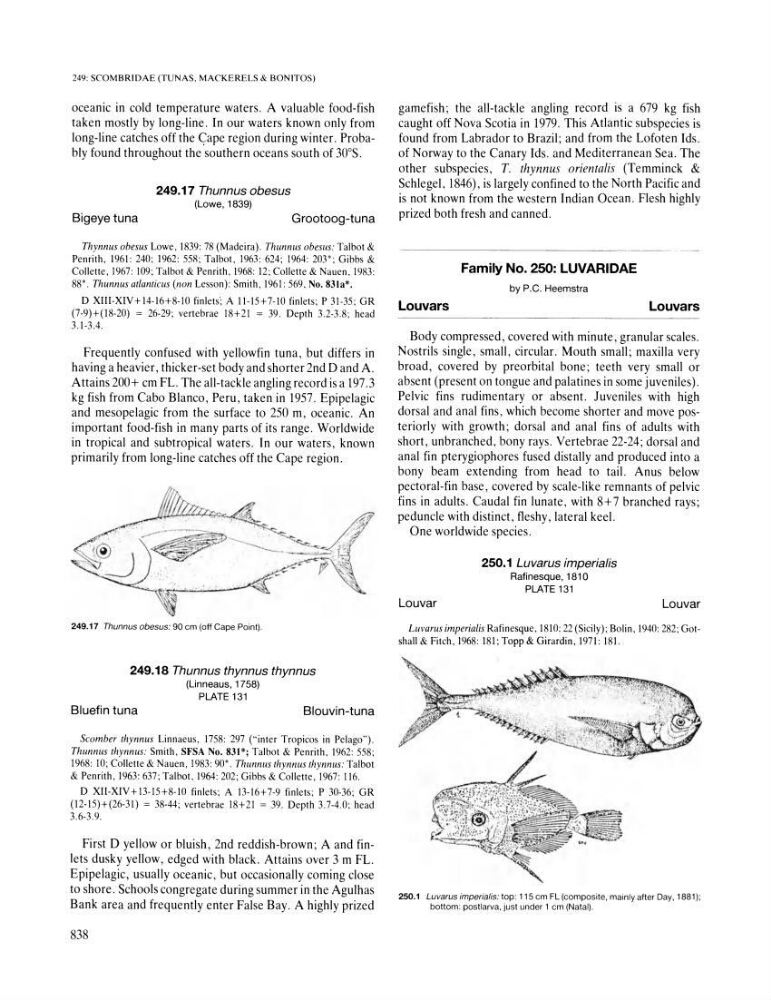
249.17 Thunnus obesus: 90 em (off Cape Point).
249.18 Thunnus thynnus thynnus
(Linneaus, 1758)
PLATE 131
Bluefin tuna
Blouvin-tuna
Scomber thynnus Linnaeus, 1758: 297 ("inter Tropicos in Pelago ").
Thllnnus thynnus: Smith, SFSA No. 831*; Talbot & Penrith, 1962: 558;
1968: 10; Collette & Nauen, 1983: 90*. Thunnus thynnus thynnus: Talbot
& Penrith , 1963: 637; Talbot, 1964: 202; Gibbs & Collette, 1967: 116.
D XII-XIV + 13-15+8-10 finlets; A 13-16+7-9 finlets; P 30-36; GR
(12-15)+(26-31) = 38-44; vertebrae 18+21 = 39. Depth 3.7-4.0; head
3.6-3.9.
First 0 yellow or bluish, 2nd reddish-brown; A and finlets dusky yellow, edged with black. Attains over 3 m FL.
Epipelagic, usually oceanic, but occasionally coming close
to shore. Schools congregate during summer in the Agulhas
Bank area and frequently enter False Bay. A highly prized
838
gamefish; the all-tackle angling record is a 679 kg fish
caught off Nova Scotia in 1979. This Atlantic subspecies is
found from Labrador to Brazil; and from the Lofoten Ids.
of Norway to the Canary Ids. and Mediterranean Sea. The
other subspecies, T. thynnus orientalis (Temminck &
Schlegel, 1846), is largely confined to the North Pacific and
is not known from the western Indian Ocean. Flesh highly
prized both fresh and canned.
Family No. 250: LUVARIDAE
by P.C. Heemstra
Louvars
Louvars
Body compressed, covered with minute, granular scales.
Nostrils single, small, circular. Mouth small; maxilla very
broad, covered by preorbital bone; teeth very small or
absent (present on tongue and palatines in some juveniles).
Pelvic fins rudimentary or absent. Juveniles with high
dorsal and anal fins, which become shorter and move posteriorly with growth; dorsal and anal fins of adults with
short, unbranched, bony rays. Vertebrae 22-24; dorsal and
anal fin pterygiophores fused distally and produced into a
bony beam extending from head to tail. Anus below
pectoral-fin base, covered by scale-like remnants of pelvic
fins in adults. Caudal fin lunate, with 8+ 7 branched rays;
peduncle with distinct, fleshy, lateral keel.
One worldwide species.
Louvar
250.1 Luvarus imperia/is
Rafinesque, 1810
PLATE 131
Louvar
Luvarus imperialis Rafinesque, 1810: 22 (Sicily); Bolin, 1940: 282; Gotshall & Fitch, 1968: 181; Topp & Girardin, 1971: 181.
250.1 Luvarus imperialis: top: 115 em FL (composite, mainly after Day, 1881);
bottom: postlarva, just under 1 em (Natal).