

243: ACANTHURIDAE (SURGEONFISHES, UNICORNFISHES)
in distribution . Most surgeonfishes occur in shallow tropical
waters; a few species penetrate depths to about 100 m. The
species of Ctenochaetus, with their distinctive comb-like
teeth, are detritus feeders. Paracanthurus hepatus and 3
species of Acanthurus feed mainly on zooplankton. The
remaining surgeonfishes graze on benthic algae . The
species of one group of Acanthurus (including nigricauda,
tennenti, dussumieri, mata and xanthopterus) often ingest
sand and have thick-walled, gizzard-like stomachs. The late
postlarval stage, termed the acronurus , is transparent with
silvery abdomen, orbicular, and has fine vertical grooves
on the body. The caudal concavity used in diagnoses below
is the difference between the lengths of the longest and
shortest caudal fin rays.
KEY TO GENERA
la 0 spines 4 or 5; snout strongly produced; 0 and
A elevated ............ ...... ........ .. .............................. Zebrasoma
Ib 0 spines 6·9; snout not strongly produced; 0 and A not
elevated .......................... ................ ........................ ... ..... 2
2a V 1,3; body bright blue and black , C and peduncle
yellow with black edges .... .................... .... ......... Paracanthurus
2b V 1,5 ; colour not as in 2a ............. ....... ... ........ .... ......... ... ...... 3
3a Teeth in jaws fixed , spatulate with denticulate
edges , 8-28 in each jaw; 0 spines usually 9 .......... .. ..... Acanthurus
3b Teeth in jaws flexible, slender with incurved
tips which are denticulate on lateral edge, more
than 30 in each jaw of adults; 0 spines 8 .... ... .... ....... Ctenochaetus
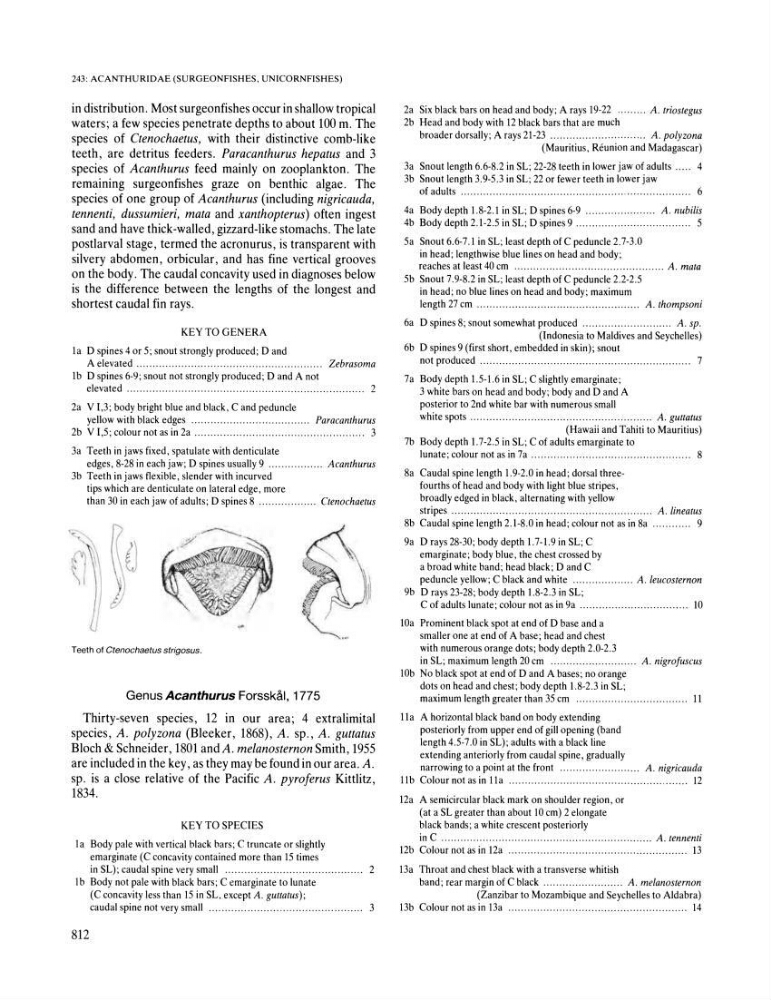
Teeth of Ctenochaetus strigosus.
Genus Acanthurus Forsskal, 1775
Thirty-seven species, 12 in our area; 4 extralimital
species, A. polyzona (Bleeker, 1868), A. sp., A. guttatus
Bloch & Schneider, 1801 andA. melanosternon Smith, 1955
are included in the key, as they may be found in our area. A.
sp, is a close relative of the Pacific A. pyroferus Kittlitz,
1834.
KEY TO SPECIES
la Body pale with vertical black bars; C truncate or slightly
emarginate (C concavity contained more than 15 times
in SL); caudal spine very small ........................................... 2
Ib Body not pale with black bars ; C emarginate to lunate
(C concavity less than 15 in SL, except A. guttalus);
caudal spine not very small ................. .......... ........ .. ... .. .... .. 3
812
2a Six black bars on head and body ; A rays 19-22 ..... .... A. triostegus
2b Head and body with 12 black bars that are much
broader dorsally; A rays 21-23 .............................. A . polyzona
(Mauritius, Reunion and Madagascar)
3a Snout length 6.6-8.2 in SL; 22-28 teeth in lower jaw of adults..... 4
3b Snout length 3.9-5.3 in SL; 22 or fewer teeth in lower jaw
of adults .... ..... ...... ........ ..... .. ..... ................ .... ........ ......... 6
4a Body depth 1.8-2.1 in SL; 0 spines 6-9 ....... ... ............ A. nubilis
4b Body depth 2.1-2.5 in SL; 0 spines 9 .................................... 5
Sa Snout 6.6-7.1 in SL; least depth of C peduncle 2.7-3.0
in head; lengthwise blue lines on head and body;
reaches at least 40 cm .. .. ............ ......... .............. .... .... A. mala
5b Snout 7.9-8.2 in SL; least depth of C peduncle 2.2-2.5
in head; no blue lines on head and body; maximum
length 27 cm .... .. ............................................. A. Ihompsoni
6a 0 spines 8; snout somewhat produced ............................ A. sp.
(Indonesia to Maldives and Seychelles)
6b 0 spines 9 (first short, embedded in skin); snout
not produced ... ....................... ........................................ 7
7a Body depth 1.5-1.6 in SL; C slightly emarginate;
3 white bars on head and body; body and 0 and A
posterior to 2nd white bar with numerous small
white spots ......................................................... A. guttatus
(Hawaii and Tahiti to Mauritius)
7b Body depth 1.7-2.5 in SL; C of adults emarginate to
lunate; colour not as in 7a .................................................. 8
8a Caudal spine length 1.9-2.0 in head; dorsal three·
fourths of head and body with light blue stripes,
broadly edged in black, alternating with yellow
stripes ............... ... ..... .. ......... ..... ... ................... .. A. lineatus
8b Caudal spine length 2.1·8.0 in head; colour not as in 8a ............ 9
9a 0 rays 28-30; body depth 1.7-1.9 in SL; C
emarginate; body blue , the chest crossed by
a broad white band; head black; 0 and C
peduncle yellow; C black and white ................... A. leucosternon
9b 0 rays 23-28; body depth 1.8-2.3 in SL;
C of adults lunate; colour not as in 9a .............. .... ...... ... ....... 10
lOa Prominent black spot at end of 0 base and a
smaller one at end of A base; head and chest
with numerous orange dots; body depth 2.0-2.3
in SL; maximum length 20 cm ........................... A. nigrofuscus
lOb No black spot at end of 0 and A bases; no orange
dots on head and chest; body depth 1.8-2.3 in SL;
maximum length greater than 35 cm ................................... 11
11a A horizontal black band on body extending
posteriorly from upper end of gill opening (band
length 4,5-7.0 in SL); adults with a black line
extending anteriorly from caudal spine, gradually
narrowing to a point at the front .... ... .................. A. nigricauda
11 b Colour not as in 11a ............... .. ........ ..... .............. .... ........ 12
12a A semicircular black mark on shoulder region, or
(at a SL greater than about 10 cm) 2 elongate
black bands; a white crescent posteriorly
in C ....................................................... .. .... .. ... A. tennenti
12b Colour not as in 12a .................. ... ....... ............................ 13
13a Throat and chest black with a transverse whitish
band; rear margin of C black .......... .. ...... ....... A. melanosternon
(Zanzibar to Mozambique and Seychelles to Aldabra)
13b Colour not as in 13a ........................................................ 14