

Genus Xenisthmus Snyder, 1908
Head depressed; top of head, cheek and operculum
scaled or naked. Anterior nostril a short tube. Gill opening
reaching to between eye and rear margin of preopercle .
Projecting lower jaw thickened anteriorly; lower edge of
lower lip free from chin. P rays branched. Head pores
developed above eye, from eye to above end of operculum,
and along rear preopercle margin. Body covered with
numerous small scales. Known only from coral reefs. Segmented Crays 17; 2nd D 1,11-12; A 1,10-11; P 14-17; LS
50-60; vertebrae 26. About 10 species, 1 in our area.
241.10 Xenisthmus africanus
Smith,1958
PLATE 127
Flathead wriggler
Platkop-wikkelaar
Xenisrhmlls african liS Smith, 1958: 153, Fig. 10 (Pinda, Mozambique);
Smith 1961: 570, No. 944b.
o VI+ 1, 12 ; A I, ll; P 15-17; LS 57-60; TRB 20-21 ; PO 18-20; GR 4+ 12.
Tongue emarginate to bilobed. Body scal es ctenoid behind A origin, cycloid anteriorly. Cheek and operculum with cycloid scales; pre dorsal scaled
to just behind eye.
Dark stripe from snout through eye across operculum,
onto P base and continued on body to lower C base; 6-8
dark vertical bars extending upward from lateral stripe to
2nd D base. Attains 38 mm. Known only from Indian
Ocean, Bazaruto , Zanzibar, Pemba, Mafia , Aldabra,
Chagos Archipelago and Cocos-Keeling Id.
Family No. 242: KRAEMERIIDAE
by D.F. Hoese
Sand darts
Sandspiese
Small fishes, less than 4 cm; scaleless; single dorsal fin
with 4-5 flexible spines and 13-17 segmented rays; anal fin
with 1 spine and 11-14 segmented rays; caudal fin with 11
segmented rays; pectoral fins small with 3-9 rays; pelvic fins
separate or connected, but not forming disc; vertebrae
(10-14)+(16-17) = 26-30; chin with a prominent forward
projection; head with small flaps along lower edge of
preopercle and often lower operculum; operculum expanded, covering pectoral base; eyes minute.
Benthic tropical fishes living buried in sand on shallow
coral reefs at mouths of creeks and in estuaries. Two genera
and about 8 species, one in our area.
Genus Kraemeria Steindachner, 1906
About 7 species, 1 in our area.
243: ACANTHURIDAE (SURGEONFISHES, UNICORNFISHES)
242.1 Kraemeria samoensis
Steindachner, 1906
Sand dart
Sandspies
Kraemeria samoensis Steindachner, 1906: 41 (Samoa); Smith, 1959:
221 *; Winterbottom, 1976: 67.
o V,14; A 1,13; P 7-9; V 1,5; GR 0+9; vertebrae 11 + 16. Gill opening
extends to below preopercle . Lower edge of preopercle with 6-7 small
flaps . Lower edge of operculum with 5-6 flaps. Tongue bilobed. Indian
Ocean specimens have fewer opercular flaps than Pacific material and
may prove to be identical with K. nudum (Regan , 1908) from the Seychelles, which is recorded as lacking opercular and preopercular flaps .
Attains 35 mm. Indo-Pacific, south to Inhaca.
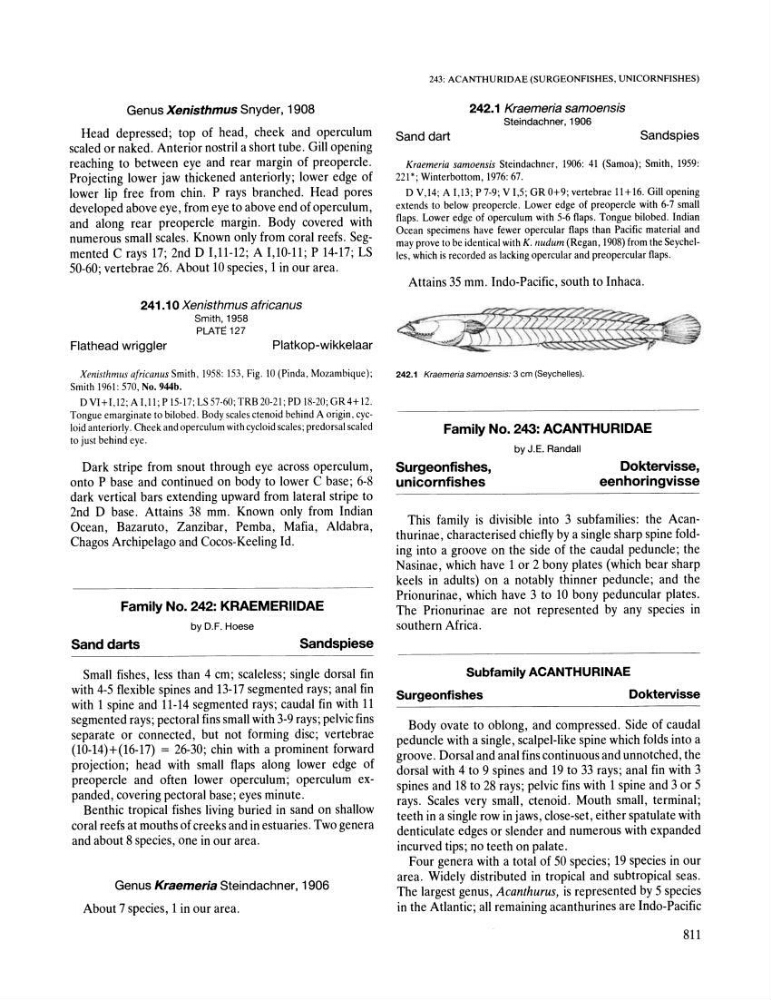
242.1 Kraemeria samoensis: 3 cm (Seychelles).
Family No. 243: ACANTHURIDAE
by J.E. Randall
Surgeonfishes,
unicornfishes
Doktervisse,
eenhoringvisse
This family is divisible into 3 subfamilies: the Acanthurinae, characterised chiefly by a single sharp spine folding into a groove on the side of the caudal peduncle; the
Nasinae , which have 1 or 2 bony plates (which bear sharp
keels in adults) on a notably thinner peduncle; and the
Prionurinae, which have 3 to 10 bony peduncular plates.
The Prionurinae are not represented by any species in
southern Africa.
Subfamily ACANTHURINAE
Surgeonfishes
Doktervisse
Body ovate to oblong, and compressed. Side of caudal
peduncle with a single, scalpel-like spine which folds into a
groove. Dorsal and anal fins continuous and unnotched, the
dorsal with 4 to 9 spines and 19 to 33 rays; anal fin with 3
spines and 18 to 28 rays; pelvic fins with 1 spine and 3 or 5
rays. Scales very small, ctenoid. Mouth small, terminal;
teeth in a single row in jaws, close-set, either spatulate with
denticulate edges or slender and numerous with expanded
incurved tips; no teeth on palate.
Four genera with a total of 50 species; 19 species in our
area. Widely distributed in tropical and subtropical seas.
The largest genus, Acanthurus, is represented by 5 species
in the Atlantic; all remaining acanthurines are Indo-Pacific
811