

7: ORECfOLOBIDAE (CARPET SHARKS)
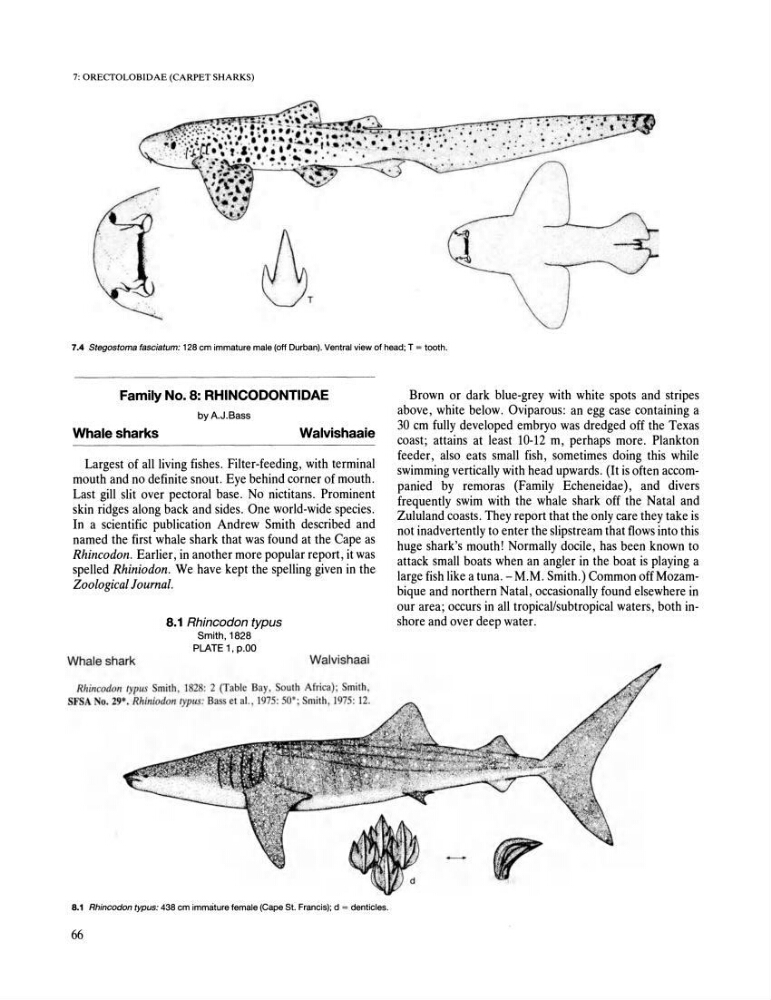
7.4 Stegostoma faseiatum: 128 em immature male (off Durban). Ventral view of head; T = tooth.
Family No.8: RHINCODONTIDAE
by A.J.Bass
Whale sharks
Walvishaaie
Largest of all living fishes. Filter-feeding, with terminal
mouth and no definite snout. Eye behind corner of mouth.
Last gill slit over pectoral base. No nictitans .. Promin.ent
skin ridges along back and sides. One world-wide species.
In a scientific publication Andrew Smith described and
named the first whale shark that was found at the Cape as
Rhincodon. Earlier, in another more popular report, it was
spelled Rhiniodon. We have kept the spelling given in the
Zoological Journal.
Whale shark
8.1 Rhincodon typus
Smith,1828
PLATE 1, p.OO
Walvishaai
Rhincodon Iypus Smith , 1828: 2 (Table Bay, South Africa) ; Smith ,
SFSA No. 29*. Rhiniodon typus: Bass et aI. , 1975: 50*; Smith , 1975: 12.
8.1 Rhineodon typus: 438 em immature female (Cape 51. Francis); d = denticles.
66
Brown or dark blue-grey with white spots and stripes
above, white below. Oviparous: an egg case containing a
30 cm fully developed embryo was dredged off the Texas
coast; attains at least 10-12 m, perhaps more. Plankton
feeder, also eats small fish, sometimes doing this while
swimming vertically with head upwards. (It is often accompanied by remoras (Family Echeneidae), and divers
frequently swim with the whale shark off the Natal and
Zululand coasts. They report that the only care they take is
not inadvertently to enter the slipstream that flows into this
huge shark's mouth! Normally docile, has been known to
attack small boats when an angler in the boat is playing a
large fish like a tuna. - M.M. Smith.) Common offMoza~bique and northern Natal, occasionally found elsewhere 10
our area; occurs in all tropical/subtropical waters, both inshore and over deep water.
7.4 Stegostoma faseiatum: 128 em immature male (off Durban). Ventral view of head; T = tooth.
Family No.8: RHINCODONTIDAE
by A.J.Bass
Whale sharks
Walvishaaie
Largest of all living fishes. Filter-feeding, with terminal
mouth and no definite snout. Eye behind corner of mouth.
Last gill slit over pectoral base. No nictitans .. Promin.ent
skin ridges along back and sides. One world-wide species.
In a scientific publication Andrew Smith described and
named the first whale shark that was found at the Cape as
Rhincodon. Earlier, in another more popular report, it was
spelled Rhiniodon. We have kept the spelling given in the
Zoological Journal.
Whale shark
8.1 Rhincodon typus
Smith,1828
PLATE 1, p.OO
Walvishaai
Rhincodon Iypus Smith , 1828: 2 (Table Bay, South Africa) ; Smith ,
SFSA No. 29*. Rhiniodon typus: Bass et aI. , 1975: 50*; Smith , 1975: 12.
8.1 Rhineodon typus: 438 em immature female (Cape 51. Francis); d = denticles.
66
Brown or dark blue-grey with white spots and stripes
above, white below. Oviparous: an egg case containing a
30 cm fully developed embryo was dredged off the Texas
coast; attains at least 10-12 m, perhaps more. Plankton
feeder, also eats small fish, sometimes doing this while
swimming vertically with head upwards. (It is often accompanied by remoras (Family Echeneidae), and divers
frequently swim with the whale shark off the Natal and
Zululand coasts. They report that the only care they take is
not inadvertently to enter the slipstream that flows into this
huge shark's mouth! Normally docile, has been known to
attack small boats when an angler in the boat is playing a
large fish like a tuna. - M.M. Smith.) Common offMoza~bique and northern Natal, occasionally found elsewhere 10
our area; occurs in all tropical/subtropical waters, both inshore and over deep water.