

240: GOBIIDAE (GOBlES)
Body yellowish , with 3-4 longitudinal rows of white spots;
2 thin brown longitudinal lines dorsally; midside with about
8 rectangular black longitudinal spots; 7-8 enlarged black
spots in a horizontal line ventrally; D and C with black
spots; D, often with yellow in life. Indo-West Pacific, not
yet known from our area, but occurs in Mozambique.
Pearl goby
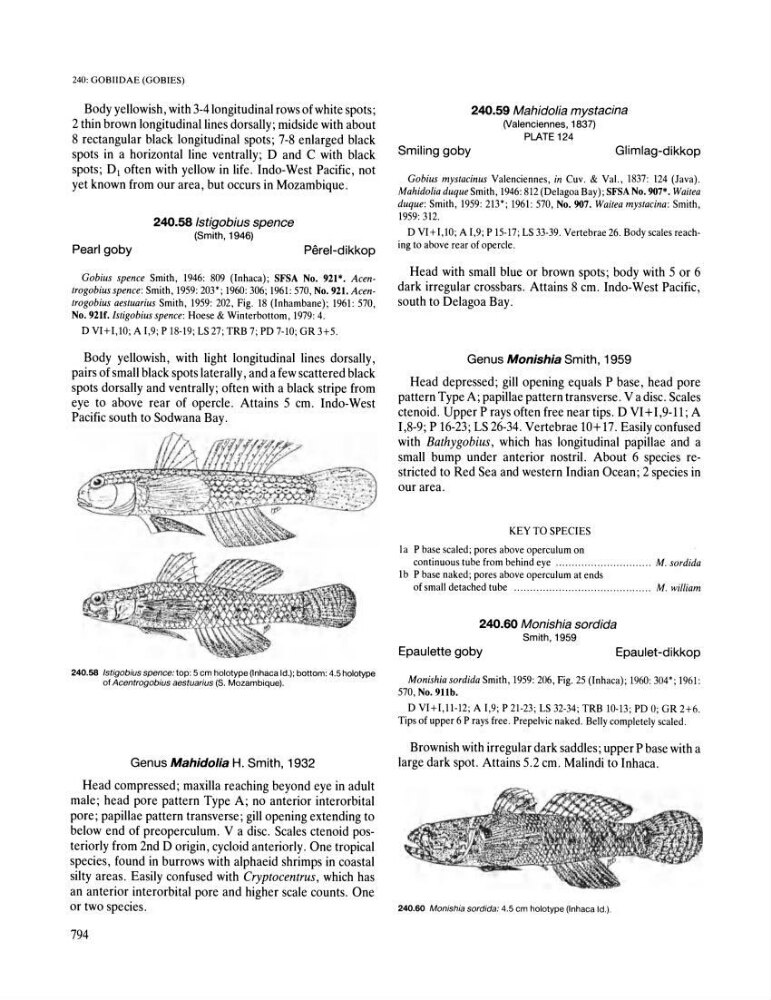
240.58 Istigobius spence
(Smith,1946)
Perel-dikkop
Gobius spence Smith , 1946: 809 (Inhaca); SFSA No. 921*. Acentrogobius spence: Smith, 1959: 203* ; 1960: 306; 1961 : 570, No. 921. Acentrogobius aestuarius Smith, 1959: 202, Fig. 18 (Inhambane); 1961: 570,
No. 921£. /stigobius spence: Haese & Winterbottom, 1979: 4.
D VI+I,10; A 1,9; P 18-19; LS 27; TRB 7; PD 7-10; GR 3+5.
Body yellowish, with light longitudinal lines dorsally,
pairs of small black spots laterally, and a few scattered black
spots dorsally and ventrally; often with a black stripe from
eye to above rear of opercle. Attains 5 cm. Indo-West
Pacific south to Sodwana Bay.
240.58 Istigobius spence: top: 5 em holotype (Inhaea Id.); bottom: 4.5 holotype
of Acentrogobius aestuarius (S. Mozambique).
Genus Mahidolia H. Smith, 1932
Head compressed ; maxilla reaching beyond eye in adult
male; head pore pattern Type A; no anterior interorbital
pore; papillae pattern transverse; gill opening extending to
below end of preoperculum. Va disc. Scales ctenoid posteriorly from 2nd D origin, cycloid anteriorly. One tropical
species, found in burrows with alphaeid shrimps in coastal
silty areas. Easily confused with Cryptocentrus, which has
an anterior interorbital pore and higher scale counts. One
or two species.
794
Smiling goby
240.59 Mahidolia mystacina
(Valenciennes, 1837)
PLATE 124
Glimlag-dikkop
Gobius mystacinus Valenciennes, in Cuv. & Val., 1837: 124 (Java).
Mahidolia duque Smith, 1946: 812 (Delagoa Bay); SFSA No. 907*. Wailea
duque: Smith, 1959: 213*; 1961: 570, No. 907. Waitea mystacina : Smith ,
1959: 312.
D VI+ 1,10; A 1,9; P 15-17; LS 33-39. Vertebrae 26. Body scales reaching to above rear of operc1e.
Head with small blue or brown spots; body with 5 or 6
dark irregular crossbars. Attains 8 cm. Indo-West Pacific,
south to Delagoa Bay.
Genus Monishia Smith, 1959
Head depressed; gill opening equals P base, head pore
pattern Type A; papillae pattern transverse. V a disc. Scales
ctenoid. Upper P rays often free near tips. D VI + 1,9-11; A
1,8-9; P 16-23; LS 26-34. Vertebrae 10+ 17. Easily confused
with Bathygobius, which has longitudinal papillae and a
small bump under anterior nostril. About 6 species restricted to Red Sea and western Indian Ocean; 2 species in
our area.
KEY TO SPECIES
I a P base scaled ; pores above operculum on
continuous tube from behind eye .. ......... .. .. .. ..... .. ...... M. sordida
I b P base naked ; pores above operculum at ends
of small detached tube .... ....... .. .. .. ... .......... .. ... .. .. .. .. M. william
240.60 Monishia sordida
Smith,1959
Epaulette goby
Epaulet-dikkop
Monishia sordida Smith, 1959: 206, Fig. 25 (Inhaca) ; 1960: 304*; 1961:
570, No. 911b.
D VI+I,1l-12; A 1,9; P 21-23; LS 32-34; TRB 10-13; PD 0; GR 2+6.
Tips of upper 6 P rays free. Prepelvic naked. Belly completely scaled .
Brownish with irregular dark saddles; upper P base with a
large dark spot. Attains 5.2 cm. Malindi to Inhaca.
240.60 Monishia sordida: 4.5 em holotype (Inhaea Id.).