

240.39 Fusigobius duospi/us
Hoese & Reader, 1985
Barenape goby
Kaalhoof-dikkop
Fusigobius neophytus africanus Smith, 1959: 208 (in part, Pinda and
Aldabra). Fusigobius duospilus Hoese & Reader, 1985: 2, Figs. 1 & 2
(Escape Reef, Queensland, Australia).
D VI+I,9; A 1,8; P 18-20; LS 23-25; TRB 7-8; GR 1 +(5-6). Lower Yz of
1st gill arch joined to gill cover; V partly connected, membrane often torn;
frenum rudimentary. Two lateral canal pores over preopercle and a tube
over opercle.
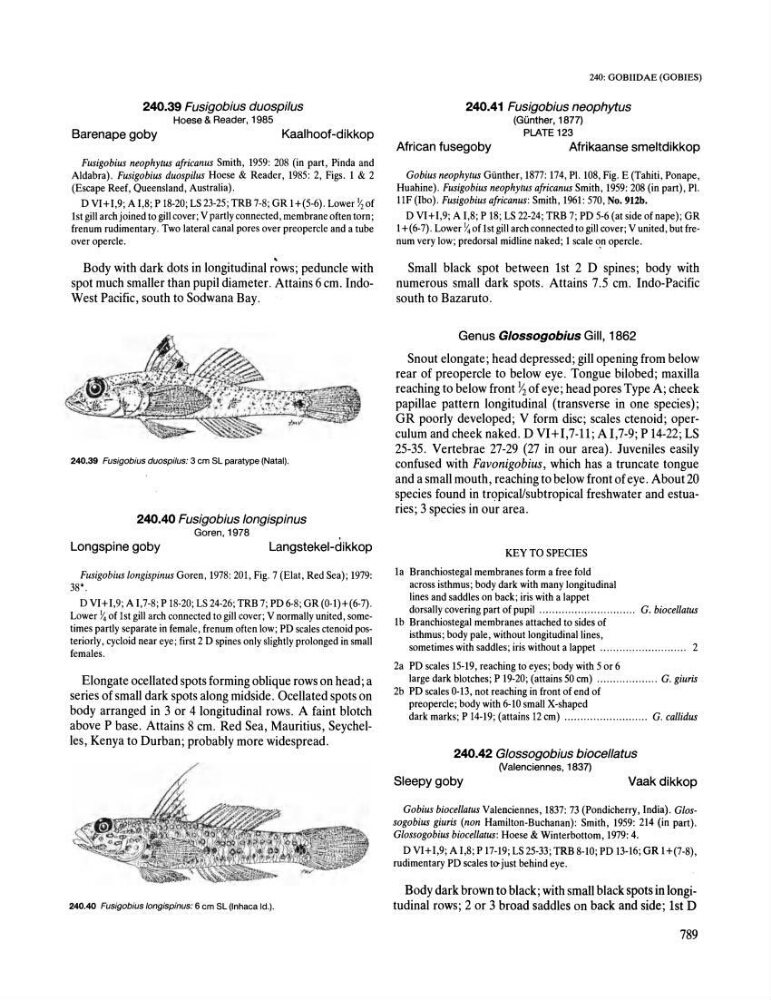
Body with dark dots in longitudinal r~ws; peduncle with
spot much smaller than pupil diameter. Attains 6 cm. IndoWest Pacific, south to Sodwana Bay.
240.39 Fusigobius duospilus: 3 em SL paratype (Natal).
240.40 Fusigobius /ongispinus
Goren, 1978
Longspine goby
Langstekel-dikkop
Fusigobius longispinus Goren, 1978: 201, Fig. 7 (Elat, Red Sea); 1979:
38*.
D VI +1,9; A 1,7-8; P 18-20; LS 24-26; TRB 7; PD 6-8; GR (0-1)+(6-7).
Lower X. of 1st gill arch connected to gill cover; V normally united, sometimes partly separate in female, frenum often low; PD scales ctenoid posteriorly, cycloid near eye; first 2 D spines only slightly prolonged in small
females.
Elongate ocellated spots forming oblique rows on head; a
series of small dark spots along midside. Ocellated spots on
body arranged in 3 or 4 longitudinal rows. A faint blotch
above P base. Attains 8 cm. Red Sea, Mauritius, Seychelles, Kenya to Durban; probably more widespread.
240.40 Fusigobius longispinus: 6 em SL (Inhaea Id.).
240: GOBIIDAE (GOBlES)
240.41 Fusigobius neophytus
(Gunther, 1877)
PLATE 123
African fusegoby
Afrikaanse smeltdikkop
Gobius neophytus Giinther, 1877: 174, PI. 108, Fig. E (Tahiti, Ponape,
Huahine). Fusigobius neophytus africanus Smith, 1959: 208 (in part), PI.
llF (Ibo). Fusigobius africanus: Smith, 1961: 570, No. 912b.
D VI+I,9; A 1,8; P 18; LS 22-24; TRB 7; PD 5-6 (at side of nape); GR
1 +(6-7). Lower X. of 1st gill arch connected to gill cover; V united, but frenum very low; pre dorsal midline naked; 1 scale ~n opercle.
Small black spot between 1st 2 D spines; body with
numerous small dark spots. Attains 7.5 cm. Indo-Pacific
south to Bazaruto.
Genus Glossogobius Gill. 1862
Snout elongate; head depressed; gill opening from below
rear of preopercle to below eye. Tongue bilobed; maxilla
reaching to below front ~ of eye; head pores Type A; cheek
papillae pattern longitudinal (transverse in one species);
GR poorly developed; V form disc; scales ctenoid; operculum and cheek naked. D VI+I,7-11; A 1,7-9; P 14-22; LS
25-35. Vertebrae 27-29 (27 in our area). Juveniles easily
confused with Favonigobius, which has a truncate tongue
and a small mouth, reaching to below front of eye. About 20
species found in tropicaUsubtropical freshwater and estuaries; 3 species in our area.
KEY TO SPECIES
la Branchiostegal membranes form a free fold
across isthmus; body dark with many longitudinal
lines and saddles on back; iris with a lappet
dorsally covering part of pupil .............................. G. biocellatus
Ib Branchiostegal membranes attached to sides of
isthmus; body pale, without longitudinal lines,
sometimes with saddles; iris without a lappet .................... ....... 2
2a PD scales 15-19, reaching to eyes; body with 5 or 6
large dark blotches; P 19-20; (attains 50 cm) ................... G. giuris
2b PD scales 0-13, not reaching in front of end of
preopercle; body with 6-10 small X-shaped
dark marks; P 14-19; (attains 12 cm) ............. ............. G. callidus
240.42 G/ossogobius biocel/atus
(Valenciennes, 1837)
Sleepygoby
Vaakdikkop
Gobius biocellatus Valenciennes, 1837: 73 (Pondicherry, India). Glossogobius giuris (non Hamilton-Buchanan): Smith, 1959: 214 (in part).
Glossogobius biocellatus: Hoese & Winterbottom, 1979: 4.
D VI +1,9; A 1,8; P 17-19; LS 25-33; TRB 8-10; PD 13-16; GR 1+(7-8),
rudimentary PD scales t~just behind eye.
Body dark brown to black; with small black spots in longitudinal rows; 2 or 3 broad saddles on back and side; 1st D
789