

240: GOBIIDAE (GOBlES)
D VI + 1,9-10; A 1,8; P 15-18; LS 23-25; TRB 6-8. Some P rays branched.
Two preopercular pores, pores around eye, none above end of preoperculum.
Five subcutaneous spots along A base to C base. Attains
2.5 cm. Recorded from Bazaruto northwards; widespread
in Indian Ocean and western tropical Pacific.
Genus Favonigobius Whitley, 1930
Gill opening extending to below mid-operculum; scales
ctenoid, none on opercle or preopercle; V a disc; head
pores Type A; papillae pattern longitudinal (multiple longitudinal in our species); tongue truncate. D VI+I,7-1O; A
1,7-10; P 14-18; LS 24-31. Vertebrae 26. Easily confused
with Silhouettea, which has A 1,13 and a broader gill opening; also similar to Fusigobius. About 10 species, found in
sandy areas around mangroves and coral reefs; 2 species in
our area.
KEY TO SPECIES
la Body scales to above mid-opercle; prepelvic
completely scaled in 6-8 rows; branchiostegal
membranes pale, meeting on isthmus below edge
of eye ..... .... ................ ...... .......... ........... ............... F. reichei
Ib Body scales to above end of opercle; prepelvic
usually with a naked area anteriorly, scales in
4-6 rows; branchiostegal membranes meet on
isthmus below rear of preopercle; membranes
black or dusky anteriorly at sides of isthmus
in adult ........................... .......... ............... F. melanobranchus
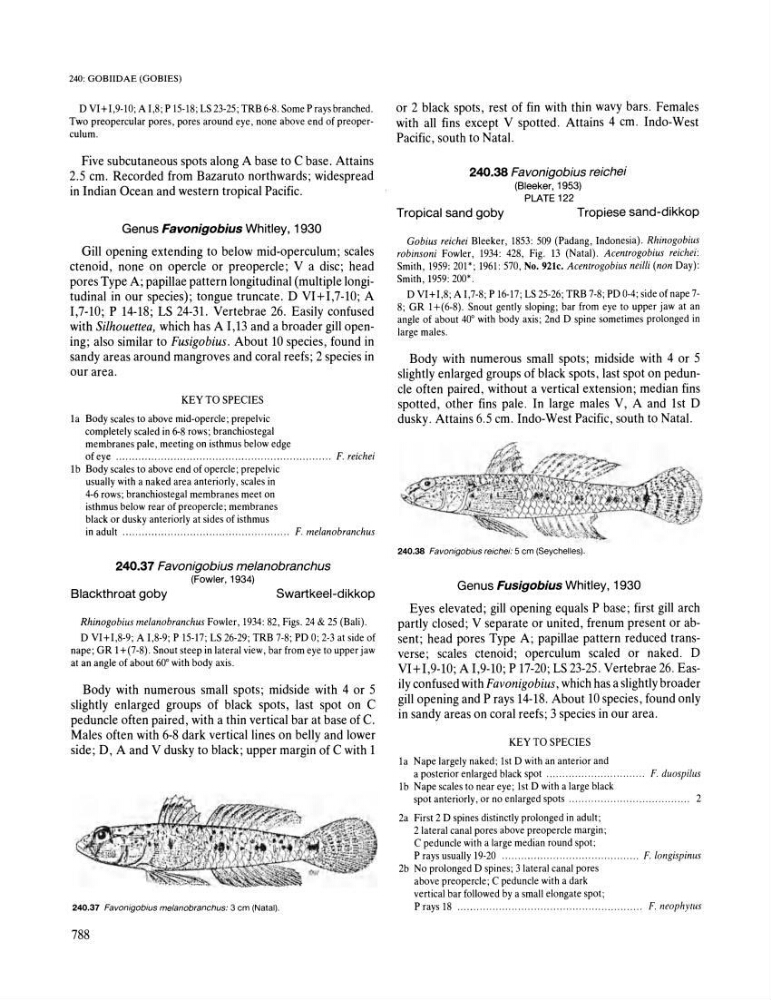
240.37 Favonigobius melanobranchus
(Fowler, 1934)
Blackthroat goby
Swartkeel-dikkop
Rhinogobius melanobranchus Fowler, 1934: 82, Figs. 24 & 25 (Bali).
D VI+I,8-9; A 1,8-9; P 15-17; LS 26-29; TRB 7-8; PD 0; 2-3 at side of
nape; GR 1 +(7-8). Snout steep in lateral view, bar from eye to upper jaw
at an angle of about 60° with body axis.
Body with numerous small spots; midside with 4 or 5
slightly enlarged groups of black spots, last spot on C
peduncle often paired, with a thin vertical bar at base of C.
Males often with 6-8 dark vertical lines on belly and lower
side; D, A and V dusky to black; upper margin of C with 1
240.37 Favonigobius melanobranehus: 3 em (Natal).
788
or 2 black spots, rest of fin with thin wavy bars. Females
with all fins except V spotted. Attains 4 cm. Indo-West
Pacific, south to Natal.
240.38 Favonigobius reichei
(Bleeker, 1953)
PLATE 122
Tropical sand goby
Tropiese sand-dikkop
Gobius reichei Bleeker, 1853: 509 (Padang, Indonesia). Rhinogobius
robinsoni Fowler, 1934: 428 , Fig. 13 (Natal). Acentrogobius reichei:
Smith, 1959: 201 *; 1961: 570 , No. 921c. Acentrogobius neilli (non Day):
Smith, 1959: 200*.
D VI+ 1,8; A 1,7-8; P 16-17; LS 25-26; TRB 7-8; PD 0-4; side of nape 78; GR 1 +(6-8). Snout gently sloping; bar from eye to upper jaw at an
angle of about 40° with body axis; 2nd D spine sometimes prolonged in
large males.
Body with numerous small spots; midside with 4 or 5
slightly enlarged groups of black spots, last spot on peduncle often paired, without a vertical extension; median fins
spotted, other fins pale. In large males V, A and 1st D
dusky. Attains 6.5 cm. Indo-West Pacific, south to Natal.
240.38 Favonigobius reiehei: 5 cm (Seychelles).
Genus Fusigobius Whitley, 1930
Eyes elevated; gill opening equals P base; first gill arch
partly closed; V separate or united, frenum present or absent; head pores Type A; papillae pattern reduced transverse; scales ctenoid; operculum scaled or naked. D
VI +1,9-10; A 1,9-10; P 17-20; LS 23-25. Vertebrae 26. Easily confused with Favonigobius, which has a slightly broader
gill opening and Prays 14-18. About 10 species, found only
in sandy areas on coral reefs; 3 species in our area.
KEY TO SPECIES
la Nape largely naked ; 1st D with an anterior and
a posterior enlarged black spot ............................... F. duospilus
Ib Nape scales to near eye; 1st D with a large black
spot anteriorly, or no enlarged spots.................. ...... .... .... ..... 2
2a First 2 D spines distinctly prolonged in adult;
2 lateral canal pores above preopercle margin ;
C peduncle with a large median round spot:
P rays usually 19-20 .......................................... F. longispinus
2b No prolonged D spines ; 3 lateral canal pores
above preopercle; C peduncle with a dark
vertical bar followed by a small elongate spot ;
Prays 18 ................................................. ........ F. neophylUs