

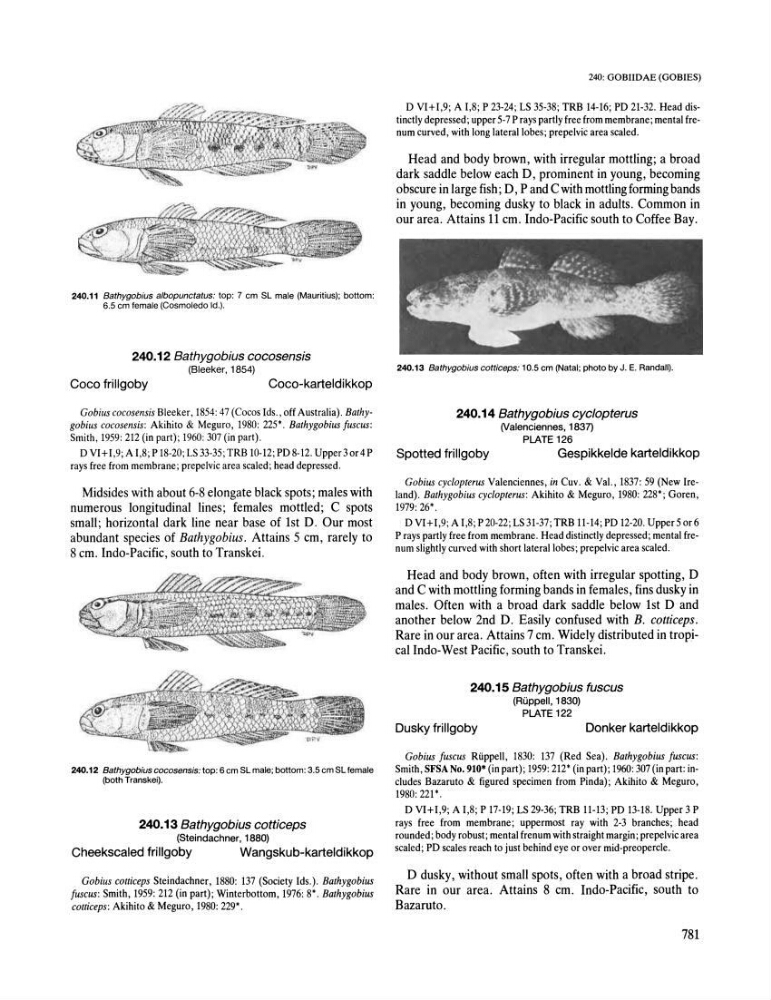
240.11 8athygobius albopunctatus: top: 7 em SL male (Mauritius); bottom:
6.5 em female (Cosmoledo Id.).
240.12 8athygobius cocosensis
(Bleeker, 1854)
Coco frillgoby
Coco-karteldikkop
Gobius cocosensis Bleeker, 1854: 47 (Cocos Ids., off Australia). Bathygobius cocosensis: Akihito & Meguro, 1980: 225*. Bathygobius fuscus:
Smith, 1959: 212 (in part); 1960: 307 (in part).
o VI+ 1,9; A 1,8; P 18-20; LS 33-35; TRB 10-12; PO 8-12. Upper30r4P
rays free from membrane; prepelvic area scaled; head depressed.
Midsides with about 6-8 elongate black spots; males with
numerous longitudinal lines; females mottled; C spots
small; horizontal dark line near base of 1st D. Our most
abundant species of Bathygobius. Attains 5 cm, rarely to
8 cm. Indo-Pacific, south to Transkei.
240.12 8athygobius cocosensis: top: 6 em SL male; bottom: 3.5 em SL female
(both Transkei).
240.13 8athygobius cotticeps
(Steindachner, 1880)
Cheekscaled frillgoby
Wangskub-karteldikkop
GoNus cotticeps Steindachner, 1880: 137 (Society Ids.). Bathygobius
fuscus: Smith, 1959: 212 (in part); Winterbottom, 1976: 8*. Bathygobius
cotticeps: Akihito & Meguro, 1980: 229*.
240: GOBIIDAE (GOBlES)
o VI +1,9; A 1,8; P 23-24; LS 35-38; TRB 14-16; PO 21-32. Head distinctly depressed; upper 5-7 P rays partly free from membrane; mental frenum curved, with long lateral lobes; prepelvic area scaled.
Head and body brown, with irregular mottling; a broad
dark saddle below each D, prominent in young, becoming
obscure in large fish; D, P and C with mottling forming bands
in young, becoming dusky to black in adults. Common in
our area. Attains 11 cm. Indo-Pacific south to Coffee Bay.
240.13 8athygobius cotticeps: 10.5 em (Natal; photo by J. E. Randall).
240.14 8athygobius cyclopterus
(Valenciennes, 1837)
PLATE 126
Spotted frillgoby
Gespikkelde karteldikkop
Gobius cyclopterus Valenciennes, in Cuv. & Val., 1837: 59 (New Ireland). Bathygobius cyclopterus: Akihito & Meguro, 1980: 228*; Goren,
1979: 26*.
o VI+ 1,9; A 1,8; P 20-22; LS 31-37; TRB 11-14; PD 12-20. Upper 5 or6
P rays partly free from membrane. Head distinctly depressed; mental frenum slightly curved with short lateral lobes; prepelvic area scaled.
Head and body brown, often with irregular spotting, D
and C with mottling forming bands in females, fins dusky in
males. Often with a broad dark saddle below 1st D and
another below 2nd D. Easily confused with B. cotticeps.
Rare in our area. Attains 7 cm. Widely distributed in tropical Indo-West Pacific, south to Transkei.
240.15 8athygobius fuscus
(Ruppel/,1830)
PLATE 122
Dusky frillgoby
Donker karteldikkop
Gobius fuscus Riippell, 1830: 137 (Red Sea). Bathygobius fuscus:
Smith, SFSA No. 910* (in part); 1959: 212* (in part); 1960: 307 (in part: includes Bazaruto & figured specimen from Pinda); Akihito & Meguro,
1980: 221*.
o VI+I,9; A 1,8; P 17-19; LS 29-36; TRB 11-13; PO 13-18. Upper 3 P
rays free from membrane; uppermost ray with 2-3 branches; head
rounded; body robust; mental frenum with straight margin; prepelvic area
scaled; PO scales reach to just behind eye or over mid-preopercle.
D dusky, without small spots, often with a broad stripe.
Rare in our area. Attains 8 cm. Indo-Pacific, south to
Bazaruto.
781