

240: GOBIIDAE (GOBlES)
Greenish with irregular blotches along midside and back .
Attains 26 cm. Estuaries and freshwaters from Algoa Bay to
Zambezi, possibly more widespread.
Genus Barbuligobius Lachner & McKinney, 1974
Head depressed; numerous elongate barbels on snout,
chin and sides of head; interorbital narrow; V a disc, frenum
reduced. Head pores Type A; anterior interorbital pore
absent; head papillae reduced and obscure. Gill opening
equals P base. One species.
240.10 Barbuligobius boehlkei
Lachner & McKinney, 1974
Bearded goby
Baard-dikkop
Barbuligobius boehlkei Lachner & McKinney, 1974: 871, Figs. 1-4
(Taiwan); Hoese & Winterbottom, 1979: 4.
D VI + 1,8-9; A 1,8-9; P 19-21; LS 23-25 ; TRB 9-10; PD O. Vertebrae 26.
Body scales ctenoid, none on head or breast.
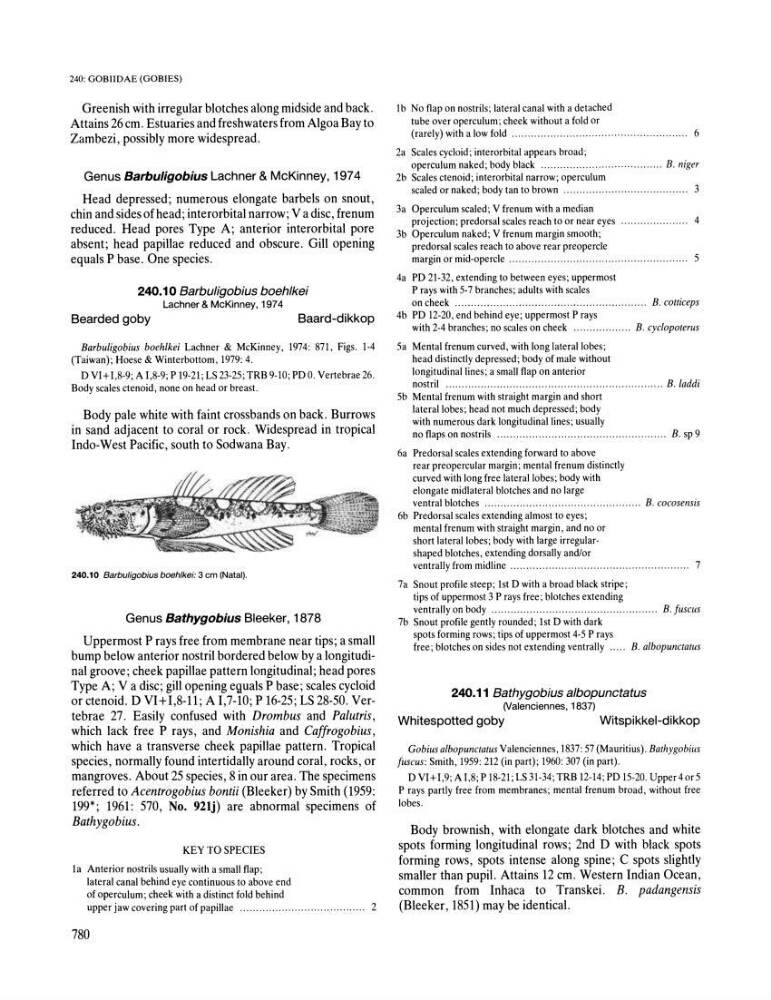
Body pale white with faint crossbands on back. Burrows
in sand adjacent to coral or rock. Widespread in tropical
Indo-West Pacific, south to Sodwana Bay.
240.10 8arbuligobius boehlkei: 3 em (Natal).
Genus Bathygobius Bleeker, 1878
Uppermost P rays free from membrane near tips; a small
bump below anterior nostril bordered below by a longitudinal groove; cheek papillae pattern longitudinal; head pores
Type A; V a disc; gill opening eguals P base; scales cycloid
or ctenoid. 0 VI + 1,8-11; A 1,7-10; P 16-25; LS 28-50. Vertebrae 27. Easily confused with Drombus and Palutris,
which lack free P rays, and Monishia and Caffrogobius,
which have a transverse cheek papillae pattern. Tropical
species, normally found intertidally around coral, rocks, or
mangroves. About 25 species, 8 in our area. The specimens
referred to Acentrogobius bontii (Bleeker) by Smith (1959:
199*; 1961: 570, No. 921j) are abnormal specimens of
Bathygobius.
KEY TO SPECIES
la Anterior nostrils usually with a small flap;
lateral canal behind eye continuous to above end
of operculum; cheek with a distinct fold behind
upper jaw covering part of papillae ...... ........ .. ...... ... .. ... ......... 2
780
1 b No flap on nostrils; lateral canal with a detached
tube over operculum; cheek without a fold or
(rarely) with a low fold ................................. .... ....... .... ...... 6
2a Scales cycloid; interorbital appears broad;
operculum naked ; body black ..... ..................... .. .......... B. niger
2b Scales ctenoid; interorbital narrow; operculum
scaled or naked; body tan to brown ...... ... .... .................. ... ..... 3
3a Operculum scaled; V frenum with a median
projection; predorsal scales reach to or near eyes ........ .... .... ..... 4
3b Operculum naked; V frenum margin smooth;
predorsal scales reach to above rear preopercle
margin or mid-opercle ................................................ ........ 5
4a PD 21-32, extending to between eyes; uppermost
P rays with 5-7 branches; adults with scales
on cheek .... ........ .... .......... .. .. ..... ..... ......... ... ........ B. colliceps
4b PD 12-20, end behind eye; uppermost Prays
with 2-4 branches; no scales on cheek .................. B. cyclopoterus
Sa Mental frenum curved, with long lateral lobes;
head distinctly depressed; body of male without
longitudinal lines; a small flap on anterior
nostril .................................................................... B.laddi
Sb Mental frenum with straight margin and short
lateral lobes; head not much depressed; body
with numerous dark longitudinal lines; usually
no flaps on nostrils ... ... .. .... ... .. ... ... ....... ............. ........ .. B. sp 9
6a Predorsal scales extending forward to above
rear preopercular margin; mental frenum distinctly
curved with long free lateral lobes; body with
elongate midlateral blotches and no large
ventral blotches ..... .................. .... ......... .. ........... B. cocosensis
6b Pre dorsal scales extending almost to eyes;
mental frenum with straight margin, and no or
short lateral lobes; body with large irregularshaped blotches , extending dorsally and/or
ventrally from midline....................................... .... ..... ..... ... 7
7a Snout profile steep; 1st D with a broad black stripe;
tips of uppermost 3 P rays free; blotches extending
ventrally on body .. ....... ... ..... ....... ...... ............ .......... B. Juscus
7b Snout profile gently rounded; 1st D with dark
spots forming rows; tips of uppermost 4-5 Prays
free; blotches on sides not extending ventrally ..... B. albopunctatus
240.11 Bathygobius albopunctatus
(Valenciennes, 1837)
Whitespotted goby
Witspikkel-dikkop
Gobius albopunctatus Valenciennes, 1837: 57 (Mauritius). Bathygobius
Juscus: Smith, 1959: 212 (in part); 1960: 307 (in part).
D VI+I ,9; A 1,8; P 18-21 ; LS 31-34; TRB 12-14; PD 15-20. Upper 4 or 5
P rays partly free from membranes; mental frenum broad , without free
lobes.
Body brownish, with elongate dark blotches and white
spots forming longitudinal rows; 2nd 0 with black spots
forming rows, spots intense along spine; C spots slightly
smaller than pupil. Attains 12 cm. Western Indian Ocean,
common from Inhaca to Transkei . B. padangensis
(Bleeker, 1851) may be identical.