

isthmus, forming a fold with a free posterior margin.
Mental frenum: on chin a V-shaped, truncate or curved
fold with a free posterior margin; often collapses in poorly
preserved material.
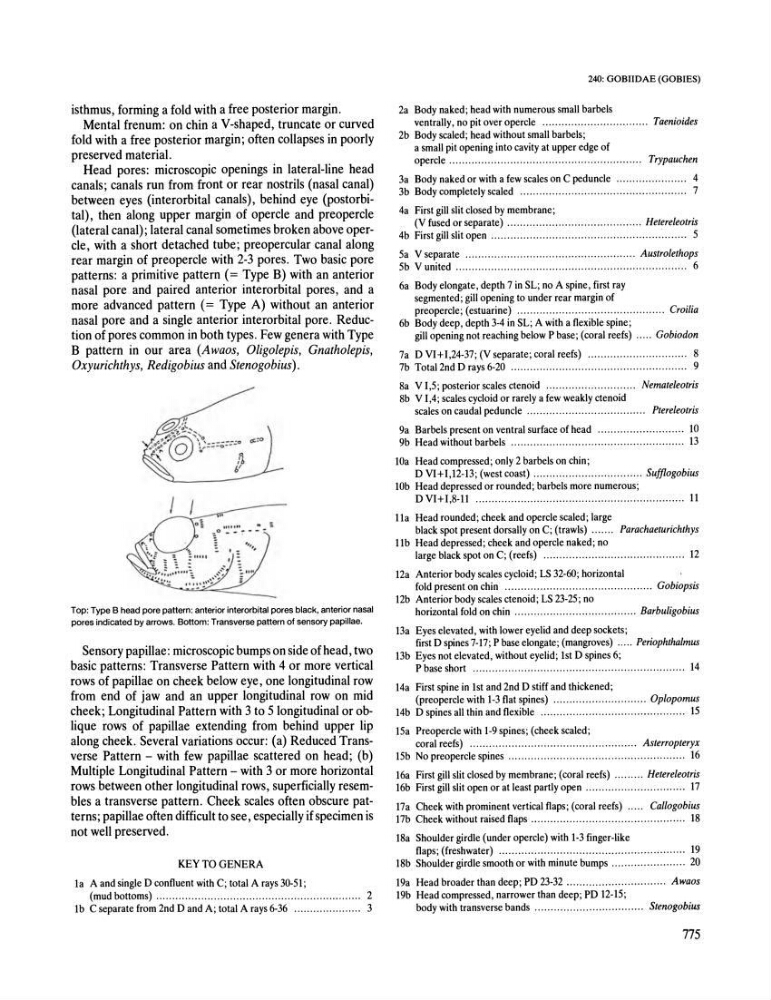
Head pores: microscopic openings in lateral-line head
canals; canals run from front or rear nostrils (nasal canal)
between eyes (interorbital canals), behind eye (postorbital), then along upper margin of operde and preoperde
(lateral canal); lateral canal sometimes broken above operde, with a short detached tube; preopercular canal along
rear margin of preoperde with 2-3 pores. Two basic pore
patterns: a primitive pattern (= Type B) with an anterior
nasal pore and paired anterior interorbital pores, and a
more advanced pattern (= Type A) without an anterior
nasal pore and a single anterior interorbital pore. Reduction of pores common in both types. Few genera with Type
B pattern in our area (Awaos, Oligolepis, Gnatholepis,
Oxyurichthys, Redigobius and Stenogobius).
Top: Type B head pore pattern: anterior interorbital pores black, anterior nasal
pores indicated by arrows. Bottom: Transverse pattern of sensory papillae.
Sensory papillae: microscopic bumps on side of head, two
basic patterns: Transverse Pattern with 4 or more vertical
rows of papillae on cheek below eye, one longitudinal row
from end of jaw and an upper longitudinal row on mid
cheek; Longitudinal Pattern with 3 to 5 longitudinal or oblique rows of papillae extending from behind upper lip
along cheek. Several variations occur: (a) Reduced Transverse Pattern - with few papillae scattered on head; (b)
Multiple Longitudinal Pattern - with 3 or more horizontal
rows between other longitudinal rows, superficially resembles a transverse pattern. Cheek scales often obscure patterns; papillae often difficult to see, especially if specimen is
not well preserved.
KEY TO GENERA
la A and single D confluent with C; total A rays 30-51;
(mud bottoms) ................................................................ 2
Ib C separate from 2nd D and A; total A rays 6-36 ...... ............... 3
240: GOBIIDAE (GOBlES)
2a Body naked; head with numerous small barbels
ventrally, no pit over opercle ................................. Taenioides
2b Body scaled; head without small barbels;
a small pit opening into cavity at upper edge of
opercle ............................................................ Trypauchen
3a Body naked or with a few scales on C peduncle ...................... 4
3b Body completely scaled .................................................... 7
4a First gill slit closed by membrane;
(V fused or separate) .................. .. ...................... Hetereleotris
4b First gill slit open ........................... ......... ......... ................ 5
Sa V separate ..................................................... Austrolethops
5b V united ........................................................................ 6
6a Body elongate, depth 7 in SL; no A spine, first ray
segmented; gill opening to under rear margin of
preopercle; (estuarine) .............................................. Croilia
6b Body deep, depth 3-4 in SL; A with a flexible spine;
gill opening not reaching below P base; (coral reefs) ..... Gobiodon
7a D VI+ 1,24-37; (V separate; coral reefs) .. ............................. 8
7b Total 2nd Drays 6-20 ....................................................... 9
8a V 1,5; posterior scales ctenoid ............................ Nemateleotris
8b V 1,4; scales cycloid or rarely a few weakly ctenoid
scales on caudal peduncle ..................................... Ptereleotris
9a Barbels present on ventral surface of head .. ......................... 10
9b Head without barbels .. .. .. ...... .. ............ .... .......... .. ...... .. .... 13
lOa Head compressed; only 2 barbels on chin;
D VI+ 1,12-13 ; (west coast) .................................. Sufflogobius
lOb Head depressed or rounded; barbels more numerous;
D VI+I,8-11 .................................................. ........ ....... 11
lla Head rounded; cheek and opercle scaled; large
black spot present dorsally on C; (trawls) ....... Parachaeturichthys
lIb Head depressed; cheek and opercle naked; no
large black spot on C; (reefs) ........................................ .. .. 12
12a Anterior body scales cycloid; LS 32-60; horizontal
fold present on chin .... .. ...... .. .. .... .... .. .. . ..... .. .. .. .. .... Gobiopsis
12b Anterior body scales ctenoid; LS 23-25; no
horizontal fold on chin ...................................... Barbuligobius
13a Eyes elevated, with lower eyelid and deep sockets;
first D spines 7-17; P base elongate; (mangroves) ..... Periophthalmus
13b Eyes not elevated, without eyelid; 1st D spines 6;
P base short .................................................................. 14
14a First spine in 1st and 2nd D stiff and thickened;
(preopercle with 1-3 flat spines) ............................. Oplopomus
14b D spines all thin and flexible .... .. .. .. .... .... ........ .. ................. 15
15a Preopercle with 1-9 spines; (cheek scaled;
coral reefs) .. .. ...... .. .... ...... .. ...... ...... .. .. .. .. ........ Asterropteryx
15b No preopercle spines .. .. .. ................................................. 16
16a First gill slit closed by membrane; (coral reefs) ......... Hetereleotris
16b First gill slit open or at least partly open ................ .. ............. 17
17a Cheek with prominent vertical flaps; (coral reefs) ..... Callogobius
17b Cheek without raised flaps ................................................ 18
18a Shoulder girdle (under opercle) with 1-3 finger-like
flaps; (freshwater) .......................................................... 19
18b Shoulder girdle smooth or with minute bumps ....................... 20
19a Head broader than deep; PD 23-32 ............................... Awaos
19b Head compressed, narrower than deep; PD 12-15;
body with transverse bands .................................. Stenogobius
775