

239: CALLIONYMIDAE (DRAGONETS)
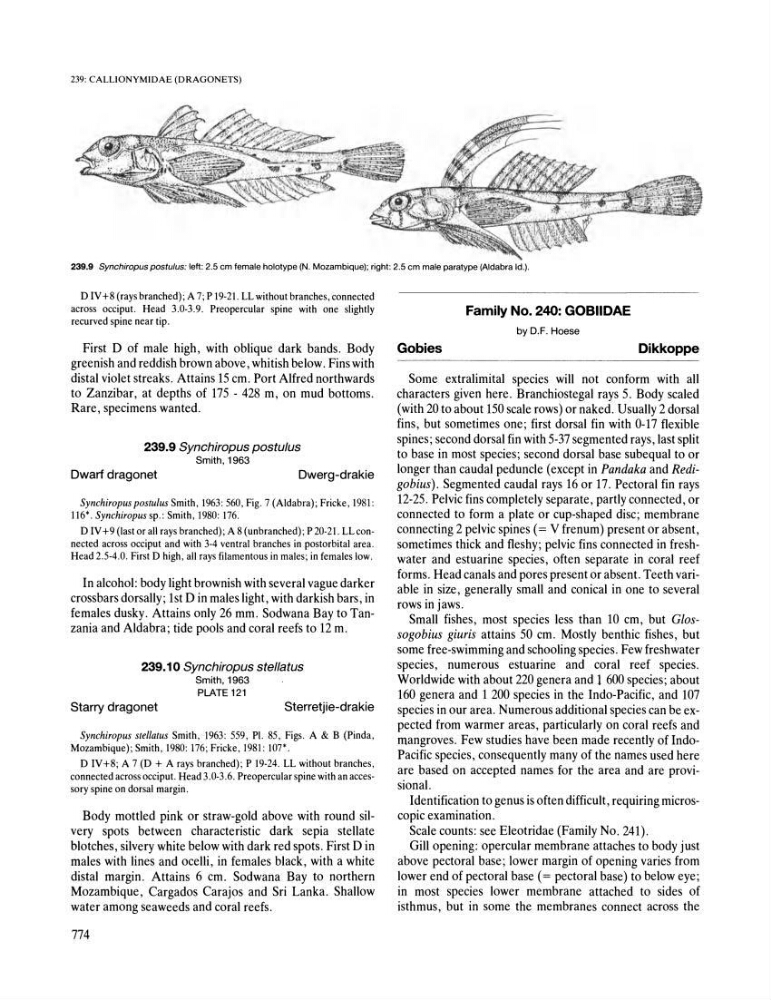
239.9 Synchiropus postulus: left: 2.5 em female holotype (N. Mozambique); right: 2.5 em male paratype (Aldabra Id.).
o IV +8 (rays branched); A 7; P 19-21. LL without branches, connected
across occiput. Head 3.0-3.9. Preopercular spine with one slightly
recurved spine near tip.
First D of male high, with oblique dark bands. Body
greenish and reddish brown above, whitish below. Fins with
distal violet streaks. Attains 15 cm. Port Alfred northwards
to Zanzibar, at depths of 175 - 428 m, on mud bottoms.
Rare, specimens wanted.
239.9 Synchiropus postulus
Smith, 1963
Dwarf dragonet
Dwerg-drakie
Synchiropus postulus Smith, 1963: 560, Fig. 7 (Aldabra); Fricke, 1981:
116*. Synchiropus sp.: Smith, 1980: 176.
o IV +9 (last or all rays branched); A 8 (unbranched); P 20-21. LL connected across occiput and with 3-4 ventral branches in postorbital area.
Head 2.5-4.0. First 0 high, all rays filamentous in males; in females low.
In alcohol: body light brownish with several vague darker
crossbars dorsally; 1st D in males light, with darkish bars, in
females dusky. Attains only 26 mm. Sodwana Bay to Tanzania and Aldabra; tide pools and coral reefs to 12 m.
239.10 Synchiropus stellatus
Smith, 1963
PLATE 121
Starry dragonet
Sterretjie-drakie
Synchiropus stellatus Smith, 1963: 559, PI. 85, Figs. A & B (Pinda,
Mozambique); Smith, 1980: 176; Fricke, 1981: 107*'
o IV+8; A 7 (0 + A rays branched); P 19-24. LL without branches,
connected across occiput. Head 3.0-3.6. Preopercular spine with an accessory spine on dorsal margin.
Body mottled pink or straw-gold above with round silvery spots between characteristic dark sepia stellate
blotches, silvery white below with dark red spots. First D in
males with lines and ocelli, in females black, with a white
distal margin. Attains 6 cm. Sodwana Bay to northern
Mozambique, Cargados Carajos and Sri Lanka. Shallow
water among seaweeds and coral reefs.
774
Family No. 240: GOBIIDAE
by D.F. Haese
Gobies
Dikkoppe
Some extralimital species will not conform with all
characters given here. Branchiostegal rays 5. Body scaled
(with 20 to about 150 scale rows) or naked. Usually 2 dorsal
fins, but sometimes one; first dorsal fin with 0-17 flexible
spines; second dorsal fin with 5-37 segmented rays, last split
to base in most species; second dorsal base subequal to or
longer than caudal peduncle (except in Pandaka and Redigobius). Segmented caudal rays 16 or 17. Pectoral fin rays
12-25. Pelvic fins completely separate, partly connected, or
connected to form a plate or cup-shaped disc; membrane
connecting 2 pelvic spines (= V frenum) present or absent,
sometimes thick and fleshy; pelvic fins connected in freshwater and estuarine species, often separate in coral reef
forms. Head canals and pores present or absent. Teeth variable in size, generally small and conical in one to several
rows in jaws.
Small fishes, most species less than 10 cm, but Glossogobius giuris attains 50 cm. Mostly benthic fishes, but
some free-swimming and schooling species. Few freshwater
species, numerous estuarine and coral reef species.
Worldwide with about 220 genera and 1 600 species; about
160 genera and 1 200 species in the Indo-Pacific, and 107
species in our area. Numerous additional species can be expected from warmer areas, particularly on coral reefs and
mangroves. Few studies have been made recently of IndoPacific species, consequently many of the names used here
are based on accepted names for the area and are provisional.
Identification to genus is often difficult, requiring microscopic examination.
Scale counts: see Eleotridae (Family No. 241).
Gill opening: opercular membrane attaches to body just
above pectoral base; lower margin of opening varies from
lower end of pectoral base (= pectoral base) to below eye;
in most species lower membrane attached to sides of
isthmus, but in some the membranes connect across the