

238: AMMODYTIDAE (SAND LANCES)
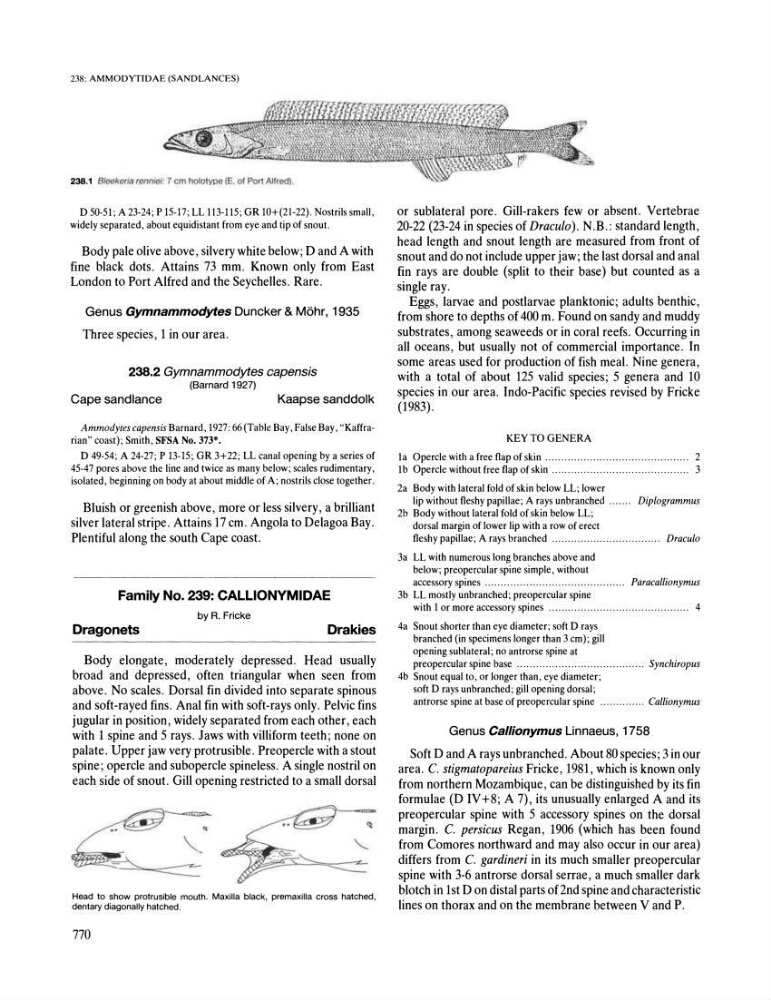
238.1 Bleekeria renniei: 7 cm hololype (E . of Port Alfred) .
D 50-51; A 23-24; P 15-17; LL 113-115; GR 10+(21-22). Nostrils small,
widely separated, about equidistant from eye and tip of snout.
Body pale olive above, silvery white below; D and A with
fine black dots. Attains 73 mm. Known only from East
London to Port Alfred and the Seychelles. Rare.
Genus Gymnammodytes Duncker & Mohr, 1935
Three species, 1 in our area.
238.2 Gymnammodytes capensis
(Barnard 1927)
Cape sandlance
Kaapse sanddolk
Ammodytescapensis Barnard, 1927: 66 (Table Bay, False Bay, "Kaffrarian" coast); Smith, SFSA No. 373*.
D 49-54; A 24-27; P 13-15; GR 3+22; LL canal opening by a series of
45-47 pores above the line and twice as many below; scales rudimentary,
isolated, beginning on body at about middle of A; nostrils close together.
Bluish or greenish above, more or less silvery, a brilliant
silver lateral stripe. Attains 17 cm. Angola to Delagoa Bay.
Plentiful along the south Cape coast.
Family No. 239: CALLIONYMIDAE
by R. Fricke
Dragonets
Drakies
Body elongate, moderately depressed. Head usually
broad and depressed, often triangular when seen from
above. No scales. Dorsal fin divided into separate spinous
and soft-rayed fins. Anal fin with soft-rays only. Pelvic fins
jugular in position, widely separated from each other, each
with 1 spine and 5 rays. Jaws with villiform teeth; none on
palate. Upper jaw very protrusible. Preopercle with a stout
spine; opercle and subopercle spineless. A single nostril on
each side of snout. Gill opening restricted to a small dorsal
Head to show prolrusible mouth. Maxilla black, premaxilla cross hatched,
dentary diagonally hatched.
770
or sublateral pore. Gill-rakers few or absent. Vertebrae
20-22 (23-24 in species of Draculo). N.B.: standard length,
head length and snout length are measured from front of
snout and do not include upper jaw; the last dorsal and anal
fin rays are double (split to their base) but counted as a
single ray.
Eggs, larvae and postlarvae planktonic; adults benthic,
from shore to depths of 400 m. Found on sandy and muddy
substrates, among seaweeds or in coral reefs. Occurring in
all oceans, but usually not of commercial importance. In
some areas used for production of fish meal. Nine genera,
with a total of about 125 valid species; 5 genera and 10
species in our area. Indo-Pacific species revised by Fricke
(1983).
KEY TO GENERA
la Opercle with a free flap of skin ............................................. 2
1 b Opercle without free flap of skin ........................................... 3
2a Body with lateral fold of skin below LL; lower
lip without fleshy papillae; A rays unbranched ....... Diplogrammus
2b Body without lateral fold of skin below LL;
dorsal margin of lower lip with a row of erect
fleshy papillae; A rays branched .................................. Draculo
3a LL with numerous long branches above and
below; preopercular spine simple, without
accessory spines ............................................ Paracallionymus
3b LL mostly unbranched; preopercular spine
with 1 or more accessory spines ............................................ 4
4a Snout shorter than eye diameter; soft Drays
branched (in specimens longer than 3 cm); gill
opening sub lateral ; no antrorse spine at
preopercular spine base .................................. .. .... Synchiropus
4b Snout equal to, or longer than, eye diameter;
soft D rays unbranched; gill opening dorsal;
antrorse spine at base of preopercular spine .............. Callionymus
Genus Cal/ionymus Linnaeus, 1758
Soft D and A rays unbranched. About 80 species; 3 in our
area. C. stigmatopareius Fricke, 1981, which is known only
from northern Mozambique, can be distinguished by its fin
formulae (D IV +8; A 7), its unusually enlarged A and its
preopercular spine with 5 accessory spines on the dorsal
margin. C. persicus Regan, 1906 (which has been found
from Comores northward and may also occur in our area)
differs from C. gardineri in its much smaller preopercular
spine with 3-6 antrorse dorsal serrae, a much smaller dark
blotch in 1st D on distal parts of 2nd spine and characteristic
lines on thorax and on the membrane between V and P.