

238: AMMODYTIDAE (SAND LANCES)
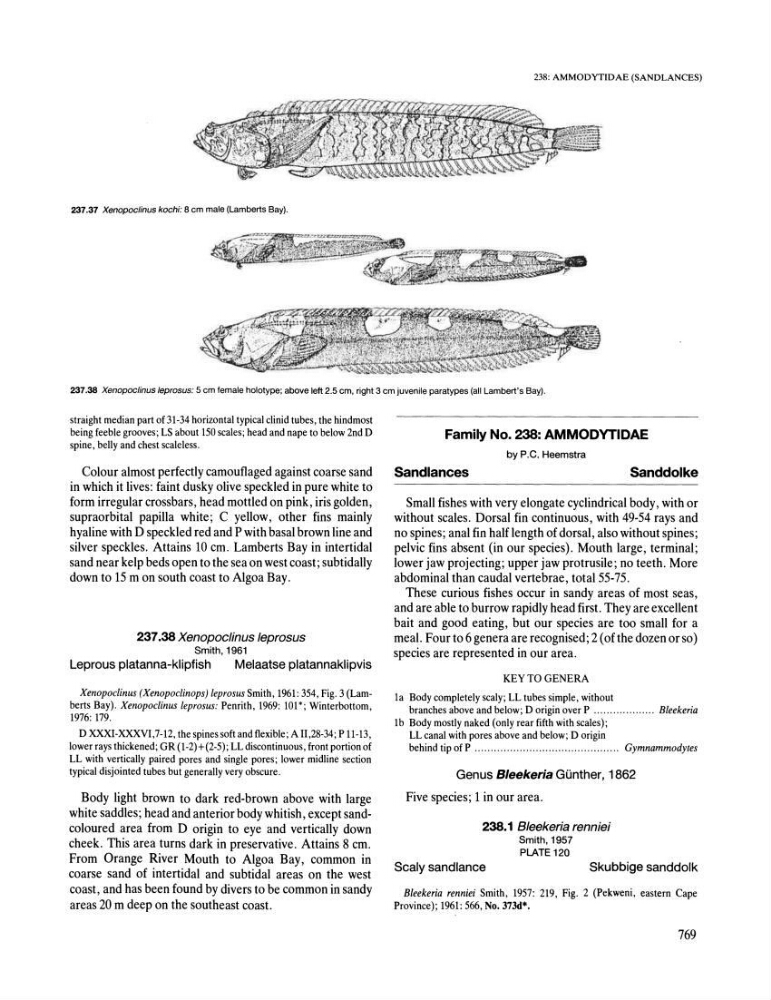
237.37 Xenopoclinus kochi: 8 cm male (Lamberts Bay).
237.38 Xenopoclinus leprosus: 5 cm female holotype; above left 2.5 em, right 3 em juvenile paratypes (all Lambert's Bay).
straight median part of 31-34 horizontal typical c1inid tubes, the hindmost
being feeble grooves; LS about 150 scales; head and nape to below 2nd D
spine, belly and chest scaleless.
Colour almost perfectly camouflaged against coarse sand
in which it lives: faint dusky olive speckled in pure white to
form irregular crossbars, head mottled on pink, iris golden,
supraorbital papilla white; C yellow, other fins mainly
hyaline with D speckled red and P with basal brown line and
silver speckles. Attains 10 cm. Lamberts Bay in intertidal
sand near kelp beds open to the sea on west coast; subtidally
down to 15 m on south coast to Algoa Bay.
237.38 Xenopoclinus leprosus
Smith,1961
Leprous platanna-klipfish
Melaatse platannaklipvis
Xenopoclinus (XenopoC/inops) /eprosus Smith, 1961: 354, Fig. 3 (Lamberts Bay). Xenopoc/inus /eprosus: Penrith, 1969: 101*; Winterbottom,
1976: 179.
D XXXI-XXXVI,7-12, the spines soft and flexible; A 1l,28-34; P 11-13,
lower rays thickened; GR (1-2)+(2-5); LL discontinuous, front portion of
LL with vertically paired pores and single pores; lower midline section
typical disjointed tubes but generally very obscure.
Body light brown to dark red-brown above with large
white saddles; head and anterior body whitish, except sandcoloured area from D origin to eye and vertically down
cheek. This area turns dark in preservative. Attains 8 cm.
From Orange River Mouth to Algoa Bay, common in
coarse sand of intertidal and subtidal areas on the west
coast, and has been found by divers to be common in sandy
areas 20 m deep on the southeast coast.
Family No. 238: AMMODYTIDAE
by P.C. Heemstra
Sandlances
Sanddolke
Small fishes with very elongate cyclindrical body, with or
without scales. Dorsal fin continuous, with 49-54 rays and
no spines; anal fin half length of dorsal, also without spines;
pelvic fins absent (in our species). Mouth large, terminal;
lower jaw projecting; upper jaw protrusile; no teeth. More
abdominal than caudal vertebrae, total 55-75.
These curious fishes occur in sandy areas of most seas,
and are able to burrow rapidly head first. They are excellent
bait and good eating, but our species are too small for a
meal. Four to 6 genera are recognised; 2 (of the dozen orso)
species are represented in our area.
KEY TO GENERA
la Body completely scaly; LL tubes simple, without
branches above and below; D origin over P ................... Bleekeria
Ib Body mostly naked (only rear fifth with scales);
LL canal with pores above and below; D origin
behind tip of P ... ... .. .... .. ........... .. .... ..... .... ..... Gymnammodytes
Genus Bleekeria Gunther, 1862
Five species; 1 in our area.
238.1 Bleekeria renniei
Smith,1957
PLATE 120
Scaly sandlance
Skubbige sanddolk
Bleekeria renniei Smith, 1957: 219, Fig. 2 (Pekweni, eastern Cape
Province); 1961: 566, No. 373d"'.
769