

235: BLENNIIDAE (BLENNIES)
235.31 Parablennius cornutus
(Linnaeus, 1758)
PLATE 115
Horned blenny
Horingsman-blennie
Blennius comUlus Linnaeus, 1758: 256 (India); Smith, SFSA No. 952*;
Smith & Smith, 1966: 112*; Penrith & Penrith, 1972: 67*; Penrith, 1976:
153. Blennius grandicomis Valenciennes, in Cuv. & Val., 1836: 258 (Cape
of Good Hope); Bauchot, 1967: 11*. Blennius scullyi Gilchrist &
Thompson, 1908: 103 (Walvis Bay). Picliblennius comulus: Bath, 1977:
202* .
D XI-XII,16-20; A II,16-23; P 13-15; V 1,4; orbital cirrus usually a long
central stalk with numerous short side branches (central stalk of males
much longer than that of females); nasal cirri tiny, consisting of few filaments; LL continuing as bipored tubes from P tip towards C (further posteriorly in larger specimens).
Body irregularly dusky banded (about 6 bands), plain
dusky, or broadly vermiculated; underside of head plain
dusky; P darkly dusky basally to completely darkly dusky;
D variably to completely dusky, dark spot usually present at
anterior end. Attains 15 cm SL. Northern Namibia to Sodwana Bay.
235.31 Parablennius cornulus: 7.5 em SL (Natal; photo by K. Bruwelheide).
Mud blenny
235.32 Parablennius lodosus
(Smith, 1959)
Modder-blennie
Blennius lodosus Smith, 1959: 230, Fig. 1 (Delagoa Bay); 1961: 571, No.
9503; Bath, 1977: 198*.
D XI-XII,14-16; A II,17-18; P 13-15; V 1,4; orbital cirrus a fleshy flap
with numerous filaments; nasal cirrus a small ragged flap; LL descending
to midline of body posterior to P, and terminating below middle of D.
Body variably dusky, usually with about 5 broken, dusky
bands, sometimes chequered in appearance; underside of
head often with 2 faint, dusky bands; P faintly dusky; dark
spot or spots at anterior end of D. Attains 4 cm SL. Known
only from Delagoa Bay.
235.32 Parablennius lodosus: 4 em male holotype (Maputo Bay).
752
235.33 Parablennius pilicornis
(Cuvier, 1829)
Ringneck blenny
Ringhals-blennie
Blennius pilicomis Cuvier, in Cuv. & Val., 1829: 237 (no locality); Penrith, 1976: 153. Blennius fascigula Barnard, 1927: 73 (South Africa);
Smith, SFSA No. 951 *; Penrith & Penrith, 1972: 72*. Blennius trifascigula
Fowler, 1936: 404 (Durban, Natal). Blennius vandervekeni Poll, 1959: 66,
Fig. 24 (Bay of Lobito, Angola). Parablennius pilicomis: Bath, 1977:
197* .
D XI-XII,18-24; A II,20-25; P 14; V 1,3; orbital cirri consisting of
several filaments arising from short, broad base; nasal cirri similar to orbital cirri, but much smaller and fewer.
Body with up to 9 dusky bands dorsally, numerous dark
spots ventrally; occasionally body pale with irregular dusky
marks; underside of head often with 2 dark bands; P pale or
pale dusky; D variably dusky or with numerous spots.
Attains 12 cm SL. Western Mediterranean, Angola, South
Africa from Knysna to Sodwana Bay, Brazil and Patagonia.
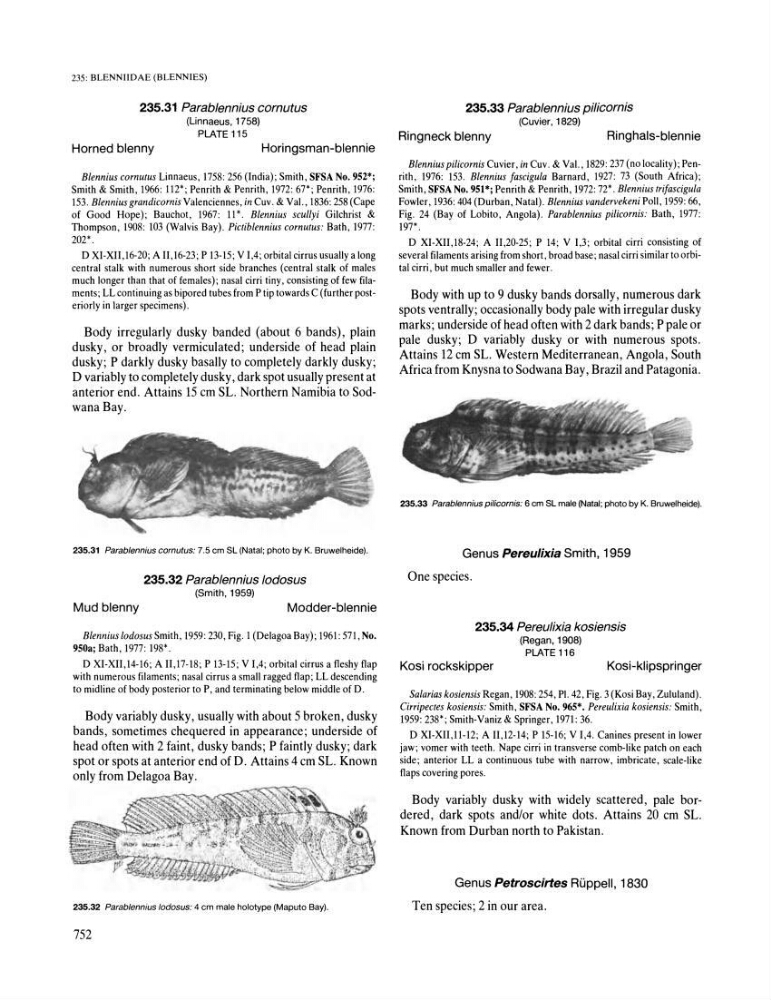
235.33 Parablennius pilicornis: 6 em SL male (Natal; photo by K. Bruwelheide).
Genus Pereu/ixia Smith, 1959
One species.
235.34 Pereulixia kosiensis
(Regan, 1908)
PLATE 116
Kosi rockskipper
Kosi-klipspringer
Salarias kosiensis Regan, 1908: 254, PI. 42, Fig. 3 (Kosi Bay, Zululand).
Cirripectes kosiensis: Smith, SFSA No. 965*. Pereulixia kosiensis: Smith,
1959: 238*; Smith-Vaniz & Springer, 1971: 36.
D XI-XII,Il-12; A II,12-14; P 15-16; V 1,4. Canines present in lower
jaw; vomer with teeth. Nape cirri in transverse comb-like patch on each
side; anterior LL a continuous tube with narrow, imbricate, scale-like
flaps covering pores.
Body variably dusky with widely scattered, pale bordered, dark spots and/or white dots. Attains 20 cm SL.
Known from Durban north to Pakistan.
Genus Petroscirtes Ruppell, 1830
Ten species; 2 in our area.