

sis (non Regan): Smith, 1959: 232*; 1961: 571, No. 955b. Omobranchus
fasciolatus: Springer & Gomon, 1975: 34*.
D XI-XII,18-19 = 30-31; A 11,20-22; gill opening not extending below
3rd from dorsalmost Pray, above P base in 95% of specimens; LL tubes on
body 3-8.
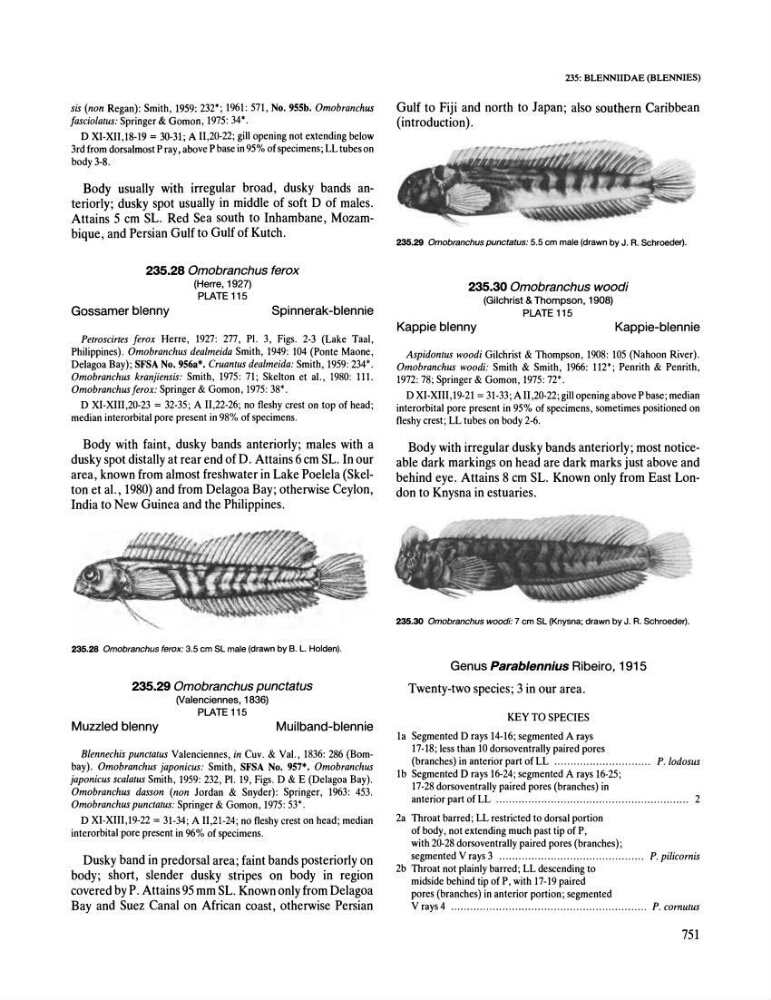
Body usually with irregular broad, dusky bands anteriorly; dusky spot usually in middle of soft D of males.
Attains 5 cm SL. Red Sea south to Inhambane, Mozambique, and Persian Gulf to Gulf of Kutch.
235.28 Omobranchus ferox
(Herre, 1927)
PLATE 115
Gossamer blenny
Spinnerak-blennie
Petroscirtes ferox Herre, 1927: 277, PI. 3, Figs. 2-3 (Lake Taal,
Philippines). Omobranchus dealmeida Smith, 1949: 104 (Ponte Maone,
Delagoa Bay); SFSA No. 956a*. Cruantus dealmeida: Smith, 1959: 234*.
Omobranchus kranjiensis: Smith, 1975: 71; Skelton et aI., 1980: 111.
Omobranchus ferox: Springer & Gomon, 1975: 38*.
D XI-XIII,20-23 = 32-35; A 11,22-26; no fleshy crest on top of head;
median interorbital pore present in 98% of specimens.
Body with faint, dusky bands anteriorly; males with a
dusky spot distally at rear end of D. Attains 6 cm SL. In our
area, known from almost freshwater in Lake Poelela (Skelton et aI., 1980) and from Delagoa Bay; otherwise Ceylon,
India to New Guinea and the Philippines.
235.28 Omobranchus ferox: 3.5 cm SL male (drawn by B. L. Holden).
235.29 Omobranchus punctatus
(Valenciennes, 1836)
PLATE 115
Muzzled blenny
Muilband-blennie
Blennechis punctatus Valenciennes, in Cuv. & Val., 1836: 286 (Bombay). Omobranchus japonicus: Smith, SFSA No. 957*. Omobranchus
japonicus scalatus Smith, 1959: 232, PI. 19, Figs. D & E (Delagoa Bay).
Omobranchus dasson (non Jordan & Snyder): Springer, 1963: 453.
Omobranchus punctatus: Springer & Gomon, 1975: 53*.
D XI-XIII,19-22 = 31-34; A 11,21-24; no fleshy crest on head; median
interorbital pore present in 96% of specimens.
Dusky band in predorsal area; faint bands posteriorly on
body; short, slender dusky stripes on body in region
covered by P. Attains 95 mm SL. Known only from Delagoa
Bay and Suez Canal on African coast, otherwise Persian
235: BLENNIIDAE (BLENNIES)
Gulf to Fiji and north to Japan; also southern Caribbean
(introduction).
235.29 Omobranchus punctatus: 5.5 cm male (drawn by J. R. Schroeder).
235.30 Omobranchus wood;
(Gilchrist & Thompson, 1908)
PLATE 115
Kappie blenny
Kappie-blennie
Aspidontus woodi Gilchrist & Thompson, 1908: 105 (Nahoon River).
Omobranchus woodi: Smith & Smith, 1966: 112*; Penrith & Penrith,
1972: 78; Springer & Gomon, 1975: 72*.
D XI-XIII,19-21 = 31-33; A 11,20-22; gill opening above Pbase; median
interorbital pore present in 95% of specimens, sometimes positioned on
fleshy crest; LL tubes on body 2-6.
Body with irregular dusky bands anteriorly; most noticeable dark markings on head are dark marks just above and
behind eye. Attains 8 cm SL. Known only from East London to Knysna in estuaries.
235.30 Omobranehus wood;: 7 em SL (Knysna; drawn by J. R. Schroeder).
Genus Parablennius Ribeiro, 1915
Twenty-two species; 3 in our area.
KEY TO SPECIES
la Segmented Drays 14-16; segmented A rays
17-18; less than 10 dorsoventrally paired pores
(branches) in anterior part of LL .............................. P. lodosus
Ib Segmented Drays 16-24; segmented A rays 16-25;
17-28 dorsoventrally paired pores (branches) in
anterior part of LL ............................................................ 2
2a Throat barred; LL restricted to dorsal portion
of body, not extending much past tip of P,
with 20-28 dorsoventrally paired pores (branches);
segmented V rays 3 ............................................. P. pilicornis
2b Throat not plainly barred; LL descending to
midside behind tip of P, with 17-19 paired
pores (branches) in anterior portion; segmented
V rays 4 ............................................................. P. cornutus
751