

234: MUGILOIDIDAE (SANDSMELTS)
(1867) supposed that the differences in colour pattern of
these two species might be due to sexual dichromatism.
Smith (SFSA) correctly illustrated the female (polyophthalma) and male (hexophthalma) forms. Females change
sex (and colour pattern) at 17-20 cm SL; attains 26 cm (TL).
Indo-West Pacific from Durban northwards; also in Red
Sea.
234.2 Parapercis multifasciata
Ooderlein, 1884
Gold-bridled sandsmelt
Gouetoom-sandspiering
Parapercis multifasciatus D6derlein, in Steindachner & D6derlein,
1884: 190, PI. 6, Figs. 2 & 2a (Tokyo Bay); Cantwell, 1964: 251 *; Masuda
et aI., 1975: 258*.
o V,23; A 1,19; P 21; LL 62; 5 scales from 1st 0 ray to LL; 27 scales
around C peduncle; GR 4+ 11; 4(6?) canines in outer row at front of lower
jaw; 2 rows of short conical teeth on palatines; rear end of subopercle with
a smooth, rounded, bony process; membrane from last 0 spine joins 1st
ray opposite spine tip; cheek scales rather large, ctenoid, imbricate.
One 18 cm SL specimen (RUSI 10966) from 150 m off
Natal; colour in life unknown; in alcohol, uniformly straw
coloured without dark marks of any kind. This specimen is
tentatively identified as P. multifasciata, previously known
only from Japan. Without knowledge of the fresh coloration of this fish, the identification is somewhat uncertain.
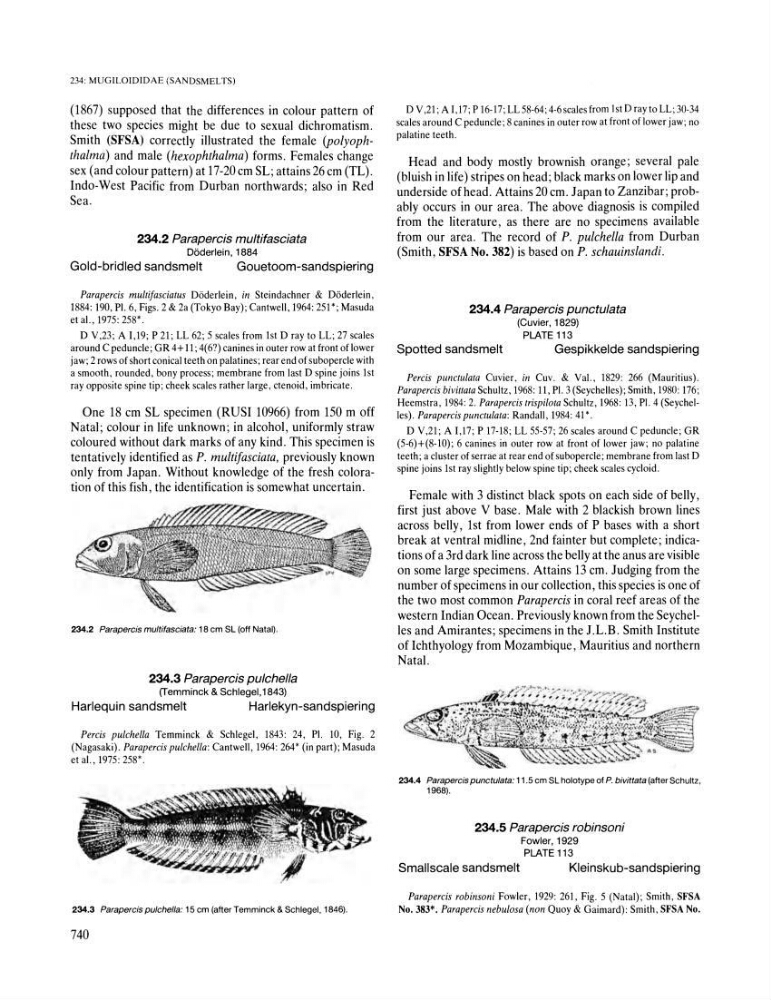
234.2 Parapercis multifasciata: 18 cm SL (off Natal).
234.3 Parapercis pulchel/a
(femminck & Schlegel,1843)
Harlequin sandsmelt
Harlekyn-sandspiering
Percis pulchel/a Temminck & Schlegel, 1843: 24, PI. 10, Fig. 2
(Nagasaki). Parapercis pulchel/a: Cantwell, 1964: 264* (in part); Masuda
et aI., 1975: 258*.
234.3 Parapercis pulchella: 15 cm (after Temminck & Schlegel, 1846).
740
o V,21; A 1,17; P 16-17; LL58-64; 4-6 scales from 1st 0 ray to LL; 30-34
scales around C peduncle; 8 canines in outer row at front of lower jaw; no
palatine teeth.
Head and body mostly brownish orange; several pale
(bluish in life) stripes on head; black marks on lower lip and
underside of head. Attains 20 cm. Japan to Zanzibar; probably occurs in our area. The above diagnosis is compiled
from the literature, as there are no specimens available
from our area. The record of P. pulchella from Durban
(Smith, SFSA No. 382) is based on P. schauinslandi.
234.4 Parapercis punctulata
(Cuvier, 1829)
PLATE 113
Spotted sandsmelt
Gespikkelde sandspiering
Percis punctulata Cuvier, in Cuv. & Val., 1829: 266 (Mauritius).
Parapercis bivittata Schultz, 1968: 11, PI. 3 (Seychelles); Smith, 1980: 176;
Heemstra, 1984: 2. Parapercis trispilota Schultz, 1968: 13, PI. 4 (Seychelles). Parapercis punctulata: Randall, 1984: 41 *.
o V,21; A 1,17; P 17-18; LL 55-57; 26 scales around C peduncle; GR
(5-6)+(8-10); 6 canines in outer row at front of lower jaw; no palatine
teeth; a cluster of serrae at rear end of subopercle; membrane from last 0
spine joins 1st ray slightly below spine tip; cheek scales cycloid.
Female with 3 distinct black spots on each side of belly,
first just above V base. Male with 2 blackish brown lines
across belly, 1st from lower ends of P bases with a short
break at ventral midline, 2nd fainter but complete; indications of a 3rd dark line across the belly at the anus are visible
on some large specimens. Attains 13 cm. Judging from the
number of specimens in our collection, this species is one of
the two most common Parapercis in coral reef areas of the
western Indian Ocean. Previously known from the Seychelles and Amirantes; specimens in the J.L.B. Smith Institute
of Ichthyology from Mozambique, Mauritius and northern
Natal.
234.4 Parapercis punctulata: 11.5 cm SL holotype of P. bivittata (after Schultz,
1968).
234.5 Parapercis robinsoni
Fowler, 1929
PLATE 113
Smallscale sands melt
Kleinskub-sandspiering
Parapercis robinsoni Fowler, 1929: 261, Fig. 5 (Natal); Smith, SFSA
No. 383*. Parapercis nebulosa (non Quay & Gaimard): Smith, SFSA No.
(1867) supposed that the differences in colour pattern of
these two species might be due to sexual dichromatism.
Smith (SFSA) correctly illustrated the female (polyophthalma) and male (hexophthalma) forms. Females change
sex (and colour pattern) at 17-20 cm SL; attains 26 cm (TL).
Indo-West Pacific from Durban northwards; also in Red
Sea.
234.2 Parapercis multifasciata
Ooderlein, 1884
Gold-bridled sandsmelt
Gouetoom-sandspiering
Parapercis multifasciatus D6derlein, in Steindachner & D6derlein,
1884: 190, PI. 6, Figs. 2 & 2a (Tokyo Bay); Cantwell, 1964: 251 *; Masuda
et aI., 1975: 258*.
o V,23; A 1,19; P 21; LL 62; 5 scales from 1st 0 ray to LL; 27 scales
around C peduncle; GR 4+ 11; 4(6?) canines in outer row at front of lower
jaw; 2 rows of short conical teeth on palatines; rear end of subopercle with
a smooth, rounded, bony process; membrane from last 0 spine joins 1st
ray opposite spine tip; cheek scales rather large, ctenoid, imbricate.
One 18 cm SL specimen (RUSI 10966) from 150 m off
Natal; colour in life unknown; in alcohol, uniformly straw
coloured without dark marks of any kind. This specimen is
tentatively identified as P. multifasciata, previously known
only from Japan. Without knowledge of the fresh coloration of this fish, the identification is somewhat uncertain.
234.2 Parapercis multifasciata: 18 cm SL (off Natal).
234.3 Parapercis pulchel/a
(femminck & Schlegel,1843)
Harlequin sandsmelt
Harlekyn-sandspiering
Percis pulchel/a Temminck & Schlegel, 1843: 24, PI. 10, Fig. 2
(Nagasaki). Parapercis pulchel/a: Cantwell, 1964: 264* (in part); Masuda
et aI., 1975: 258*.
234.3 Parapercis pulchella: 15 cm (after Temminck & Schlegel, 1846).
740
o V,21; A 1,17; P 16-17; LL58-64; 4-6 scales from 1st 0 ray to LL; 30-34
scales around C peduncle; 8 canines in outer row at front of lower jaw; no
palatine teeth.
Head and body mostly brownish orange; several pale
(bluish in life) stripes on head; black marks on lower lip and
underside of head. Attains 20 cm. Japan to Zanzibar; probably occurs in our area. The above diagnosis is compiled
from the literature, as there are no specimens available
from our area. The record of P. pulchella from Durban
(Smith, SFSA No. 382) is based on P. schauinslandi.
234.4 Parapercis punctulata
(Cuvier, 1829)
PLATE 113
Spotted sandsmelt
Gespikkelde sandspiering
Percis punctulata Cuvier, in Cuv. & Val., 1829: 266 (Mauritius).
Parapercis bivittata Schultz, 1968: 11, PI. 3 (Seychelles); Smith, 1980: 176;
Heemstra, 1984: 2. Parapercis trispilota Schultz, 1968: 13, PI. 4 (Seychelles). Parapercis punctulata: Randall, 1984: 41 *.
o V,21; A 1,17; P 17-18; LL 55-57; 26 scales around C peduncle; GR
(5-6)+(8-10); 6 canines in outer row at front of lower jaw; no palatine
teeth; a cluster of serrae at rear end of subopercle; membrane from last 0
spine joins 1st ray slightly below spine tip; cheek scales cycloid.
Female with 3 distinct black spots on each side of belly,
first just above V base. Male with 2 blackish brown lines
across belly, 1st from lower ends of P bases with a short
break at ventral midline, 2nd fainter but complete; indications of a 3rd dark line across the belly at the anus are visible
on some large specimens. Attains 13 cm. Judging from the
number of specimens in our collection, this species is one of
the two most common Parapercis in coral reef areas of the
western Indian Ocean. Previously known from the Seychelles and Amirantes; specimens in the J.L.B. Smith Institute
of Ichthyology from Mozambique, Mauritius and northern
Natal.
234.4 Parapercis punctulata: 11.5 cm SL holotype of P. bivittata (after Schultz,
1968).
234.5 Parapercis robinsoni
Fowler, 1929
PLATE 113
Smallscale sands melt
Kleinskub-sandspiering
Parapercis robinsoni Fowler, 1929: 261, Fig. 5 (Natal); Smith, SFSA
No. 383*. Parapercis nebulosa (non Quay & Gaimard): Smith, SFSA No.