

Body pale (in alcohol), with 6 faint broad dark bars, 1st
on nape, last on C peduncle. Males (?) with black band on
1st D as shown in figure; females have shorter D spines and
the fin is almost entirely black. Attains 50 mm. Known only
from 2 specimens collected in a dredge off southern Natal.
Family No. 234: MUGILOIDIDAE
by P.C. Heemstra
Sandsmelts
Sandspierings
Body elongate, subcylindrical, posteriorly compressed.
Dorsal fin with 4 or 5 pungent spines and 20 to 24 soft-rays,
the last spine more or less attached by membrane to first
soft-ray; anal fin with 1 weak spine and 16 to 19 branched
soft-rays; pelvic fins with 1 short, hidden spine and 5
branched soft-rays; caudal fin rounded, truncate to emarginate, upper and lower rays prolonged in some adults,
branched rays 15; pectoral fins with 15 to 21 rays. Maxilla
mostly covered by preorbital; lips somewhat thickened;
jaws with a band of villiform teeth, an outer row of larger,
cardiform teeth and a few curved canines at front of jaws;
teeth present on vomer, present or absent on palatines. Gill
membranes united, attached to isthmus far forward, with a
broad to narrow fold across isthmus; branchiostegal rays 6.
One stout spine on opercle; preopercle edge smooth,
broadly rounded. Scales small to moderate, ctenoid, those
on cheeks usually cycloid; lateral line complete, slightly
curved above pectoral fin. Gills 4, a slit behind fourth arch.
Swim bladder absent.
Small to moderate-sized benthic fishes of sandy, shallowwater habitats. Three or four genera with about 60 species.
The family diagnosis given above is based on Parapercis,
the only genus represented in our area.
Genus Parapercis Bleeker, 1863
Distinguishing the species of Parapercis is complicated by
sexual dichromatism in some species and by the hermaphroditism of these species. The smaller (female) fish often have
a colour pattern that is different from the pattern of the
larger (male) specimens of the same species. About 50
species, including several undescribed ones. Six species
occur in our area, and another 2 species are likely to be
found here. Scales from 1st D ray to LL are counted in a
series downwards and backwards from the base of the ray to
the LL.
KEY TO SPECIES
I a Scales small, LL 79-86; 8-10 scales from 1st Dray
to LL .. ......................... ... ...... ... ...... .. .. ........ .... .. P. robinsoni
Ib LL 55-64; 4-8 scales from 1st D ray to LL ............................... 2
2a D V,23; A 1,19; P 21 .................................. .. .... P. multifasciata
2b D V,21-22; A 1,16-18; P 16-18 ................................ .. ............ 3
234: MUGILOIDIDAE (SANDSMELTS)
3a Front of lower jaw with 8 canines in outer row
(4 on each side of symphysis) ............................................... 4
3b Front of lower jaw with 6 canines in outer row .. ....................... 5
4a Membrane from last D spine joins 1st D ray at its
base ; no black blotch covering most of C .. .. .. .... .. ... .... P. pulchella
4b Membrane from last D spine joins 1st D ray opposite
tip of spine; black blotch covers most of C ...... .... P. hexophthalma
5a C emarginate, the upper and lower rays elongated
in specimens> 7 cm SL; membrane from last D
spine joins 1st D ray at (or near) its base ............. P. schauinslandi
5b C truncate or rounded, without elongated rays
(except dorsal branched rays slightly elongated in
some specimens); membrane from last D spine
joins 1st D ray opposite or slightly below tip of spine..... .... .. .. .... 6
6a Scales from 1st D ray to LL 6-7; 29-31 scales
in a zigzag series around C peduncle; lower-limb
GR 12 ........................................................... P. xanthozona
6b Scales from 1st D ray to LL 4 or 5; 24-26 scales
around C peduncle; lower-limb GR 8-11 ................................ 7
7a Large black blotch covering most of spinous D;
belly with 3 black spots on each side or 2 or 3 narrow
black crossbars; 5 scales from 1st D ray to LL ........... P. punctulata
7b No black blotch on spinous D; belly without black
markings; 4 scales from 1st D ray to LL .................. P. somaliensis
234.1 Parapercis hexophthalma
(Ehrenberg, 1829)
PLATE 113
Blacktail sandsmelt
Swartstert-sandspiering
Percis hexophthalma Ehrenberg, in Cuv. & VaL, 1829: 271 (Massawa,
Red Sea). Percis polyophthalma Ehrenberg, in Cuv. & VaL, 1829: 272
(Massawa, Red Sea). Parapercis hexophthalma: Smith, SFSA No. 380*;
Cantwell, 1964: 269*. Parapercis polyophthalma: Cantwell, 1964: 270*.
Parapercis cylindrica (non Bloch): Smith & Smith, 1963: 13*.
D V,21; A 1,16; P 16-17; LL59-61; 6-8 scales from 1st D ray to LL; 29-33
scales around C peduncle; GR (4-6)+(8-10); 8 canines in outer row at
front of lower jaw, the pair nearest symphysis are the smallest and mostly
hidden by spongy tissue and the lower lip; no palatine teeth; rear end of
subopercle smooth or with a few minute serrae; snout narrow, the lower
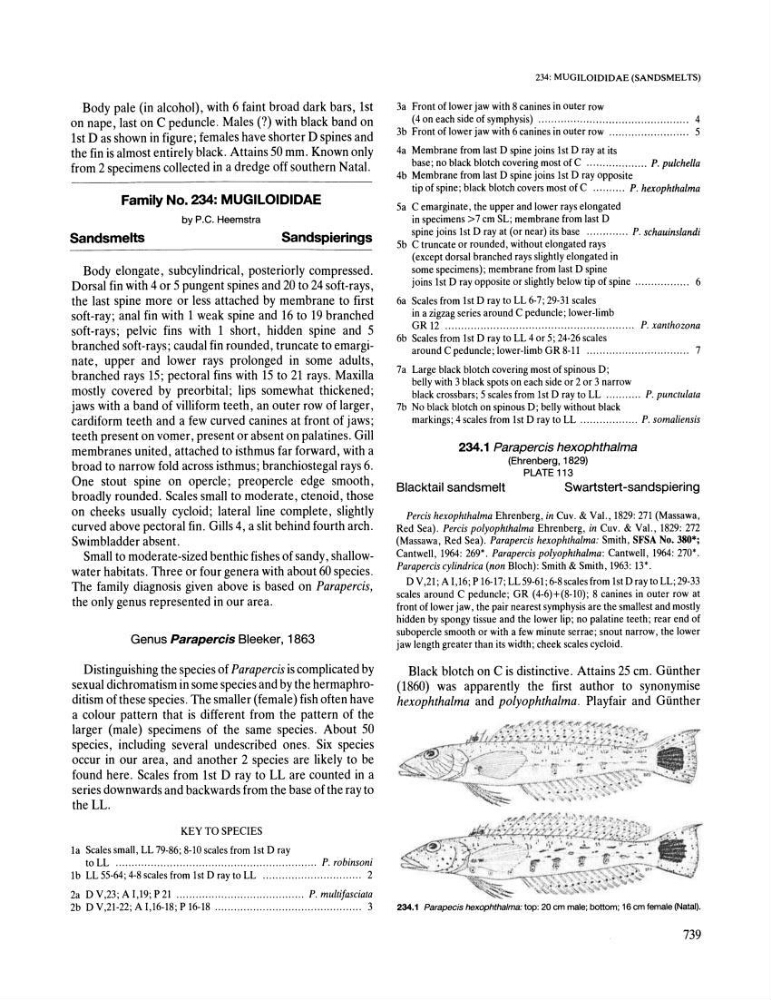
jaw length greater than its width; cheek scales cycloid.
Black blotch on C is distinctive. Attains 25 cm. Gunther
(1860) was apparently the first author to synonymise
hexophthalma and polyophthalma. Playfair and Gunther
234.1 Parapecis hexophthalma: top: 20 em male; bottom; 16 em female (Natal).
739
on nape, last on C peduncle. Males (?) with black band on
1st D as shown in figure; females have shorter D spines and
the fin is almost entirely black. Attains 50 mm. Known only
from 2 specimens collected in a dredge off southern Natal.
Family No. 234: MUGILOIDIDAE
by P.C. Heemstra
Sandsmelts
Sandspierings
Body elongate, subcylindrical, posteriorly compressed.
Dorsal fin with 4 or 5 pungent spines and 20 to 24 soft-rays,
the last spine more or less attached by membrane to first
soft-ray; anal fin with 1 weak spine and 16 to 19 branched
soft-rays; pelvic fins with 1 short, hidden spine and 5
branched soft-rays; caudal fin rounded, truncate to emarginate, upper and lower rays prolonged in some adults,
branched rays 15; pectoral fins with 15 to 21 rays. Maxilla
mostly covered by preorbital; lips somewhat thickened;
jaws with a band of villiform teeth, an outer row of larger,
cardiform teeth and a few curved canines at front of jaws;
teeth present on vomer, present or absent on palatines. Gill
membranes united, attached to isthmus far forward, with a
broad to narrow fold across isthmus; branchiostegal rays 6.
One stout spine on opercle; preopercle edge smooth,
broadly rounded. Scales small to moderate, ctenoid, those
on cheeks usually cycloid; lateral line complete, slightly
curved above pectoral fin. Gills 4, a slit behind fourth arch.
Swim bladder absent.
Small to moderate-sized benthic fishes of sandy, shallowwater habitats. Three or four genera with about 60 species.
The family diagnosis given above is based on Parapercis,
the only genus represented in our area.
Genus Parapercis Bleeker, 1863
Distinguishing the species of Parapercis is complicated by
sexual dichromatism in some species and by the hermaphroditism of these species. The smaller (female) fish often have
a colour pattern that is different from the pattern of the
larger (male) specimens of the same species. About 50
species, including several undescribed ones. Six species
occur in our area, and another 2 species are likely to be
found here. Scales from 1st D ray to LL are counted in a
series downwards and backwards from the base of the ray to
the LL.
KEY TO SPECIES
I a Scales small, LL 79-86; 8-10 scales from 1st Dray
to LL .. ......................... ... ...... ... ...... .. .. ........ .... .. P. robinsoni
Ib LL 55-64; 4-8 scales from 1st D ray to LL ............................... 2
2a D V,23; A 1,19; P 21 .................................. .. .... P. multifasciata
2b D V,21-22; A 1,16-18; P 16-18 ................................ .. ............ 3
234: MUGILOIDIDAE (SANDSMELTS)
3a Front of lower jaw with 8 canines in outer row
(4 on each side of symphysis) ............................................... 4
3b Front of lower jaw with 6 canines in outer row .. ....................... 5
4a Membrane from last D spine joins 1st D ray at its
base ; no black blotch covering most of C .. .. .. .... .. ... .... P. pulchella
4b Membrane from last D spine joins 1st D ray opposite
tip of spine; black blotch covers most of C ...... .... P. hexophthalma
5a C emarginate, the upper and lower rays elongated
in specimens> 7 cm SL; membrane from last D
spine joins 1st D ray at (or near) its base ............. P. schauinslandi
5b C truncate or rounded, without elongated rays
(except dorsal branched rays slightly elongated in
some specimens); membrane from last D spine
joins 1st D ray opposite or slightly below tip of spine..... .... .. .. .... 6
6a Scales from 1st D ray to LL 6-7; 29-31 scales
in a zigzag series around C peduncle; lower-limb
GR 12 ........................................................... P. xanthozona
6b Scales from 1st D ray to LL 4 or 5; 24-26 scales
around C peduncle; lower-limb GR 8-11 ................................ 7
7a Large black blotch covering most of spinous D;
belly with 3 black spots on each side or 2 or 3 narrow
black crossbars; 5 scales from 1st D ray to LL ........... P. punctulata
7b No black blotch on spinous D; belly without black
markings; 4 scales from 1st D ray to LL .................. P. somaliensis
234.1 Parapercis hexophthalma
(Ehrenberg, 1829)
PLATE 113
Blacktail sandsmelt
Swartstert-sandspiering
Percis hexophthalma Ehrenberg, in Cuv. & VaL, 1829: 271 (Massawa,
Red Sea). Percis polyophthalma Ehrenberg, in Cuv. & VaL, 1829: 272
(Massawa, Red Sea). Parapercis hexophthalma: Smith, SFSA No. 380*;
Cantwell, 1964: 269*. Parapercis polyophthalma: Cantwell, 1964: 270*.
Parapercis cylindrica (non Bloch): Smith & Smith, 1963: 13*.
D V,21; A 1,16; P 16-17; LL59-61; 6-8 scales from 1st D ray to LL; 29-33
scales around C peduncle; GR (4-6)+(8-10); 8 canines in outer row at
front of lower jaw, the pair nearest symphysis are the smallest and mostly
hidden by spongy tissue and the lower lip; no palatine teeth; rear end of
subopercle smooth or with a few minute serrae; snout narrow, the lower
jaw length greater than its width; cheek scales cycloid.
Black blotch on C is distinctive. Attains 25 cm. Gunther
(1860) was apparently the first author to synonymise
hexophthalma and polyophthalma. Playfair and Gunther
234.1 Parapecis hexophthalma: top: 20 em male; bottom; 16 em female (Natal).
739