

220: LABRIDAE (WRASSES)
Reaches 20 cm. Indian Ocean (occurrence in Pacific uncertain); south to Natal. Generally found on substrate with
heavy plant growth.
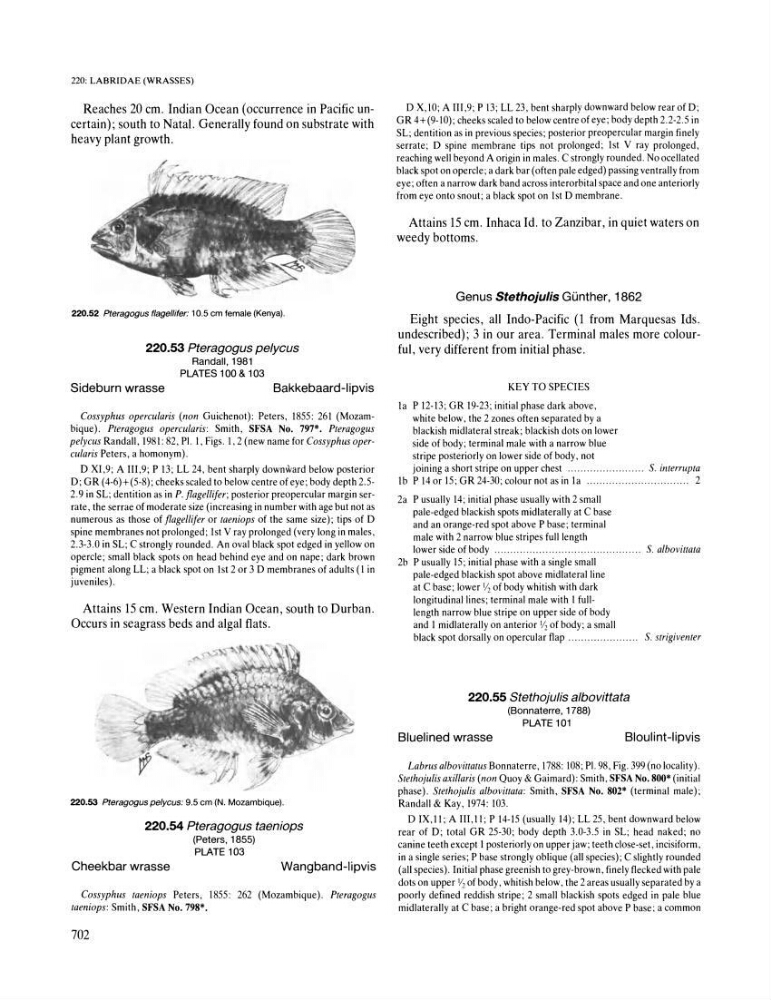
220.52 Pteragogus flagellifer: 10.5 em female (Kenya).
220.53 Pteragogus pelycus
Randall,1981
PLATES 100 & 103
Sideburn wrasse
Bakkebaard-lipvis
Cossyphus opercu/aris (non Guichenot): Peters, 1855: 261 (Mozambique). Pteragogus opercu/aris: Smith, SFSA No. 797*. Pteragogus
pe/ycus Randall, 1981: 82, PI. 1, Figs. 1,2 (new name for Cossyphus opercu/aris Peters, a homonym).
D XI,9; A I1I,9; P 13; LL 24, bent sharply downward below posterior
D; G R (4-6)+ (5-8); cheeks scaled to below centre of eye; body depth 2.52.9 in SL; dentition as in P. flagellifer; posterior preopercular margin serrate, the serrae of moderate size (increasing in number with age but not as
numerous as those of flagel/ifer or taeniops of the same size); tips of D
spine membranes not prolonged; 1st V ray prolonged (very long in males,
2.3-3.0 in SL; C strongly rounded. An oval black spot edged in yellow on
opercle; small black spots on head behind eye and on nape; dark brown
pigment along LL; a black spot on 1st 2 or 3 D membranes of adults (1 in
juveniles).
Attains 15 cm. Western Indian Ocean, south to Durban.
Occurs in seagrass beds and algal flats.
220.53 Pteragogus pe/ycus: 9.5 em (N. Mozambique).
220.54 Pteragogus taeniops
(Peters, 1855)
PLATE 103
Cheekbar wrasse
Wangband-Iipvis
Cossyphus taeniops Peters, 1855: 262 (Mozambique). Pleragogus
taeniops: Smith, SFSA No. 798*.
702
D X,lO; A I1I,9; P 13; LL 23, bent sharply downward below rear of D;
GR 4+(9-10); cheeks scaled to below centre of eye; body depth 2.2-2.5 in
SL; dentition as in previous species; posterior preopercular margin finely
serrate; D spine membrane tips not prolonged; 1st V ray prolonged,
reaching well beyond A origin in males. C strongly rounded. No ocellated
black spot on opercle; a dark bar (often pale edged) passing ventrally from
eye; often a narrow dark band across interorbital space and one anteriorly
from eye onto snout; a black spot on 1st D membrane.
Attains 15 cm. Inhaca Id. to Zanzibar, in quiet waters on
weedy bottoms.
Genus Stethojulis Gunther, 1862
Eight species, all Indo-Pacific (1 from Marquesas Ids.
undescribed); 3 in our area. Terminal males more colourful, very different from initial phase.
KEY TO SPECIES
Ia P 12-13; GR 19-23; initial phase dark above,
white below, the 2 zones often separated by a
blackish midlateral streak; blackish dots on lower
side of body; terminal male with a narrow blue
stripe posteriorly on lower side of body, not
joining a short stripe on upper chest ........................ S. interrupta
Ib P 14 or 15; GR 24-30; colour not as in 1a ............................... 2
2a P usually 14; initial phase usually with 2 small
pale-edged blackish spots midlaterally at C base
and an orange-red spot above P base; terminal
male with 2 narrow blue stripes full length
lower side of body ..................................
.. .... S. albovillala
2b P usually 15; initial phase with a single small
pale-edged blackish spot above midlateralline
at C base; lower 1/2 of body whitish with dark
longitudinal lines; terminal male with 1 fulllength narrow blue stripe on upper side of body
and 1 midlaterally on anterior 1/2 of body; a small
black spot dorsally on opercular flap...................... S. slrigivenler
220.55 Stethojulis albovittata
(Bonnaterre, 1788)
PLATE 101
Bluelined wrasse
Bloulint-lipvis
Labrus a/bovillatus Bonnaterre, 1788: 108; PI. 98, Fig. 399 (no locality).
Slelhojulis axil/aTis (non Quoy & Gaimard): Smith, SFSA No. 800* (initial
phase). Stethojulis a/bovillata: Smith, SFSA No. 802* (terminal male);
Randall & Kay, 1974: 103.
D IX,ll; A III,II; P 14-15 (usually 14); LL25, bent downward below
rear of D; total GR 25-30; body depth 3.0-3.5 in SL; head naked; no
canine teeth except 1 posteriorly on upper jaw; teeth close-set, incisiform,
in a single series; P base strongly oblique (all species); C slightly rounded
(all species). Initial phase greenish to grey-brown, finely flecked with pale
dots on upper \12 of body, whitish below. the 2 areas usually separated by a
poorly defined reddish stripe; 2 small blackish spots edged in pale blue
midlaterally at C base; a bright orange-red spot above P base; a common
Reaches 20 cm. Indian Ocean (occurrence in Pacific uncertain); south to Natal. Generally found on substrate with
heavy plant growth.
220.52 Pteragogus flagellifer: 10.5 em female (Kenya).
220.53 Pteragogus pelycus
Randall,1981
PLATES 100 & 103
Sideburn wrasse
Bakkebaard-lipvis
Cossyphus opercu/aris (non Guichenot): Peters, 1855: 261 (Mozambique). Pteragogus opercu/aris: Smith, SFSA No. 797*. Pteragogus
pe/ycus Randall, 1981: 82, PI. 1, Figs. 1,2 (new name for Cossyphus opercu/aris Peters, a homonym).
D XI,9; A I1I,9; P 13; LL 24, bent sharply downward below posterior
D; G R (4-6)+ (5-8); cheeks scaled to below centre of eye; body depth 2.52.9 in SL; dentition as in P. flagellifer; posterior preopercular margin serrate, the serrae of moderate size (increasing in number with age but not as
numerous as those of flagel/ifer or taeniops of the same size); tips of D
spine membranes not prolonged; 1st V ray prolonged (very long in males,
2.3-3.0 in SL; C strongly rounded. An oval black spot edged in yellow on
opercle; small black spots on head behind eye and on nape; dark brown
pigment along LL; a black spot on 1st 2 or 3 D membranes of adults (1 in
juveniles).
Attains 15 cm. Western Indian Ocean, south to Durban.
Occurs in seagrass beds and algal flats.
220.53 Pteragogus pe/ycus: 9.5 em (N. Mozambique).
220.54 Pteragogus taeniops
(Peters, 1855)
PLATE 103
Cheekbar wrasse
Wangband-Iipvis
Cossyphus taeniops Peters, 1855: 262 (Mozambique). Pleragogus
taeniops: Smith, SFSA No. 798*.
702
D X,lO; A I1I,9; P 13; LL 23, bent sharply downward below rear of D;
GR 4+(9-10); cheeks scaled to below centre of eye; body depth 2.2-2.5 in
SL; dentition as in previous species; posterior preopercular margin finely
serrate; D spine membrane tips not prolonged; 1st V ray prolonged,
reaching well beyond A origin in males. C strongly rounded. No ocellated
black spot on opercle; a dark bar (often pale edged) passing ventrally from
eye; often a narrow dark band across interorbital space and one anteriorly
from eye onto snout; a black spot on 1st D membrane.
Attains 15 cm. Inhaca Id. to Zanzibar, in quiet waters on
weedy bottoms.
Genus Stethojulis Gunther, 1862
Eight species, all Indo-Pacific (1 from Marquesas Ids.
undescribed); 3 in our area. Terminal males more colourful, very different from initial phase.
KEY TO SPECIES
Ia P 12-13; GR 19-23; initial phase dark above,
white below, the 2 zones often separated by a
blackish midlateral streak; blackish dots on lower
side of body; terminal male with a narrow blue
stripe posteriorly on lower side of body, not
joining a short stripe on upper chest ........................ S. interrupta
Ib P 14 or 15; GR 24-30; colour not as in 1a ............................... 2
2a P usually 14; initial phase usually with 2 small
pale-edged blackish spots midlaterally at C base
and an orange-red spot above P base; terminal
male with 2 narrow blue stripes full length
lower side of body ..................................
.. .... S. albovillala
2b P usually 15; initial phase with a single small
pale-edged blackish spot above midlateralline
at C base; lower 1/2 of body whitish with dark
longitudinal lines; terminal male with 1 fulllength narrow blue stripe on upper side of body
and 1 midlaterally on anterior 1/2 of body; a small
black spot dorsally on opercular flap...................... S. slrigivenler
220.55 Stethojulis albovittata
(Bonnaterre, 1788)
PLATE 101
Bluelined wrasse
Bloulint-lipvis
Labrus a/bovillatus Bonnaterre, 1788: 108; PI. 98, Fig. 399 (no locality).
Slelhojulis axil/aTis (non Quoy & Gaimard): Smith, SFSA No. 800* (initial
phase). Stethojulis a/bovillata: Smith, SFSA No. 802* (terminal male);
Randall & Kay, 1974: 103.
D IX,ll; A III,II; P 14-15 (usually 14); LL25, bent downward below
rear of D; total GR 25-30; body depth 3.0-3.5 in SL; head naked; no
canine teeth except 1 posteriorly on upper jaw; teeth close-set, incisiform,
in a single series; P base strongly oblique (all species); C slightly rounded
(all species). Initial phase greenish to grey-brown, finely flecked with pale
dots on upper \12 of body, whitish below. the 2 areas usually separated by a
poorly defined reddish stripe; 2 small blackish spots edged in pale blue
midlaterally at C base; a bright orange-red spot above P base; a common