

220: LABRIDAE (WRASSES)
Reaches at least 55 cm. Indo-Pacific but distribution not
continuous; south to Durban on Natal coast.
Diana's hagfish
220.8 Badianus diana
(Lacepede, 1801)
PLATE 94
Diana se varkvis
Labrus diana Lacepede, 1801: 450, PI. 32, Fig. 1 (Indian Ocean).
Lepidaplois diana: Smith, SFSA No. 774*. Lepidaplois aldabrensis Smith,
1955: 932, PI. 24A (Aldabra). Bodianus diana: Smith, 1980: 181; van der
Elst, 1981: 188*.
D XII, 10; A m,12; P 15-17; LL 30; total GR 15-18; scales dorsally on
head extending anteriorly to above middle of eyes; cheek scales to corner
of mouth; a basal scaly sheath of D and A 2V2 scales high at its greatest
depth; V not approaching anus in adults (relatively longer in juveniles, but
not reaching anus); C truncate, slightly rounded in juveniles. Adults
reddish to purplish brown on head, shading to dull yellow on body, the
scales rimmed with brown except 3 rows above LL posteriorly on body
where each scale has a blackish spot; a longitudinal row of 3 pale yellow
spots along back; a small black spot centred at base of C; 2 black spots on
soft A, the anterior one large, and a large black spot on V; a blackish spot
anteriorly on D; juveniles reddish brown with longitudinal rows of white
blotches and small spots in addition to black spots in fins.
Attains 25 cm. Indo-Pacific, south to Transkei.
220.9 Badianus leucastictus
(Bennett, 1831)
PLATE 94
Lined hogfish
Gestreepte varkvis
Labrus leucostictus Bennett, 1831: 166 (Mauritius). Lepidaplois
trilineatus Fowler, 1934: 492, Fig. 47 (Natal coast); Smith, SFSA No. 772*.
Lepidaplois luteopunctatus Smith, 1957: 102, PI. 1A (Delagoa Bay); 1961:
569, No. 772a*. Lepidaplois bourboni Fourmanoir & Gueze, 1961: 7, Fig.
1 (Reunion). Bodianus trilineatus: Smith, 1980: 181; van der Elst, 1981:
190*. Bodianus luteopunctatus: Smith, 1980: 181.
D XII,lO; A m,12; P 16; LL30; total GR 17-19; scales dorsally on head
extending to anterior nostrils; cheek scales reaching before corner of
mouth; basal scaly sheath of D and A low; V approaching anus in large
adults (shorter in small fish); C truncate to slightly rounded. Orangeyellow shading to white or pale yellow ventrally with 4 or 5 red, or red and
black lines on body, the upper 3 of which extend to eye (lines may be
broken into segments or the black part may be a series of spots or dashes
superimposed on the red); a black spot at P base present or absent (appears to be reduced to a small red spot or disappears with age); black or
red dots on body in irregular rows between the lines (also seem to disappear with age).
Attains at least 27 cm. Mauritius, Reunion, Somalia,
Mozambique, Natal and southern Japan. Usually found at
moderate depths (about 50 m). The placement of trilineatus
in the synonymy of leucostictus is provisional; more specimens are needed to ascertain if the colour and V length differences mentioned above are changes with age and growth
of a single species as here presumed.
688
220.10 Badianus perditia
(Quoy & Gaimard, 1834)
PLATE 90
Goldsaddle hogfish
Goudsaal-varkvis
Labrus perditio Quoy & Gaimard, 1834: 702, PI. 20, Fig. 4 (Tongatapu).
Cossyphus nigromaculatus Gilchrist & Thompson, 1908: 197 (Natal).
Chaeropsodes pictus Gilchrist & Thompson, 1909: 260 (Durban market).
Lepidaplois perditio: Smith, SFSA No. 776*. Bodianus perditio: Smith,
1980: 181; van der Elst, 1981: 189*.
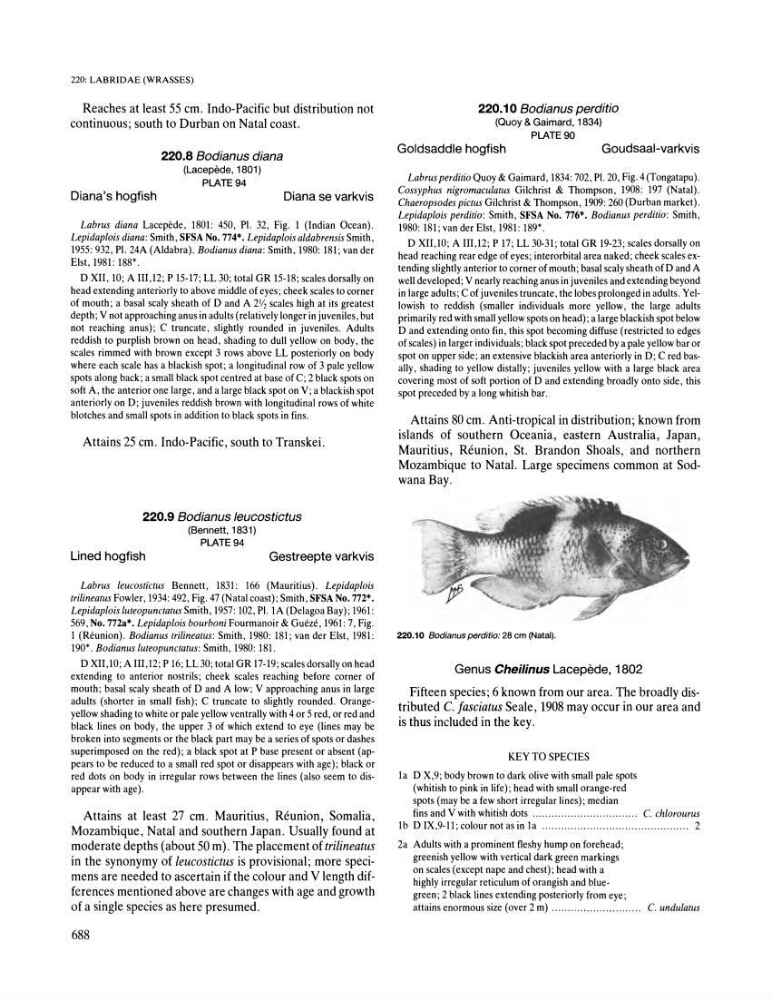
D XII,lO; A m,12; P 17; LL 30-31; total GR 19-23; scales dorsally on
head reaching rear edge of eyes; interorbital area naked; cheek scales extending slightly anterior to corner of mouth; basal scaly sheath of D and A
well developed; V nearly reaching anus in juveniles and extending beyond
in large adults; C of juveniles truncate, the lobes prolonged in adults. Yellowish to reddish (smaller individuals more yellow, the large adults
primarily red with small yellow spots on head); a large blackish spot below
D and extending onto fin, this spot becoming diffuse (restricted to edges
of scales) in larger individuals; black spot preceded by a pale yellow bar or
spot on upper side; an extensive blackish area anteriorly in D; C red basally, shading to yellow distally; juveniles yellow with a large black area
covering most of soft portion of D and extending broadly onto side, this
spot preceded by a long whitish bar.
Attains 80 cm. Anti-tropical in distribution; known from
islands of southern Oceania, eastern Australia, Japan,
Mauritius, Reunion, St. Brandon Shoals, and northern
Mozambique to Natal. Large specimens common at Sodwana Bay.
220.10 Bodianus perditio: 28 cm (Natal).
Genus Cheilinus Lacepede, 1802
Fifteen species; 6 known from our area. The broadly distributed C. jasciatus Seale, 1908 may occur in our area and
is thus included in the key.
KEY TO SPECIES
1a D X,9; body brown to dark olive with small pale spots
(whitish to pink in life); head with small orange-red
spots (may be a few short irregular lines); median
fins and V with whitish dots ................................. C. chlorourus
1b D IX,9-11; colour not as in 1a .............................................. 2
2a Adults with a prominent fleshy hump on forehead;
greenish yellow with vertical dark green markings
on scales (except nape and chest); head with a
highly irregular reticulum of orangish and bluegreen; 2 black lines extending posteriorly from eye;
attains enormous size (over 2 m) ............................ C. undulatus
Reaches at least 55 cm. Indo-Pacific but distribution not
continuous; south to Durban on Natal coast.
Diana's hagfish
220.8 Badianus diana
(Lacepede, 1801)
PLATE 94
Diana se varkvis
Labrus diana Lacepede, 1801: 450, PI. 32, Fig. 1 (Indian Ocean).
Lepidaplois diana: Smith, SFSA No. 774*. Lepidaplois aldabrensis Smith,
1955: 932, PI. 24A (Aldabra). Bodianus diana: Smith, 1980: 181; van der
Elst, 1981: 188*.
D XII, 10; A m,12; P 15-17; LL 30; total GR 15-18; scales dorsally on
head extending anteriorly to above middle of eyes; cheek scales to corner
of mouth; a basal scaly sheath of D and A 2V2 scales high at its greatest
depth; V not approaching anus in adults (relatively longer in juveniles, but
not reaching anus); C truncate, slightly rounded in juveniles. Adults
reddish to purplish brown on head, shading to dull yellow on body, the
scales rimmed with brown except 3 rows above LL posteriorly on body
where each scale has a blackish spot; a longitudinal row of 3 pale yellow
spots along back; a small black spot centred at base of C; 2 black spots on
soft A, the anterior one large, and a large black spot on V; a blackish spot
anteriorly on D; juveniles reddish brown with longitudinal rows of white
blotches and small spots in addition to black spots in fins.
Attains 25 cm. Indo-Pacific, south to Transkei.
220.9 Badianus leucastictus
(Bennett, 1831)
PLATE 94
Lined hogfish
Gestreepte varkvis
Labrus leucostictus Bennett, 1831: 166 (Mauritius). Lepidaplois
trilineatus Fowler, 1934: 492, Fig. 47 (Natal coast); Smith, SFSA No. 772*.
Lepidaplois luteopunctatus Smith, 1957: 102, PI. 1A (Delagoa Bay); 1961:
569, No. 772a*. Lepidaplois bourboni Fourmanoir & Gueze, 1961: 7, Fig.
1 (Reunion). Bodianus trilineatus: Smith, 1980: 181; van der Elst, 1981:
190*. Bodianus luteopunctatus: Smith, 1980: 181.
D XII,lO; A m,12; P 16; LL30; total GR 17-19; scales dorsally on head
extending to anterior nostrils; cheek scales reaching before corner of
mouth; basal scaly sheath of D and A low; V approaching anus in large
adults (shorter in small fish); C truncate to slightly rounded. Orangeyellow shading to white or pale yellow ventrally with 4 or 5 red, or red and
black lines on body, the upper 3 of which extend to eye (lines may be
broken into segments or the black part may be a series of spots or dashes
superimposed on the red); a black spot at P base present or absent (appears to be reduced to a small red spot or disappears with age); black or
red dots on body in irregular rows between the lines (also seem to disappear with age).
Attains at least 27 cm. Mauritius, Reunion, Somalia,
Mozambique, Natal and southern Japan. Usually found at
moderate depths (about 50 m). The placement of trilineatus
in the synonymy of leucostictus is provisional; more specimens are needed to ascertain if the colour and V length differences mentioned above are changes with age and growth
of a single species as here presumed.
688
220.10 Badianus perditia
(Quoy & Gaimard, 1834)
PLATE 90
Goldsaddle hogfish
Goudsaal-varkvis
Labrus perditio Quoy & Gaimard, 1834: 702, PI. 20, Fig. 4 (Tongatapu).
Cossyphus nigromaculatus Gilchrist & Thompson, 1908: 197 (Natal).
Chaeropsodes pictus Gilchrist & Thompson, 1909: 260 (Durban market).
Lepidaplois perditio: Smith, SFSA No. 776*. Bodianus perditio: Smith,
1980: 181; van der Elst, 1981: 189*.
D XII,lO; A m,12; P 17; LL 30-31; total GR 19-23; scales dorsally on
head reaching rear edge of eyes; interorbital area naked; cheek scales extending slightly anterior to corner of mouth; basal scaly sheath of D and A
well developed; V nearly reaching anus in juveniles and extending beyond
in large adults; C of juveniles truncate, the lobes prolonged in adults. Yellowish to reddish (smaller individuals more yellow, the large adults
primarily red with small yellow spots on head); a large blackish spot below
D and extending onto fin, this spot becoming diffuse (restricted to edges
of scales) in larger individuals; black spot preceded by a pale yellow bar or
spot on upper side; an extensive blackish area anteriorly in D; C red basally, shading to yellow distally; juveniles yellow with a large black area
covering most of soft portion of D and extending broadly onto side, this
spot preceded by a long whitish bar.
Attains 80 cm. Anti-tropical in distribution; known from
islands of southern Oceania, eastern Australia, Japan,
Mauritius, Reunion, St. Brandon Shoals, and northern
Mozambique to Natal. Large specimens common at Sodwana Bay.
220.10 Bodianus perditio: 28 cm (Natal).
Genus Cheilinus Lacepede, 1802
Fifteen species; 6 known from our area. The broadly distributed C. jasciatus Seale, 1908 may occur in our area and
is thus included in the key.
KEY TO SPECIES
1a D X,9; body brown to dark olive with small pale spots
(whitish to pink in life); head with small orange-red
spots (may be a few short irregular lines); median
fins and V with whitish dots ................................. C. chlorourus
1b D IX,9-11; colour not as in 1a .............................................. 2
2a Adults with a prominent fleshy hump on forehead;
greenish yellow with vertical dark green markings
on scales (except nape and chest); head with a
highly irregular reticulum of orangish and bluegreen; 2 black lines extending posteriorly from eye;
attains enormous size (over 2 m) ............................ C. undulatus