

inshore waters. Indian Ocean distribution not well established, known from Durban northward to Zanzibar, also
Madagascar, Sri Lanka, Okinawa to Australia and Fiji.
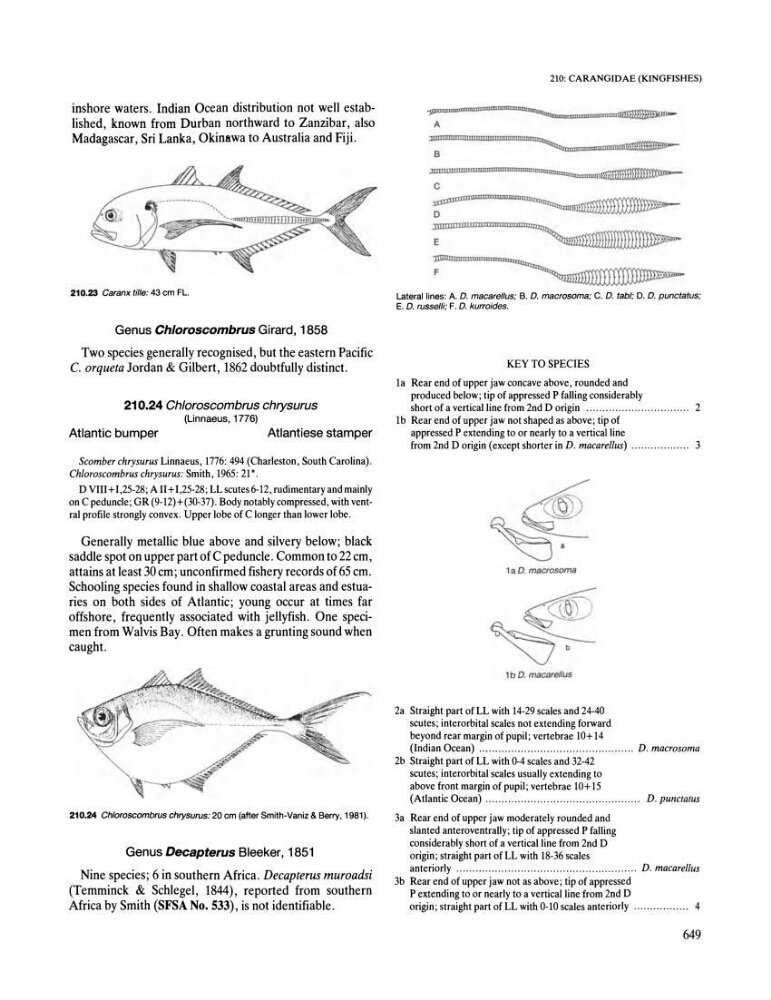
210.23 Caranx til/e: 43 em FL.
Genus Chloroscombrus Girard, 1858
Two species generally recognised, but the eastern Pacific
C. orqueta Jordan & Gilbert, 1862 doubtfully distinct.
210.24 Chloroscombrus chrysurus
(Linnaeus, 1776)
Atlantic bumper
Atlantiese stamper
Scomber chrysurus Linnaeus, 1776: 494 (Charleston, South Carolina).
Chloroscombrus chrysurus: Smith, 1965: 21 *.
D VIII+I,25-28; A II+I,25-28; LLscutes6-12, rudimentary and mainly
on C peduncle; GR (9-12}+(30-37). Body notably compressed, with ventral profile strongly convex. Upper lobe of C longer than lower lobe.
Generally metallic blue above and silvery below; black
saddle spot on upper part of C peduncle. Common to 22 ern,
attains at least 30 cm; unconfirmed fishery records of 65 cm.
Schooling species found in shallow coastal areas and estuaries on both sides of Atlantic; young occur at times far
offshore, frequently associated with jellyfish. One specimen from Walvis Bay. Often makes a grunting sound when
caught.
210.24 Chloroscombrus chrysurus: 20 em (after Smith-Vaniz & Berry. 1981).
Genus Decapterus Bleeker, 1851
Nine species; 6 in southern Africa. Decapterus muroadsi
(Temminck & Schlegel, 1844), reported from southern
Africa by Smith (SFSA No. 533), is not identifiable.
210: CARANGIDAE (KINGFISHES)
')SII<"t",,"mnm,""
1III"''''''~'''''''!1
I "aJl"~
A
~II!I!!II""J!lIJIIII~I'''''''iiliI!II~
=="""I"I'II""I"I""""'J~~
C
o
E
F
Lateral lines: A. D. macarellus; B. D. macrosoma; C. D. tabl; D. D. punctatus;
E. D. russelli; F. D. kurroides.
KEY TO SPECIES
la Rear end of upper jaw concave above, rounded and
produced below; tip of appressed P falling considerably
short of a vertical line from 2nd D origin ................................ 2
1 b Rear end of upper jaw not shaped as above; tip of
appressed P extending to or nearly to a vertical line
from 2nd D origin (except shorter in D. macarellus) .................. 3
1 a D. macrosoma
1 b D. maearellus
2a Straight part of LL with 14-29 scales and 24-40
scutes; interorbital scales not extending forward
beyond rear margin of pupil; vertebrae 10+ 14
(Indian Ocean) ................................................ D. macrosoma
2b Straight part of LL with 0-4 scales and 32-42
scutes; interorbital scales usually extending to
above front margin of pupil; vertebrae 10+ 15
(Atlantic Ocean) ................................................ D. punctatus
3a Rear end of upper jaw moderately rounded and
slanted anteroventrally; tip of appressed P falling
considerably short of a vertical line from 2nd D
origin; straight part of LL with 18-36 scales
anteriorly ........................................................ D. macarellus
3b Rear end of upper jaw not as above; tip of appressed
P extending to or nearly to a vertical line from 2nd D
origin; straight part of LL with 0-10 scales anteriorly ................. 4
649
Madagascar, Sri Lanka, Okinawa to Australia and Fiji.
210.23 Caranx til/e: 43 em FL.
Genus Chloroscombrus Girard, 1858
Two species generally recognised, but the eastern Pacific
C. orqueta Jordan & Gilbert, 1862 doubtfully distinct.
210.24 Chloroscombrus chrysurus
(Linnaeus, 1776)
Atlantic bumper
Atlantiese stamper
Scomber chrysurus Linnaeus, 1776: 494 (Charleston, South Carolina).
Chloroscombrus chrysurus: Smith, 1965: 21 *.
D VIII+I,25-28; A II+I,25-28; LLscutes6-12, rudimentary and mainly
on C peduncle; GR (9-12}+(30-37). Body notably compressed, with ventral profile strongly convex. Upper lobe of C longer than lower lobe.
Generally metallic blue above and silvery below; black
saddle spot on upper part of C peduncle. Common to 22 ern,
attains at least 30 cm; unconfirmed fishery records of 65 cm.
Schooling species found in shallow coastal areas and estuaries on both sides of Atlantic; young occur at times far
offshore, frequently associated with jellyfish. One specimen from Walvis Bay. Often makes a grunting sound when
caught.
210.24 Chloroscombrus chrysurus: 20 em (after Smith-Vaniz & Berry. 1981).
Genus Decapterus Bleeker, 1851
Nine species; 6 in southern Africa. Decapterus muroadsi
(Temminck & Schlegel, 1844), reported from southern
Africa by Smith (SFSA No. 533), is not identifiable.
210: CARANGIDAE (KINGFISHES)
')SII<"t",,"mnm,""
1III"''''''~'''''''!1
I "aJl"~
A
~II!I!!II""J!lIJIIII~I'''''''iiliI!II~
=="""I"I'II""I"I""""'J~~
C
o
E
F
Lateral lines: A. D. macarellus; B. D. macrosoma; C. D. tabl; D. D. punctatus;
E. D. russelli; F. D. kurroides.
KEY TO SPECIES
la Rear end of upper jaw concave above, rounded and
produced below; tip of appressed P falling considerably
short of a vertical line from 2nd D origin ................................ 2
1 b Rear end of upper jaw not shaped as above; tip of
appressed P extending to or nearly to a vertical line
from 2nd D origin (except shorter in D. macarellus) .................. 3
1 a D. macrosoma
1 b D. maearellus
2a Straight part of LL with 14-29 scales and 24-40
scutes; interorbital scales not extending forward
beyond rear margin of pupil; vertebrae 10+ 14
(Indian Ocean) ................................................ D. macrosoma
2b Straight part of LL with 0-4 scales and 32-42
scutes; interorbital scales usually extending to
above front margin of pupil; vertebrae 10+ 15
(Atlantic Ocean) ................................................ D. punctatus
3a Rear end of upper jaw moderately rounded and
slanted anteroventrally; tip of appressed P falling
considerably short of a vertical line from 2nd D
origin; straight part of LL with 18-36 scales
anteriorly ........................................................ D. macarellus
3b Rear end of upper jaw not as above; tip of appressed
P extending to or nearly to a vertical line from 2nd D
origin; straight part of LL with 0-10 scales anteriorly ................. 4
649