

Family No. 192: EPHIPPIDAE
by M.M. Smith
Batfishes
Vlermuisvisse
Deep compressed body with moderate to small ctenoid
scales. Head short, parabolic profile; no scales in front of
eye. Mouth small, terminal with tricuspid teeth; 6 branchiostegals, gasbladder present; vertebrae 10+ 14.
In this family is included the Platacidae but not the Drepanidae. Five genera: 2 in our area plus Chaetodipterus
Lacepede, 1802 (synonym Ephippus Cuvier, 1816) from the
Pacific and Atlantic, Parapsettus Steindachner, 1876 from
the East Pacific and Zabidius Whitley, 1930 from Australia.
KEY TO GENERA
1a 0 spines not easily seen, graduated up and confluent
with soft fin; LL 50 or more ..................................... .. .... Platax
1b 0 spines strong, distinct, 3-5th longest, longer
than soft-rays; LL 43-45 ........................................ Tripterodon
Genus Platax Cuvier, 1816
Easily recognised by the smooth dorsal profile sweeping
uninterruptedly to the long soft dorsal anterior rays. Lower
GR 8-10; preopercle margin smooth in adults; teeth slender
but dilated and tricuspid apically, a few teeth on vomer in
some species. Scales small and adherent; nearly the whole
interorbital naked. Considerable changes occur in shape
with growth; juveniles with very elongate D and A. Generally caught by nets; flesh not esteemed. Difficulty in distinguishing between the species caused the genus at one time
to be considered monotypic. Now, however, 4 species are
recognised, 3 from our area; P. batavianus Cuvier, 1831
from Australia and the Pacific has D VI-VII,28-32 and
A III,19-21.
KEY TO SPECIES
1a All 3 cusps on teeth subequal; mouth profile
rounded; anterior dorsal profile of head smoothly
convex; scales small: 40-45 from LL origin to 1st 0
spine; soft 0 and A greatly elongated; 28-34 0 rays ........... P. teira
1 b Middle tooth cusp longer and stronger than
lateral cusps, mouth profile pointed; 25-30 scales
from LL origin to 1st 0 spine; 35-37 0 rays ............................. 2
2a Snout convex; chin with 5 mandibular pores each
side ................................................................ P. orbicularis
2b Snout concave before eyes; chin with 3-4
mandibular pores each side; colour generally
dark most of life .................................................. P. pinnatus
192: EPHIPPIDAE (BA TFISHES)
192.1 Platax orbicularis
(Forsskal,1775)
Orbicular batfish
Ronde vlermuisvis
Chaetodon orbicularis Forsskal, 1775: 59 (Djedda, Red Sea). Platax
vespertilio: Barnard, 1927: 606. Platax pinnatus (non Linnaeus): Smith,
SFSA No. 577* .
o V,36-37; A III,26-27; P 17-19; LL48-56.
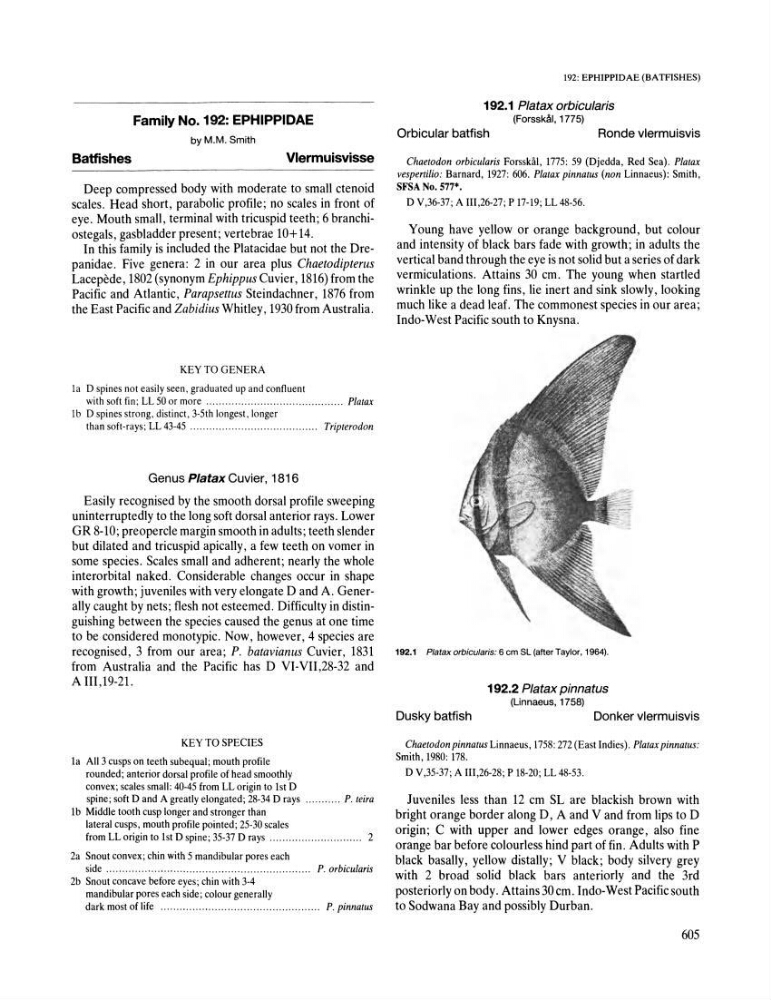
Young have yellow or orange background, but colour
and intensity of black bars fade with growth; in adults the
vertical band through the eye is not solid but a series of dark
vermiculations. Attains 30 cm. The young when startled
wrinkle up the long fins, lie inert and sink slowly, looking
much like a dead leaf. The commonest species in our area;
Indo-West Pacific south to Knysna.
192.1 Platax orbicularis: 6 em SL (after Taylor, 1964).
192.2 Platax pinnatus
(Linnaeus, 1758)
Dusky batfish
Danker vlermuisvis
Chaetodon pinnatus Linnaeus, 1758: 272 (East Indies). Platax pinnatus:
Smith, 1980: 178.
o V,35-37; A III,26-28; P 18-20; LL 48-53.
Juveniles less than 12 cm SL are blackish brown with
bright orange border along D, A and V and from lips to D
origin; C with upper and lower edges orange, also fine
orange bar before colourless hind part of fin. Adults with P
black basally, yellow distally; V black; body silvery grey
with 2 broad solid black bars anteriorly and the 3rd
posteriorly on body. Attains 30 cm. Indo-West Pacific south
to Sodwana Bay and possibly Durban.
605
by M.M. Smith
Batfishes
Vlermuisvisse
Deep compressed body with moderate to small ctenoid
scales. Head short, parabolic profile; no scales in front of
eye. Mouth small, terminal with tricuspid teeth; 6 branchiostegals, gasbladder present; vertebrae 10+ 14.
In this family is included the Platacidae but not the Drepanidae. Five genera: 2 in our area plus Chaetodipterus
Lacepede, 1802 (synonym Ephippus Cuvier, 1816) from the
Pacific and Atlantic, Parapsettus Steindachner, 1876 from
the East Pacific and Zabidius Whitley, 1930 from Australia.
KEY TO GENERA
1a 0 spines not easily seen, graduated up and confluent
with soft fin; LL 50 or more ..................................... .. .... Platax
1b 0 spines strong, distinct, 3-5th longest, longer
than soft-rays; LL 43-45 ........................................ Tripterodon
Genus Platax Cuvier, 1816
Easily recognised by the smooth dorsal profile sweeping
uninterruptedly to the long soft dorsal anterior rays. Lower
GR 8-10; preopercle margin smooth in adults; teeth slender
but dilated and tricuspid apically, a few teeth on vomer in
some species. Scales small and adherent; nearly the whole
interorbital naked. Considerable changes occur in shape
with growth; juveniles with very elongate D and A. Generally caught by nets; flesh not esteemed. Difficulty in distinguishing between the species caused the genus at one time
to be considered monotypic. Now, however, 4 species are
recognised, 3 from our area; P. batavianus Cuvier, 1831
from Australia and the Pacific has D VI-VII,28-32 and
A III,19-21.
KEY TO SPECIES
1a All 3 cusps on teeth subequal; mouth profile
rounded; anterior dorsal profile of head smoothly
convex; scales small: 40-45 from LL origin to 1st 0
spine; soft 0 and A greatly elongated; 28-34 0 rays ........... P. teira
1 b Middle tooth cusp longer and stronger than
lateral cusps, mouth profile pointed; 25-30 scales
from LL origin to 1st 0 spine; 35-37 0 rays ............................. 2
2a Snout convex; chin with 5 mandibular pores each
side ................................................................ P. orbicularis
2b Snout concave before eyes; chin with 3-4
mandibular pores each side; colour generally
dark most of life .................................................. P. pinnatus
192: EPHIPPIDAE (BA TFISHES)
192.1 Platax orbicularis
(Forsskal,1775)
Orbicular batfish
Ronde vlermuisvis
Chaetodon orbicularis Forsskal, 1775: 59 (Djedda, Red Sea). Platax
vespertilio: Barnard, 1927: 606. Platax pinnatus (non Linnaeus): Smith,
SFSA No. 577* .
o V,36-37; A III,26-27; P 17-19; LL48-56.
Young have yellow or orange background, but colour
and intensity of black bars fade with growth; in adults the
vertical band through the eye is not solid but a series of dark
vermiculations. Attains 30 cm. The young when startled
wrinkle up the long fins, lie inert and sink slowly, looking
much like a dead leaf. The commonest species in our area;
Indo-West Pacific south to Knysna.
192.1 Platax orbicularis: 6 em SL (after Taylor, 1964).
192.2 Platax pinnatus
(Linnaeus, 1758)
Dusky batfish
Danker vlermuisvis
Chaetodon pinnatus Linnaeus, 1758: 272 (East Indies). Platax pinnatus:
Smith, 1980: 178.
o V,35-37; A III,26-28; P 18-20; LL 48-53.
Juveniles less than 12 cm SL are blackish brown with
bright orange border along D, A and V and from lips to D
origin; C with upper and lower edges orange, also fine
orange bar before colourless hind part of fin. Adults with P
black basally, yellow distally; V black; body silvery grey
with 2 broad solid black bars anteriorly and the 3rd
posteriorly on body. Attains 30 cm. Indo-West Pacific south
to Sodwana Bay and possibly Durban.
605