

189: KYPHOSIDAE (SEA CHUBS)
D X-XI,14; A III,12-14; P 19-20; GR (9-lO)+(20-24) = 30-34; LL 7780 (58-61 pores).
Colour slate blue with brilliant bronzy lines along head
and scale rows of body; P orange. Attains 60 cm. IndoPacific south to Algoa Bay.
Family No. 190: SCORPIDIDAE
by M.M. Smith
Stonebreams
Stinkvisse
Body compressed, ovate, covered with small, firmly
adherent, ctenoid scales which extend onto head and soft
parts of vertical fins. Dorsal fin with 6-8 short spines; anal
fin with 3 minute spines covered by skin and scales at front
margin of fin; pelvic fins small but distinct, with 1 spine and
5 branched rays. Mouth small; jaws with fine teeth in bands,
outer row enlarged, pointed.
At least 7 genera with 9 species, mostly in the Pacific and
around Australia; anti-tropical distribution. (Parascorpis
is, in this work, placed in its own family, Parascorpididae.)
One genus in our area.
Genus Neoscorpis Smith, 1931
Preoperc1e not serrated; gasbladder posteriorly divided.
A single endemic species.
Stonebream
190.1 Neoscorpis lithophilus
(Gilchrist & Thompson, 1908)
PLATE 68
Stinkvis
Scorpis lithophilus Gilchrist & Thompson, 1908: 162 (Natal). Neoscorpis lithophilus Smith, SFSA No. 646*; Smith & Smith, 1966: 129*; van der
Elst, 1981: 282*.
D VI-VIII+20-25; A III,23-26; P 16-18; GR (6-8)+(12-15) = 20-23;
LL 72-76; LS 90-97.
Eats red and green algae; it has been suggested that the
black lining of the coelomic cavity stops photosynthesis of
the algae in the gut. Similar habitat to banded galjoen.
Sexually mature at 35 cm; spawns spring to summer off
Natal; uses tidepools as nursery areas. Attains 50 cm,
angling record 2.5 kg; takes shrimp and redbait readily and
affords good sport on light tackle. Good eating despite
unpleasant odour from intestine. False Bay to southern
Mozambique in shallow rocky areas.
604
Family No. 191: SCATOPHAGIDAE
by P.C. Heemstra
Scatties
Skatties
Body compressed, covered with minute, ctenoid scales;
lateral line complete. Head scaly; no spines or serrae on
head bones. Postlarvae with bony shields on the head and a
large spine at the shoulder, all vanishing with growth. Jaws
not protrusile, with bands of minute, slender, tricuspid,
movable teeth; vomer and palatines edentate. Maxilla
covered by preorbital bone. Fins with strong spines that can
produce a painful wound; anal fin spines 4; pelvic fins with
1 spine and 5 branched rays; caudal fin branched rays 14.
Gasbladder simple. Branchiostegal membranes united,
forming a narrow fold across isthmus; branchiostegals 6;
gill-rakers short and slender.
Two genera and 3 or 4 species; 1 species in our area.
Scatty
191.1 Scatophagus tetracanthus
(Lacepede, 1801)
PLATE 68
Skattie
Chaetodon tetracanthus Lacepede, 1801: PI. 25, Fig. 2 (no locality);
1802: 726. Scatophagus tetracanthus: Smith, SFSA No. 582*.
D XlI,15-18; A IV,14-15; P 16; GR 9-11. Depth 1.4-1.6, head 3.1-3.3 in
SL; eye 1.9-2.1 in interorbital.
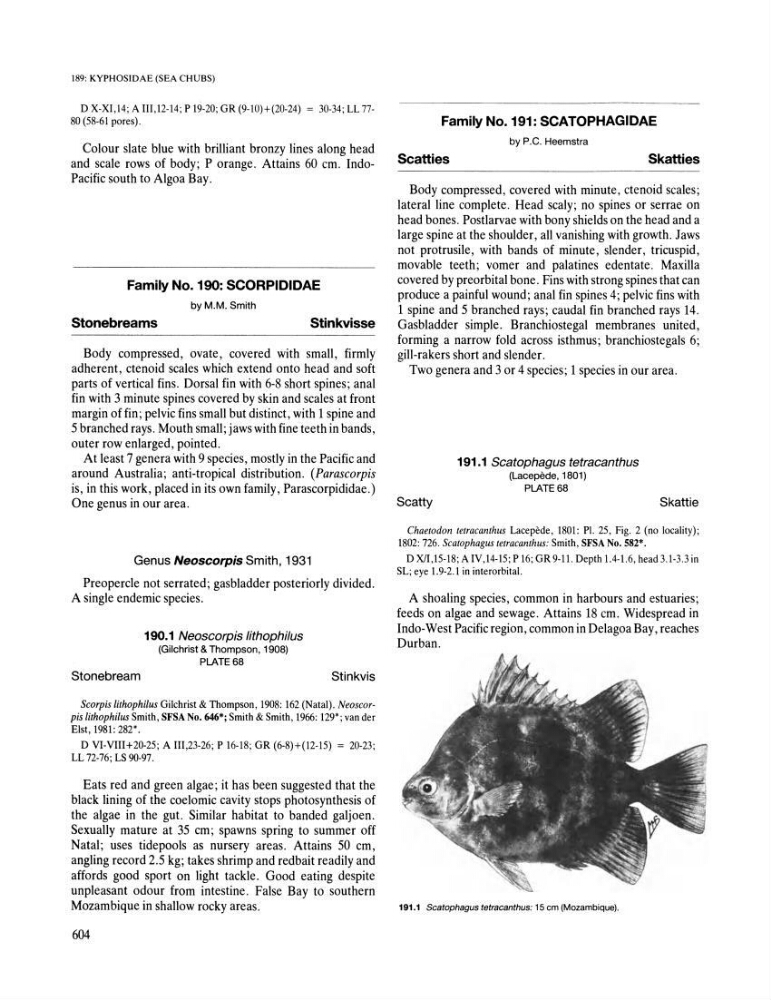
A shoaling species, common in harbours and estuaries;
feeds on algae and sewage. Attains 18 cm. Widespread in
Indo-West Pacific region, common in Delagoa Bay, reaches
Durban.
191.1 Scatophagus tetracanthus: 15 em (Mozambique).
D X-XI,14; A III,12-14; P 19-20; GR (9-lO)+(20-24) = 30-34; LL 7780 (58-61 pores).
Colour slate blue with brilliant bronzy lines along head
and scale rows of body; P orange. Attains 60 cm. IndoPacific south to Algoa Bay.
Family No. 190: SCORPIDIDAE
by M.M. Smith
Stonebreams
Stinkvisse
Body compressed, ovate, covered with small, firmly
adherent, ctenoid scales which extend onto head and soft
parts of vertical fins. Dorsal fin with 6-8 short spines; anal
fin with 3 minute spines covered by skin and scales at front
margin of fin; pelvic fins small but distinct, with 1 spine and
5 branched rays. Mouth small; jaws with fine teeth in bands,
outer row enlarged, pointed.
At least 7 genera with 9 species, mostly in the Pacific and
around Australia; anti-tropical distribution. (Parascorpis
is, in this work, placed in its own family, Parascorpididae.)
One genus in our area.
Genus Neoscorpis Smith, 1931
Preoperc1e not serrated; gasbladder posteriorly divided.
A single endemic species.
Stonebream
190.1 Neoscorpis lithophilus
(Gilchrist & Thompson, 1908)
PLATE 68
Stinkvis
Scorpis lithophilus Gilchrist & Thompson, 1908: 162 (Natal). Neoscorpis lithophilus Smith, SFSA No. 646*; Smith & Smith, 1966: 129*; van der
Elst, 1981: 282*.
D VI-VIII+20-25; A III,23-26; P 16-18; GR (6-8)+(12-15) = 20-23;
LL 72-76; LS 90-97.
Eats red and green algae; it has been suggested that the
black lining of the coelomic cavity stops photosynthesis of
the algae in the gut. Similar habitat to banded galjoen.
Sexually mature at 35 cm; spawns spring to summer off
Natal; uses tidepools as nursery areas. Attains 50 cm,
angling record 2.5 kg; takes shrimp and redbait readily and
affords good sport on light tackle. Good eating despite
unpleasant odour from intestine. False Bay to southern
Mozambique in shallow rocky areas.
604
Family No. 191: SCATOPHAGIDAE
by P.C. Heemstra
Scatties
Skatties
Body compressed, covered with minute, ctenoid scales;
lateral line complete. Head scaly; no spines or serrae on
head bones. Postlarvae with bony shields on the head and a
large spine at the shoulder, all vanishing with growth. Jaws
not protrusile, with bands of minute, slender, tricuspid,
movable teeth; vomer and palatines edentate. Maxilla
covered by preorbital bone. Fins with strong spines that can
produce a painful wound; anal fin spines 4; pelvic fins with
1 spine and 5 branched rays; caudal fin branched rays 14.
Gasbladder simple. Branchiostegal membranes united,
forming a narrow fold across isthmus; branchiostegals 6;
gill-rakers short and slender.
Two genera and 3 or 4 species; 1 species in our area.
Scatty
191.1 Scatophagus tetracanthus
(Lacepede, 1801)
PLATE 68
Skattie
Chaetodon tetracanthus Lacepede, 1801: PI. 25, Fig. 2 (no locality);
1802: 726. Scatophagus tetracanthus: Smith, SFSA No. 582*.
D XlI,15-18; A IV,14-15; P 16; GR 9-11. Depth 1.4-1.6, head 3.1-3.3 in
SL; eye 1.9-2.1 in interorbital.
A shoaling species, common in harbours and estuaries;
feeds on algae and sewage. Attains 18 cm. Widespread in
Indo-West Pacific region, common in Delagoa Bay, reaches
Durban.
191.1 Scatophagus tetracanthus: 15 em (Mozambique).