

185 : LETHRINIDAE (EMPERORS)
D X,9-1O; A III,9-1O; P 14; GR (3-4)+5; LL 46-51; 4 rows of cheek
scales; jaws with outer row of strong conical teeth, inner villiform teeth in
6-7 irregular rows.
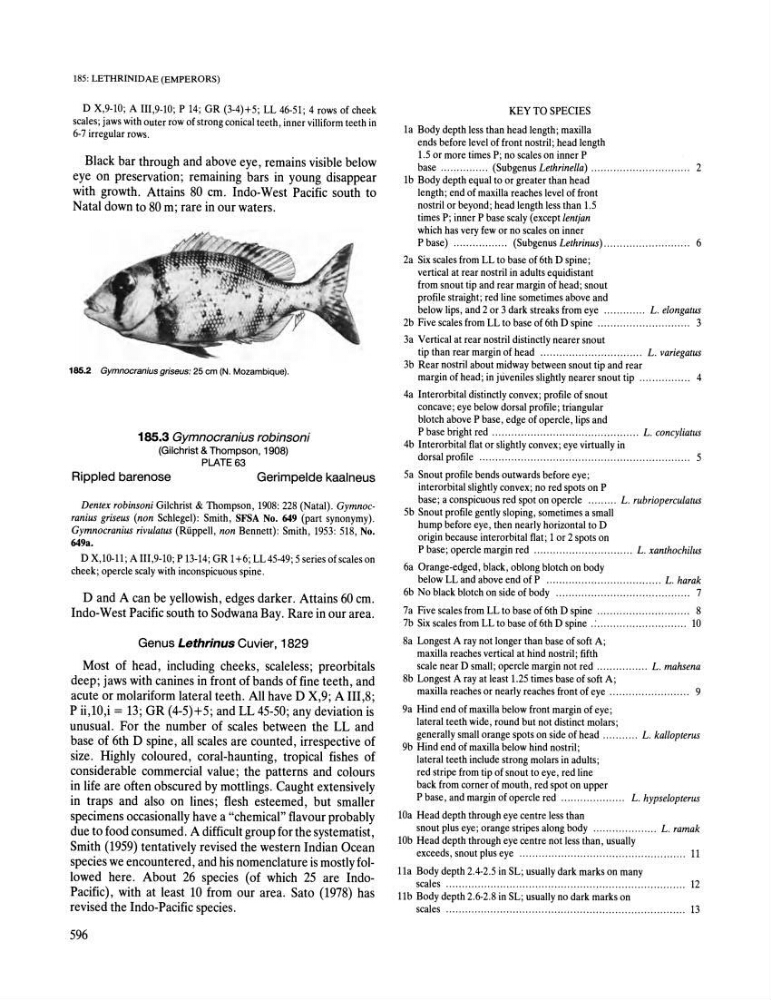
Black bar through and above eye, remains visible below
eye on preservation; remaining bars in young disappear
with growth. Attains 80 cm. Indo-West Pacific south to
Natal down to 80 m; rare in our waters.
185.2 Gymnocranius griseus: 25 em (N . Mozambique).
185.3 Gymnocranius robinsoni
(Gilchrist & Thompson, 1908)
PLATE 63
Rippled barenose
Gerimpelde kaalneus
Dentex robinsoni Gilchrist & Thompson, 1908: 228 (Natal). Gymnocranius griseus (non Schlegel): Smith, SFSA No. 649 (part synonymy) .
Gymnocranius rivulatus (Riippell, non Bennett): Smith , 1953: 518, No.
649a.
D X,lO-U ; A III,9-1O; P 13-14; GR 1+6; LL45-49; 5 series of scales on
cheek; opercle scaly with inconspicuous spine.
D and A can be yellowish, edges darker. Attains 60 cm.
Indo-West Pacific south to Sodwana Bay. Rare in our area.
Genus Lethrinus Cuvier, 1829
Most of head, including cheeks, scaleless; preorbitals
deep; jaws with canines in front of bands of fine teeth, and
acute or molariform lateral teeth. All have D X,9; A III,8;
P ii,lO,i = 13; GR (4-5)+5; and LL 45-50; any deviation is
unusual. For the number of scales between the LL and
base of 6th D spine, all scales are counted, irrespective of
size. Highly coloured, coral-haunting, tropical fishes of
considerable commercial value; the patterns and colours
in life are often obscured by mottlings. Caught extensively
in traps and also on lines; flesh esteemed, but smaller
specimens occasionally have a "chemical" flavour probably
due to food consumed. A difficult group for the systematist,
Smith (1959) tentatively revised the western Indian Ocean
species we encountered, and his nomenclature is mostly followed here. About 26 species (of which 25 are IndoPacific), with at least 10 from our area. Sato (1978) has
revised the Indo-Pacific species.
596
KEY TO SPECIES
la Body depth less than head length; maxilla
ends before level offront nostril; head length
1.5 or more times P; no scales on inner P
base ....... .. ...... (Subgenus Lethrinella) ....... ... .. ...... ............. 2
Ib Body depth equal to or greater than head
length; end of maxilla reaches level of front
nostril or beyond; head length less than 1.5
times P; inner P base scaly (except lent jan
which has very few or no scales on inner
P base) ... ........ ...... (Subgenus Lethrinus) .... .. ... .... ... .. ..... .. .. 6
2a Six scales from LL to base of 6th D spine;
vertical at rear nostril in adults equidistant
from snout tip and rear margin of head; snout
profile straight; red line sometimes above and
below lips, and 2 or 3 dark streaks from eye .. .. .. ... .. .. L. elongatus
2b Five scales from LL to base of 6th D spine ....... .. ...... ...... .. .. .... 3
3a Vertical at rear nostril distinctly nearer snout
tip than rear margin of head .. .. .. .... .......... .. ......... . L. variegatus
3b Rear nostril about midway between snout tip and rear
margin of head; in juveniles slightly nearer snout tip .. .... ... .. ..... 4
4a Interorbital distinctly convex; profile of snout
concave; eye below dorsal profile; triangular
blotch above P base, edge of opercle, lips and
P base bright red .. .. ...... ....... ...... .... ....... ... .. ...... . L. concyliatus
4b Interorbital flat or slightly convex; eye virtually in
dorsal profile ... .. ............ ...... .. .......... .......... ..... .. ..... .. ....... 5
Sa Snout profile bends outwards before eye ;
interorbital slightly convex; no red spots on P
base; a conspicuous red spot on opercle .... .. ... L. rubrioperculatus
5b Snout profile gently sloping, sometimes a small
hump before eye, then nearly horizontal to D
origin because interorbital flat; 1 or 2 spots on
P base ; opercle margin red ............... ................ L. xanthochilus
6a Orange-edged, black, oblong blotch on body
below LL and above end of P ............ .... .. .. .. .. ...... .. .... L. harak
6b No black blotch on side of body ...... .. ......... .......... .. ............. 7
7a Five scales from LL to base of 6th D spine ... ...... .. ...... ........ .... 8
7b Six scales from LL to base of 6th D spine .:.. .. .... .. .. .......... ...... 10
8a Longest A ray not longer than base of soft A;
maxilla reaches vertical at hind nostril; fifth
scale near D small; opercle margin not red ...... ..... .. .. . L. mahsena
8b Longest A ray at least 1.25 times base of soft A;
maxilla reaches or nearly reaches front of eye .... ...... .. ............. 9
9a Hind end of maxilla below front margin of eye ;
lateral teeth wide, round but not distinct molars;
generally small orange spots on side of head ... .. ... ... L. kallopterus
9b Hind end of maxilla below hind nostril;
lateral teeth include strong molars in adults;
red stripe from tip of snout to eye, red line
back from corner of mouth, red spot on upper
P base, and margin of opercle red .. .. .. .............. L. hypselopterus
lOa Head depth through eye centre less than
snout plus eye ; orange stripes along body ...... .... .. ...... .. L. ramak
lOb Head depth through eye centre not less than, usually
exceeds, snout plus eye .. .. .. .. .. .. .. ............... ................... .... 11
l1a Body depth 2.4-2.5 in SL; usually dark marks on many
scales .............. .. ...... .. .. .... .. ... .. .. .... .... .... .. ... .. ... .... .... ... ... 12
lIb Body depth 2.6-2.8 in SL; usually no dark marks on
scales ... ... ...... .. ........ ... ... .... ..... ....... ..... ..... .... ... ............ .. 13
D X,9-1O; A III,9-1O; P 14; GR (3-4)+5; LL 46-51; 4 rows of cheek
scales; jaws with outer row of strong conical teeth, inner villiform teeth in
6-7 irregular rows.
Black bar through and above eye, remains visible below
eye on preservation; remaining bars in young disappear
with growth. Attains 80 cm. Indo-West Pacific south to
Natal down to 80 m; rare in our waters.
185.2 Gymnocranius griseus: 25 em (N . Mozambique).
185.3 Gymnocranius robinsoni
(Gilchrist & Thompson, 1908)
PLATE 63
Rippled barenose
Gerimpelde kaalneus
Dentex robinsoni Gilchrist & Thompson, 1908: 228 (Natal). Gymnocranius griseus (non Schlegel): Smith, SFSA No. 649 (part synonymy) .
Gymnocranius rivulatus (Riippell, non Bennett): Smith , 1953: 518, No.
649a.
D X,lO-U ; A III,9-1O; P 13-14; GR 1+6; LL45-49; 5 series of scales on
cheek; opercle scaly with inconspicuous spine.
D and A can be yellowish, edges darker. Attains 60 cm.
Indo-West Pacific south to Sodwana Bay. Rare in our area.
Genus Lethrinus Cuvier, 1829
Most of head, including cheeks, scaleless; preorbitals
deep; jaws with canines in front of bands of fine teeth, and
acute or molariform lateral teeth. All have D X,9; A III,8;
P ii,lO,i = 13; GR (4-5)+5; and LL 45-50; any deviation is
unusual. For the number of scales between the LL and
base of 6th D spine, all scales are counted, irrespective of
size. Highly coloured, coral-haunting, tropical fishes of
considerable commercial value; the patterns and colours
in life are often obscured by mottlings. Caught extensively
in traps and also on lines; flesh esteemed, but smaller
specimens occasionally have a "chemical" flavour probably
due to food consumed. A difficult group for the systematist,
Smith (1959) tentatively revised the western Indian Ocean
species we encountered, and his nomenclature is mostly followed here. About 26 species (of which 25 are IndoPacific), with at least 10 from our area. Sato (1978) has
revised the Indo-Pacific species.
596
KEY TO SPECIES
la Body depth less than head length; maxilla
ends before level offront nostril; head length
1.5 or more times P; no scales on inner P
base ....... .. ...... (Subgenus Lethrinella) ....... ... .. ...... ............. 2
Ib Body depth equal to or greater than head
length; end of maxilla reaches level of front
nostril or beyond; head length less than 1.5
times P; inner P base scaly (except lent jan
which has very few or no scales on inner
P base) ... ........ ...... (Subgenus Lethrinus) .... .. ... .... ... .. ..... .. .. 6
2a Six scales from LL to base of 6th D spine;
vertical at rear nostril in adults equidistant
from snout tip and rear margin of head; snout
profile straight; red line sometimes above and
below lips, and 2 or 3 dark streaks from eye .. .. .. ... .. .. L. elongatus
2b Five scales from LL to base of 6th D spine ....... .. ...... ...... .. .. .... 3
3a Vertical at rear nostril distinctly nearer snout
tip than rear margin of head .. .. .. .... .......... .. ......... . L. variegatus
3b Rear nostril about midway between snout tip and rear
margin of head; in juveniles slightly nearer snout tip .. .... ... .. ..... 4
4a Interorbital distinctly convex; profile of snout
concave; eye below dorsal profile; triangular
blotch above P base, edge of opercle, lips and
P base bright red .. .. ...... ....... ...... .... ....... ... .. ...... . L. concyliatus
4b Interorbital flat or slightly convex; eye virtually in
dorsal profile ... .. ............ ...... .. .......... .......... ..... .. ..... .. ....... 5
Sa Snout profile bends outwards before eye ;
interorbital slightly convex; no red spots on P
base; a conspicuous red spot on opercle .... .. ... L. rubrioperculatus
5b Snout profile gently sloping, sometimes a small
hump before eye, then nearly horizontal to D
origin because interorbital flat; 1 or 2 spots on
P base ; opercle margin red ............... ................ L. xanthochilus
6a Orange-edged, black, oblong blotch on body
below LL and above end of P ............ .... .. .. .. .. ...... .. .... L. harak
6b No black blotch on side of body ...... .. ......... .......... .. ............. 7
7a Five scales from LL to base of 6th D spine ... ...... .. ...... ........ .... 8
7b Six scales from LL to base of 6th D spine .:.. .. .... .. .. .......... ...... 10
8a Longest A ray not longer than base of soft A;
maxilla reaches vertical at hind nostril; fifth
scale near D small; opercle margin not red ...... ..... .. .. . L. mahsena
8b Longest A ray at least 1.25 times base of soft A;
maxilla reaches or nearly reaches front of eye .... ...... .. ............. 9
9a Hind end of maxilla below front margin of eye ;
lateral teeth wide, round but not distinct molars;
generally small orange spots on side of head ... .. ... ... L. kallopterus
9b Hind end of maxilla below hind nostril;
lateral teeth include strong molars in adults;
red stripe from tip of snout to eye, red line
back from corner of mouth, red spot on upper
P base, and margin of opercle red .. .. .. .............. L. hypselopterus
lOa Head depth through eye centre less than
snout plus eye ; orange stripes along body ...... .... .. ...... .. L. ramak
lOb Head depth through eye centre not less than, usually
exceeds, snout plus eye .. .. .. .. .. .. .. ............... ................... .... 11
l1a Body depth 2.4-2.5 in SL; usually dark marks on many
scales .............. .. ...... .. .. .... .. ... .. .. .... .... .... .. ... .. ... .... .... ... ... 12
lIb Body depth 2.6-2.8 in SL; usually no dark marks on
scales ... ... ...... .. ........ ... ... .... ..... ....... ..... ..... .... ... ............ .. 13