

183: SPARIDAE (SEABREAMS)
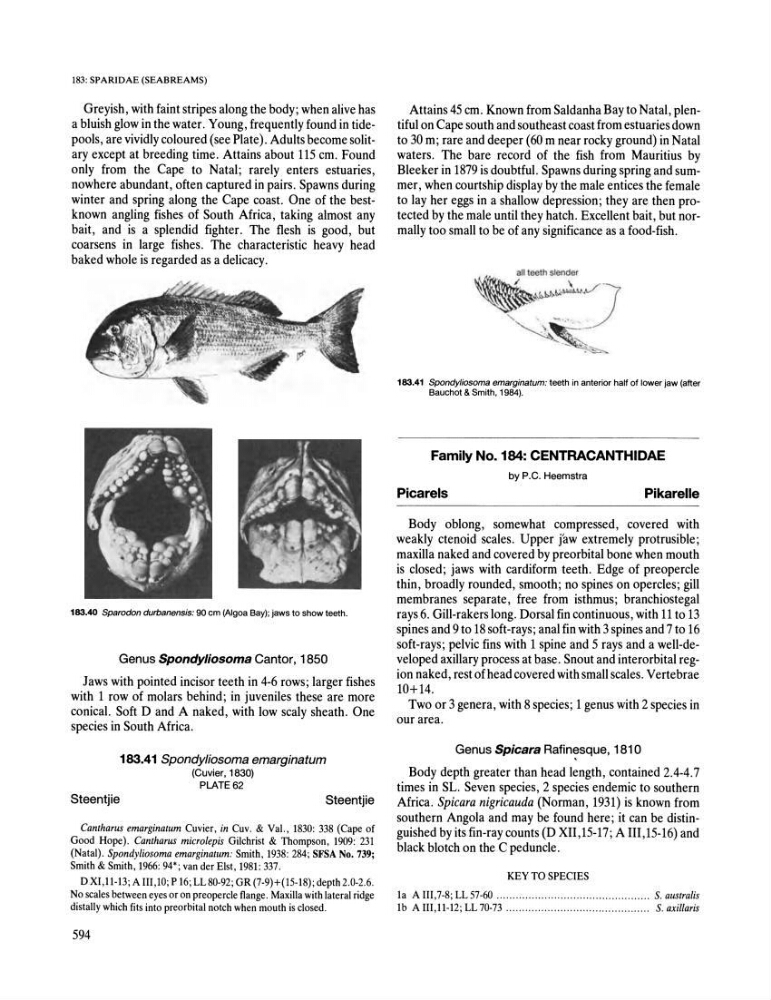
Greyish, with faint stripes along the body; when alive has
a bluish glow in the water. Young, frequently found in tidepools, are vividly coloured (see Plate). Adults become solitary except at breeding time. Attains about 115 cm. Found
only from the Cape to Natal; rarely enters estuaries,
nowhere abundant, often captured in pairs. Spawns during
winter and spring along the Cape coast. One of the bestknown angling fishes of South Africa, taking almost any
bait, and is a splendid fighter. The flesh is good, but
coarsens in large fishes. The characteristic heavy head
baked whole is regarded as a delicacy.
183.40 Sparodon durbanensis: 90 em (Algoa Bay); jaws to show teeth.
Genus Spondyliosoma Cantor, 1850
Jaws with pointed incisor teeth in 4-6 rows; larger fishes
with 1 row of molars behind; in juveniles these are more
conical. Soft D and A naked, with low scaly sheath. One
species in South Africa.
Steentjie
183.41 Spondyliosoma emarginatum
(Cuvier, 1830)
PLATE 62
Steentjie
Cantharus emarginatum Cuvier, in Cuv. & Val., 1830: 338 (Cape of
Good Hope). Cantharus microlepis Gilchrist & Thompson, 1909: 231
(Natal) . Spondyliosoma emarginatum: Smith, 1938: 284; SFSA No. 739;
Smith & Smith, 1966: 94*; van der Elst, 1981: 337.
D XI,ll-13 ; A m , lD; P 16; LL 80-92; GR (7-9)+(15-18); depth 2.0-2.6.
No scales between eyes or on preopercle flange. Maxilla with lateral ridge
distally which fits into preorbital notch when mouth is closed .
594
Attains 45 cm. Known from Saldanha Bay to Natal, plentiful on Cape south and southeast coast from estuaries down
to 30 m; rare and deeper (60 m near rocky ground) in Natal
waters. The bare record of the fish from Mauritius by
Bleeker in 1879 is doubtful. Spawns during spring and summer, when courtship display by the male entices the female
to lay her eggs in a shallow depression; they are then protected by the male until they hatch. Excellent bait, but normally too small to be of any significance as a food-fish .
all teeth slender
~:' .l.')
, " '~ " . . , .
~.
-
..... --..: ~"
. ......
183.41 Spondyliosoma emarginatum: teeth in anterior half of lower jaw (after
Bauehot & Smith, 1984).
Family No. 184: CENTRACANTHIDAE
by P.C. Heemstra
Picarels
Pikarelle
Body oblong, somewhat compressed, covered with
weakly ctenoid scales. Upper jaw extremely protrusible;
maxilla naked and covered by preorbital bone when mouth
is closed; jaws with cardiform teeth. Edge of preopercle
thin, broadly rounded, smooth; no spines on opercles; gill
membranes separate, free from isthmus; branchiostegal
rays 6. Gill-rakers long. Dorsal fin continuous, with 11 to 13
spines and 9 to 18 soft-rays; anal fin with 3 spines and 7 to 16
soft-rays; pelvic fins with 1 spine and 5 rays and a well-developed axillary process at base . Snout and interorbital region naked, rest of head covered with small scales. Vertebrae
10+14.
Two or 3 genera, with 8 species; 1 genus with 2 species in
our area.
Genus Spicara Rafinesque, 1810
,
Body depth greater than head length, contained 2.4-4.7
times in SL. Seven species, 2 species endemic to southern
Africa. Spicara nigricauda (Norman, 1931) is known from
southern Angola and may be found here; it can be distinguished by its fin-ray counts (D XII, 15-17; A III, 15-16) and
black blotch on the C peduncle.
KEY TO SPECIES
1a A III ,7-8; LL 57-60 ... .. ..... .... .... .. ... ........ .. ... ...... ... .. . S. australis
1b A III,1l-12; LL 70-73 ............... .. .......... .. .. ...... ...... .. S. axillaris
Greyish, with faint stripes along the body; when alive has
a bluish glow in the water. Young, frequently found in tidepools, are vividly coloured (see Plate). Adults become solitary except at breeding time. Attains about 115 cm. Found
only from the Cape to Natal; rarely enters estuaries,
nowhere abundant, often captured in pairs. Spawns during
winter and spring along the Cape coast. One of the bestknown angling fishes of South Africa, taking almost any
bait, and is a splendid fighter. The flesh is good, but
coarsens in large fishes. The characteristic heavy head
baked whole is regarded as a delicacy.
183.40 Sparodon durbanensis: 90 em (Algoa Bay); jaws to show teeth.
Genus Spondyliosoma Cantor, 1850
Jaws with pointed incisor teeth in 4-6 rows; larger fishes
with 1 row of molars behind; in juveniles these are more
conical. Soft D and A naked, with low scaly sheath. One
species in South Africa.
Steentjie
183.41 Spondyliosoma emarginatum
(Cuvier, 1830)
PLATE 62
Steentjie
Cantharus emarginatum Cuvier, in Cuv. & Val., 1830: 338 (Cape of
Good Hope). Cantharus microlepis Gilchrist & Thompson, 1909: 231
(Natal) . Spondyliosoma emarginatum: Smith, 1938: 284; SFSA No. 739;
Smith & Smith, 1966: 94*; van der Elst, 1981: 337.
D XI,ll-13 ; A m , lD; P 16; LL 80-92; GR (7-9)+(15-18); depth 2.0-2.6.
No scales between eyes or on preopercle flange. Maxilla with lateral ridge
distally which fits into preorbital notch when mouth is closed .
594
Attains 45 cm. Known from Saldanha Bay to Natal, plentiful on Cape south and southeast coast from estuaries down
to 30 m; rare and deeper (60 m near rocky ground) in Natal
waters. The bare record of the fish from Mauritius by
Bleeker in 1879 is doubtful. Spawns during spring and summer, when courtship display by the male entices the female
to lay her eggs in a shallow depression; they are then protected by the male until they hatch. Excellent bait, but normally too small to be of any significance as a food-fish .
all teeth slender
~:' .l.')
, " '~ " . . , .
~.
-
..... --..: ~"
. ......
183.41 Spondyliosoma emarginatum: teeth in anterior half of lower jaw (after
Bauehot & Smith, 1984).
Family No. 184: CENTRACANTHIDAE
by P.C. Heemstra
Picarels
Pikarelle
Body oblong, somewhat compressed, covered with
weakly ctenoid scales. Upper jaw extremely protrusible;
maxilla naked and covered by preorbital bone when mouth
is closed; jaws with cardiform teeth. Edge of preopercle
thin, broadly rounded, smooth; no spines on opercles; gill
membranes separate, free from isthmus; branchiostegal
rays 6. Gill-rakers long. Dorsal fin continuous, with 11 to 13
spines and 9 to 18 soft-rays; anal fin with 3 spines and 7 to 16
soft-rays; pelvic fins with 1 spine and 5 rays and a well-developed axillary process at base . Snout and interorbital region naked, rest of head covered with small scales. Vertebrae
10+14.
Two or 3 genera, with 8 species; 1 genus with 2 species in
our area.
Genus Spicara Rafinesque, 1810
,
Body depth greater than head length, contained 2.4-4.7
times in SL. Seven species, 2 species endemic to southern
Africa. Spicara nigricauda (Norman, 1931) is known from
southern Angola and may be found here; it can be distinguished by its fin-ray counts (D XII, 15-17; A III, 15-16) and
black blotch on the C peduncle.
KEY TO SPECIES
1a A III ,7-8; LL 57-60 ... .. ..... .... .... .. ... ........ .. ... ...... ... .. . S. australis
1b A III,1l-12; LL 70-73 ............... .. .......... .. .. ...... ...... .. S. axillaris