

183.37 Rhabdosargus sarba
(Forsskal,1775)
PLATE 62
Natal stumpnose
Natalse stompneus
Sparus sarba Forsskal, 1775: xi, 31 (Djedda, Red Sea). Sargusauriventris Peters, 1855: 243 (Mozambique). Chrysophrys natalensis Castelnau,
1861: 25 (Natal). Austrosparus sarba: Smith, 1938: 245*. Rhabdosargus
sarba: Smith, SFSA No. 710*; Smith & Smith, 1966: 49*; Smith, 1979:
707*; van der Elst, 1981: 334* (in part).
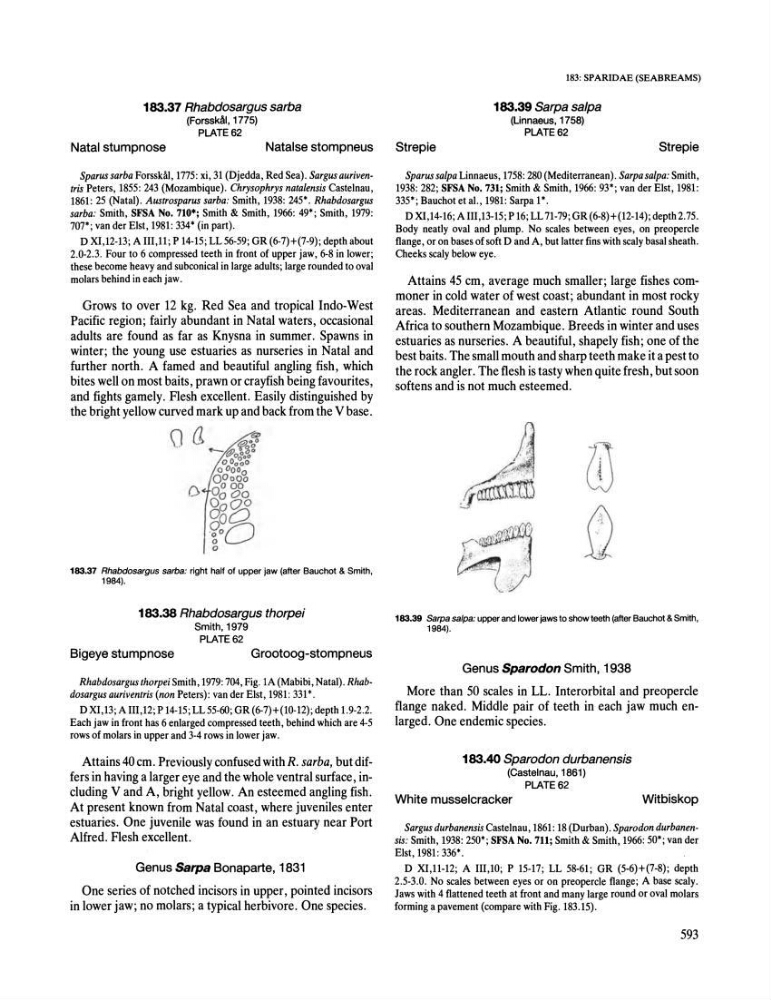
D XI,12-13; A 1II,1l; P 14-15; LL 56-59; GR (6-7)+(7-9); depth about
2.0-2.3. Four to 6 compressed teeth in front of upper jaw, 6-8 in lower;
these become heavy and subconical in large adults; large rounded to oval
molars behind in each jaw.
Grows to over 12 kg. Red Sea and tropical Indo-West
Pacific region; fairly abundant in Natal waters, occasional
adults are found as far as Knysna in summer. Spawns in
winter; the young use estuaries as nurseries in Natal and
further north. A famed and beautiful angling fish, which
bites well on most baits, prawn or crayfish being favourites,
and fights gamely. Flesh excellent. Easily distinguished by
the bright yellow curved mark up and back from the V base.
\] {l
/ff,~~
-tWo 0'3 0
o O~o,,°6
0 0 0°0
0°000
0. 0°00
0°00
CPa
' ~?o o
183.37 Rhabdosargus sarba: right half of upper jaw (after Bauchot & Smith,
1984).
183.38 Rhabdosargus thorpei
Smith,1979
PLATE 62
Bigeye stumpnose
Grootoog-stompneus
Rhabdosargus thorpei Smith, 1979: 704, Fig. lA (Mabibi, Natal). Rhabdosargus auriventris (non Peters): van der Elst, 1981: 331*.
D XI,13; A 1II,12; P 14-15; LL 55-60; GR (6-7)+(10-12); depth 1.9-2.2.
Each jaw in front has 6 enlarged compressed teeth, behind which are 4-5
rows of molars in upper and 3-4 rows in lower jaw.
Attains 40 cm. Previously confused with R. sarba, but differs in having a larger eye and the whole ventral surface, including V and A, bright yellow. An esteemed angling fish.
At present known from Natal coast, where juveniles enter
estuaries. One juvenile was found in an estuary near Port
Alfred. Flesh excellent.
Genus Sarpa Bonaparte, 1831
One series of notched incisors in upper, pointed incisors
in lower jaw; no molars; a typical herbivore. One species.
183: SPARIDAE (SEABREAMS)
Strepie
183.39 Sarpa sa/pa
(Linnaeus, 1758)
PLATE 62
Strepie
Sparus salpa Linnaeus, 1758: 280 (Mediterranean). Sarpa salpa: Smith,
1938: 282; SFSA No. 731; Smith & Smith, 1966: 93*; van der Elst, 1981:
335*; Bauchot et aI., 1981: Sarpa 1*.
D XI,14-16; AIII,13-15; P 16; LL 71-79; GR(6-8)+(12-14); depth 2.75.
Body neatly oval and plump. No scales between eyes, on preopercIe
flange, or on bases of soft D and A, but latter fins with scaly basal sheath.
Cheeks scaly below eye.
Attains 45 cm, average much smaller; large fishes commoner in cold water of west coast; abundant in most rocky
areas. Mediterranean and eastern Atlantic round South
Africa to southern Mozambique. Breeds in winter and uses
estuaries as nurseries. A beautiful, shapely fish; one of the
best baits. The small mouth and sharp teeth make it a pest to
the rock angler. The flesh is tasty when quite fresh, but soon
softens and is not much esteemed.
W
0 \
-' 1.
'.
183.39 Sarpa salpa: upper and lower jaws to show teeth (after Bauchot & Smith,
1984).
Genus Sparodon Smith, 1938
More than 50 scales in LL. Interorbital and preopercle
flange naked. Middle pair of teeth in each jaw much enlarged. One endemic species.
183.40 Sparodon durbanensis
(Castelnau, 1861)
PLATE 62
White musselcracker
Witbiskop
Sargus durbanensis Castelnau, 1861: 18 (Durban). Sparodon durbanensis: Smith, 1938: 250*; SFSA No. 711; Smith & Smith, 1966: 50*; van der
Elst, 1981: 336*.
D XI,1l-12; A 1II,1O; P 15-17; LL 58-61; GR (5-6)+(7-8); depth
2.5-3.0. No scales between eyes or on preopercIe flange; A base scaly.
Jaws with 4 flattened teeth at front and many large round or oval molars
forming a pavement (compare with Fig. 183.15).
593
(Forsskal,1775)
PLATE 62
Natal stumpnose
Natalse stompneus
Sparus sarba Forsskal, 1775: xi, 31 (Djedda, Red Sea). Sargusauriventris Peters, 1855: 243 (Mozambique). Chrysophrys natalensis Castelnau,
1861: 25 (Natal). Austrosparus sarba: Smith, 1938: 245*. Rhabdosargus
sarba: Smith, SFSA No. 710*; Smith & Smith, 1966: 49*; Smith, 1979:
707*; van der Elst, 1981: 334* (in part).
D XI,12-13; A 1II,1l; P 14-15; LL 56-59; GR (6-7)+(7-9); depth about
2.0-2.3. Four to 6 compressed teeth in front of upper jaw, 6-8 in lower;
these become heavy and subconical in large adults; large rounded to oval
molars behind in each jaw.
Grows to over 12 kg. Red Sea and tropical Indo-West
Pacific region; fairly abundant in Natal waters, occasional
adults are found as far as Knysna in summer. Spawns in
winter; the young use estuaries as nurseries in Natal and
further north. A famed and beautiful angling fish, which
bites well on most baits, prawn or crayfish being favourites,
and fights gamely. Flesh excellent. Easily distinguished by
the bright yellow curved mark up and back from the V base.
\] {l
/ff,~~
-tWo 0'3 0
o O~o,,°6
0 0 0°0
0°000
0. 0°00
0°00
CPa
' ~?o o
183.37 Rhabdosargus sarba: right half of upper jaw (after Bauchot & Smith,
1984).
183.38 Rhabdosargus thorpei
Smith,1979
PLATE 62
Bigeye stumpnose
Grootoog-stompneus
Rhabdosargus thorpei Smith, 1979: 704, Fig. lA (Mabibi, Natal). Rhabdosargus auriventris (non Peters): van der Elst, 1981: 331*.
D XI,13; A 1II,12; P 14-15; LL 55-60; GR (6-7)+(10-12); depth 1.9-2.2.
Each jaw in front has 6 enlarged compressed teeth, behind which are 4-5
rows of molars in upper and 3-4 rows in lower jaw.
Attains 40 cm. Previously confused with R. sarba, but differs in having a larger eye and the whole ventral surface, including V and A, bright yellow. An esteemed angling fish.
At present known from Natal coast, where juveniles enter
estuaries. One juvenile was found in an estuary near Port
Alfred. Flesh excellent.
Genus Sarpa Bonaparte, 1831
One series of notched incisors in upper, pointed incisors
in lower jaw; no molars; a typical herbivore. One species.
183: SPARIDAE (SEABREAMS)
Strepie
183.39 Sarpa sa/pa
(Linnaeus, 1758)
PLATE 62
Strepie
Sparus salpa Linnaeus, 1758: 280 (Mediterranean). Sarpa salpa: Smith,
1938: 282; SFSA No. 731; Smith & Smith, 1966: 93*; van der Elst, 1981:
335*; Bauchot et aI., 1981: Sarpa 1*.
D XI,14-16; AIII,13-15; P 16; LL 71-79; GR(6-8)+(12-14); depth 2.75.
Body neatly oval and plump. No scales between eyes, on preopercIe
flange, or on bases of soft D and A, but latter fins with scaly basal sheath.
Cheeks scaly below eye.
Attains 45 cm, average much smaller; large fishes commoner in cold water of west coast; abundant in most rocky
areas. Mediterranean and eastern Atlantic round South
Africa to southern Mozambique. Breeds in winter and uses
estuaries as nurseries. A beautiful, shapely fish; one of the
best baits. The small mouth and sharp teeth make it a pest to
the rock angler. The flesh is tasty when quite fresh, but soon
softens and is not much esteemed.
W
0 \
-' 1.
'.
183.39 Sarpa salpa: upper and lower jaws to show teeth (after Bauchot & Smith,
1984).
Genus Sparodon Smith, 1938
More than 50 scales in LL. Interorbital and preopercle
flange naked. Middle pair of teeth in each jaw much enlarged. One endemic species.
183.40 Sparodon durbanensis
(Castelnau, 1861)
PLATE 62
White musselcracker
Witbiskop
Sargus durbanensis Castelnau, 1861: 18 (Durban). Sparodon durbanensis: Smith, 1938: 250*; SFSA No. 711; Smith & Smith, 1966: 50*; van der
Elst, 1981: 336*.
D XI,1l-12; A 1II,1O; P 15-17; LL 58-61; GR (5-6)+(7-8); depth
2.5-3.0. No scales between eyes or on preopercIe flange; A base scaly.
Jaws with 4 flattened teeth at front and many large round or oval molars
forming a pavement (compare with Fig. 183.15).
593